

D V-VII,29-33; A II-III,27-31; P 17-20; V 1,6; LL 83-91; GR (5-6)+(1922). Depth 1.4-1.7; head 2.2-2.7, both measurements from specimens
longer than 12 cm. Shape rhomboidal. Scales ctenoid. Operculum
covered with radiating bony ridges, unscaled. Prejuveniles with 2 rows of
enlarged scales low on belly; less distinct with age, but their remnants may
still be seen on large fishes.
Adults blackish violet; prejuveniles silvery, back
greenish with large grey blotches, disappearing at about 12
cm. Attains at least 38 cm. Feed mainly on shrimps,
cephalopods and fish. Common between 400 and 1500 m,
from Walvis Bay to Mozambique Channel; also known
from Walvis Ridge, Gulf of Guinea, off Mauretania, western Atlantic and Australia.
Genus Neocyttus Gilchrist, 1906
Three species, 1 in our area and another likely to be
found here.
KEY TO SPECIES
la Snout fully scaled; no prominent spines at front
of preorbitals . . . . . . . . . . . . . . . . . . . . . . .. N. rhomboidalis
Ib No scales across front of snout; 2
strong spines or lumps on anterior
part of preorbitals . . . . . . . . .. N. acanthorhynchus Regan, 1908
(1 specimen known from Saya de Malha Bank, western Indian Ocean)
139.3 Neocyttus rhomboidalis
Gilchrist, 1906
Neocyttus rhomboidalis Gilchrist, 1906: 153, PI. 42 (off Cape Point);
Smith, SFSA No. 278*; Karrer, 1973: 233; Pakhorukhov, 1981: 28.
D VII,33-35; A III-IV,30-33; P 19-21; V 1,6; LL about 95-110; GR
(4-5)+(16-18). Depth 1.3-1.5; head 2.3-2.6. Body elevated, greatest
depth between origins ofD and A; concavity of predorsal profile variable.
Caudal peduncle relatively short and deep. Operculum dorsally with
radiating ridges, ventrally scaled. Fin spines long and stout; soft-rays ofD
and A with lateral spinules at their bases. Scales ctenoid. The smallest
known specimen (95 mm) already has the adult shape.
Body grey, fins dark. Attains 34 cm. At depths of
460 - 900 m from Walvis Bay to Cape; also off Argentina
and Australia.
139.3 Neocyttus rhomboidafis: 12 cm (off South Africa).
139: OREOSOMATIDAE (OREOS)
Genus Oreosoma Cuvier, 1829
Oreosoma, described from a 35 mm prejuvenile (Cuvier,
1829), has priority over Cyttosoma Gilchrist, 1904. Monotypic.
Oxeye dory
139.4 Oreosoma atlanticum
Cuvier, 1829
Osoog-dorie
Oreosoma atlanticum Cuvier, in Cuv. & VaL, 1829: 515, PI. 99 (as O.
coniferum) (Atlantic Ocean); Smith, 1961: 565*; Trunov, 1982: 50. Cyttosoma boops Gilchrist, 1904: 6, PI. 23 (near Cape Point); Smith, SFSA
No. 275*.
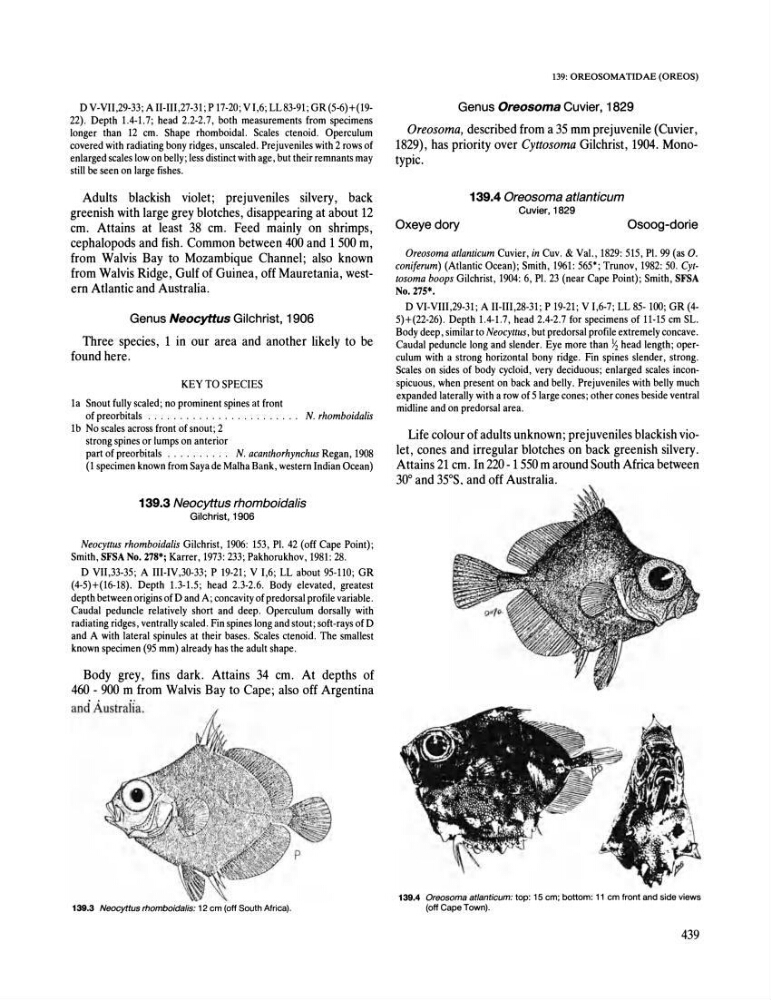
D VI-VIII,29-31; A II-III,28-31; P 19-21; V 1,6-7; LL 85- 100; GR (45)+(22-26). Depth 1.4-1.7, head 2.4-2.7 for specimens of 11-15 cm SL.
Body deep, similar to Neocyttus, but pre dorsal profile extremely concave.
Caudal peduncle long and slender. Eye more than Yz head length; operculum with a strong horizontal bony ridge. Fin spines slender, strong.
Scales on sides of body cycloid, very deciduous; enlarged scales inconspicuous, when present on back and belly. Prejuveniles with belly much
expanded laterally with a row of 5 large cones; other cones beside ventral
midline and on predorsal area.
Life colour of adults unknown; prejuveniles blackish violet, cones and irregular blotches on back greenish silvery.
Attains 21 cm. In 220 - 1550 m around South Africa between
30° and 35°S. and off Australia.
139.4 Oreosoma atfanticum: top: 15 cm; bottom: 11 cm front and side views
(off Cape Town).
439
longer than 12 cm. Shape rhomboidal. Scales ctenoid. Operculum
covered with radiating bony ridges, unscaled. Prejuveniles with 2 rows of
enlarged scales low on belly; less distinct with age, but their remnants may
still be seen on large fishes.
Adults blackish violet; prejuveniles silvery, back
greenish with large grey blotches, disappearing at about 12
cm. Attains at least 38 cm. Feed mainly on shrimps,
cephalopods and fish. Common between 400 and 1500 m,
from Walvis Bay to Mozambique Channel; also known
from Walvis Ridge, Gulf of Guinea, off Mauretania, western Atlantic and Australia.
Genus Neocyttus Gilchrist, 1906
Three species, 1 in our area and another likely to be
found here.
KEY TO SPECIES
la Snout fully scaled; no prominent spines at front
of preorbitals . . . . . . . . . . . . . . . . . . . . . . .. N. rhomboidalis
Ib No scales across front of snout; 2
strong spines or lumps on anterior
part of preorbitals . . . . . . . . .. N. acanthorhynchus Regan, 1908
(1 specimen known from Saya de Malha Bank, western Indian Ocean)
139.3 Neocyttus rhomboidalis
Gilchrist, 1906
Neocyttus rhomboidalis Gilchrist, 1906: 153, PI. 42 (off Cape Point);
Smith, SFSA No. 278*; Karrer, 1973: 233; Pakhorukhov, 1981: 28.
D VII,33-35; A III-IV,30-33; P 19-21; V 1,6; LL about 95-110; GR
(4-5)+(16-18). Depth 1.3-1.5; head 2.3-2.6. Body elevated, greatest
depth between origins ofD and A; concavity of predorsal profile variable.
Caudal peduncle relatively short and deep. Operculum dorsally with
radiating ridges, ventrally scaled. Fin spines long and stout; soft-rays ofD
and A with lateral spinules at their bases. Scales ctenoid. The smallest
known specimen (95 mm) already has the adult shape.
Body grey, fins dark. Attains 34 cm. At depths of
460 - 900 m from Walvis Bay to Cape; also off Argentina
and Australia.
139.3 Neocyttus rhomboidafis: 12 cm (off South Africa).
139: OREOSOMATIDAE (OREOS)
Genus Oreosoma Cuvier, 1829
Oreosoma, described from a 35 mm prejuvenile (Cuvier,
1829), has priority over Cyttosoma Gilchrist, 1904. Monotypic.
Oxeye dory
139.4 Oreosoma atlanticum
Cuvier, 1829
Osoog-dorie
Oreosoma atlanticum Cuvier, in Cuv. & VaL, 1829: 515, PI. 99 (as O.
coniferum) (Atlantic Ocean); Smith, 1961: 565*; Trunov, 1982: 50. Cyttosoma boops Gilchrist, 1904: 6, PI. 23 (near Cape Point); Smith, SFSA
No. 275*.
D VI-VIII,29-31; A II-III,28-31; P 19-21; V 1,6-7; LL 85- 100; GR (45)+(22-26). Depth 1.4-1.7, head 2.4-2.7 for specimens of 11-15 cm SL.
Body deep, similar to Neocyttus, but pre dorsal profile extremely concave.
Caudal peduncle long and slender. Eye more than Yz head length; operculum with a strong horizontal bony ridge. Fin spines slender, strong.
Scales on sides of body cycloid, very deciduous; enlarged scales inconspicuous, when present on back and belly. Prejuveniles with belly much
expanded laterally with a row of 5 large cones; other cones beside ventral
midline and on predorsal area.
Life colour of adults unknown; prejuveniles blackish violet, cones and irregular blotches on back greenish silvery.
Attains 21 cm. In 220 - 1550 m around South Africa between
30° and 35°S. and off Australia.
139.4 Oreosoma atfanticum: top: 15 cm; bottom: 11 cm front and side views
(off Cape Town).
439