

139: OREOSOMATIDAE (ORE OS)
Genus Pseudocyttus Gilchrist, 1906
PrejuveniJes described as Xenocyttus Abe, 1957.
Monotypic.
139.5 Pseudocyttus maculatus
Gilchrist, 1906
Pseudocytlus maculatus Gilchrist, 1906: 153, PI. 41 (off Cape Point);
Karrer, 1973: 233*; Pakhorukov, 1981: 28; Trunov, 1982: 49. Cytlosoma
maculatus: Smith, SFSA No. 276; Penrith, 1969: 69. Xenocytlus nemotoi
Abe, 1957: 228, PIs. 1,2 (Antarctic); Abe & Suzuki, 1981: 123*.
D V-VI,34-36; A II-III,31-34; P 19-21; V 1,5; LL about 98-110; GR (67)+(17-21). Depth 1.5-1.8; head 2.6-3.2, both measurements from specimens longer than 13 cm. Body rhomboidal. Operculum fully scaled. Fin
spines weak. Scales on sides of body cycloid, deciduous. Specimens less
than 12 cm are unknown; prejuveniles with 3 small hillocks in a line on
belly.
The largest specimen, a ripe female of 50 cm, was (freshly
caught) chocolate brown, fins darker; prejuveniles silvery,
completely covered with numerous dark spots of various
sizes, becoming larger with age but still visible on preserved
specimens of 25 cm. In 460 - 1160 m from Walvis Bay to the
Cape; also Walvis Ridge, western Atlantic, New Zealand,
and Southern Ocean.
139.5 Pseudocyttus maculatus: 31 em (New Zealand).
Family No. 140: GRAMMICOLEPIDIDAE
Tinselfishes
by Ch. Karrer & P.C. Heemstra
Klatergoudvisse
Body deep and compressed; scales much elongated vertically, covering body and most of head; a row of small spines
along each side of dorsal and anal fin bases. Mouth very
small; maxilla ridged, bound to ascending process of premaxilla, loosely connected to palatines. Jaws with 1 or 2
rows of minute slender teeth, none on vomer or palatines.
Caudal fin branched rays 13; pelvic fin rays 1,6; gills 3Yz, no
slit behind last hemibranch; branchiostegal rays 7, the
membranes joined to isthmus. In young specimens, the 1st
anal spine is greatly prolonged, reaching to or well beyond
caudal fin, and the 2nd dorsal spine is usually longer than
440
the head; these prolonged fin rays become greatly shortened in adults.
Tinselfishes occur worldwide (but not in polar seas) at
depths of 100 - 800 m; 2 genera, each with 1 species. Revision in preparation by Karrer & DeWitt.
KEY TO SPECIES
la Total D spines + soft (segmented)
rays = 32-35; no spiny scutes on body
at any stage ...... . . . . . . . . . . .. Xenolepidichthys dalgleishi
Ib Total D spines + soft-rays = 39-41; young
(less than 24 cm SL) with 10 or 11 widely
separated spiny scutes on sides of body
and caudal peduncle .......... . Grammicoiepis brachiusculus
140.1 Grammicolepis brachiusculus
Poey, 1873
PLATE 24
Thorny tinselfish
Doring-klatergoudvis
Grammicoiepis brachiusculus Poey, 1873: 403, PI. 12 (Cuba); Quero,
1979: 573*; Trunov, 1982: 42. Xenolepidichthys americanus: Barnard,
1948: 363*; Smith, SFSA No. 279a. Daramatlus armatus Smith, 1960: 231,
PIs. 3 & 4; 1961: 566, No. 279a* (name change); 1968: 7*; Trunov, 1982:
42. Daramatlus barnardi Smith, 1968: 8 (on Xenolepidichthys american us
of Barnard, 1948; offTable Bay).
D VI-VII ,32-34; A II +33-35; P 14-15; GR rudimentary, (1-2)+ 12; 3436 spines along base of D and A; vertebrae 43-46. Prejuveniles with body
depth 1.4-1.6 (2.0-2.3 in adult), head length 3.2-3.8 (4.2-4.4 in adult) in
SL; body with conspicuous, horizontally flattened spiny scutes. Metamorphosis from prejuvenile stage occurs at about 25-30 cm SL, at which time
the body becomes more elongate, the spiny scutes are lost and the prolonged fin rays greatly shortened.
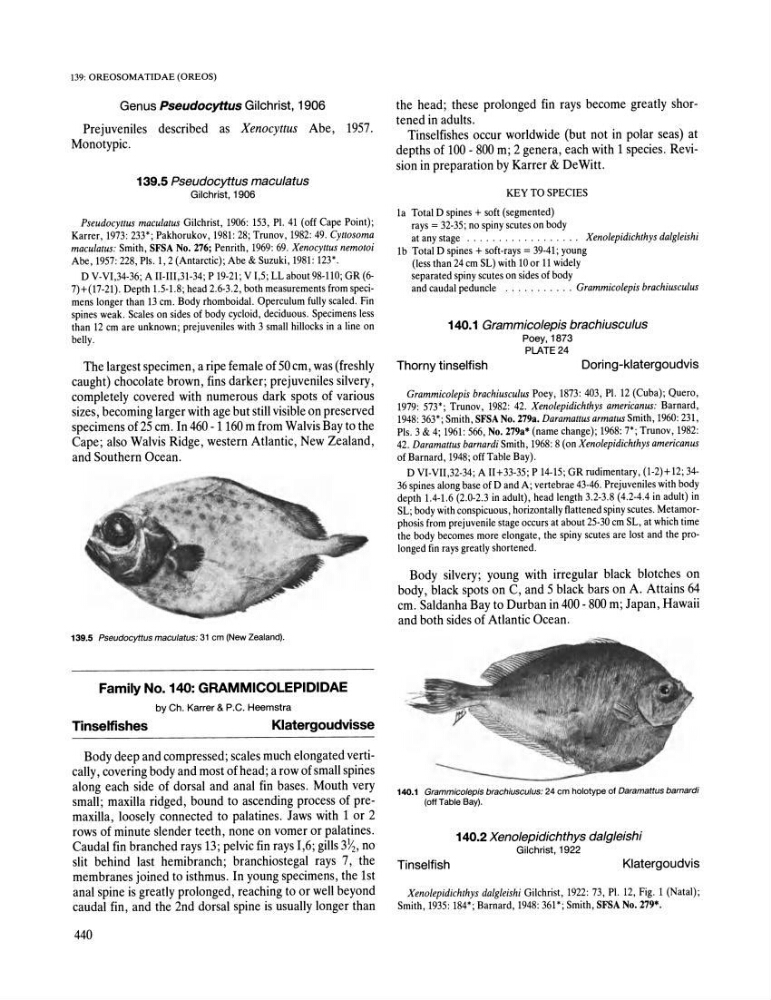
Body silvery; young with irregular black blotches on
body, black spots on C, and 5 black bars on A. Attains 64
cm. Saldanha Bay to Durban in 400 - 800 m; Japan, Hawaii
and both sides of Atlantic Ocean.
140.1 Grammicolepis brachiusculus: 24 em holotype of Daramattus barnardi
(off Table Bay).
Tinselfish
140.2 Xenolepidichthys dalgleishi
Gilchrist, 1922
Klatergoudvis
Xenolepidichthys dalgleishi Gilchrist, 1922: 73, PI. 12, Fig. 1 (Natal);
Smith, 1935: 184*; Barnard, 1948: 361 *; Smith, SFSA No. 279*.
Genus Pseudocyttus Gilchrist, 1906
PrejuveniJes described as Xenocyttus Abe, 1957.
Monotypic.
139.5 Pseudocyttus maculatus
Gilchrist, 1906
Pseudocytlus maculatus Gilchrist, 1906: 153, PI. 41 (off Cape Point);
Karrer, 1973: 233*; Pakhorukov, 1981: 28; Trunov, 1982: 49. Cytlosoma
maculatus: Smith, SFSA No. 276; Penrith, 1969: 69. Xenocytlus nemotoi
Abe, 1957: 228, PIs. 1,2 (Antarctic); Abe & Suzuki, 1981: 123*.
D V-VI,34-36; A II-III,31-34; P 19-21; V 1,5; LL about 98-110; GR (67)+(17-21). Depth 1.5-1.8; head 2.6-3.2, both measurements from specimens longer than 13 cm. Body rhomboidal. Operculum fully scaled. Fin
spines weak. Scales on sides of body cycloid, deciduous. Specimens less
than 12 cm are unknown; prejuveniles with 3 small hillocks in a line on
belly.
The largest specimen, a ripe female of 50 cm, was (freshly
caught) chocolate brown, fins darker; prejuveniles silvery,
completely covered with numerous dark spots of various
sizes, becoming larger with age but still visible on preserved
specimens of 25 cm. In 460 - 1160 m from Walvis Bay to the
Cape; also Walvis Ridge, western Atlantic, New Zealand,
and Southern Ocean.
139.5 Pseudocyttus maculatus: 31 em (New Zealand).
Family No. 140: GRAMMICOLEPIDIDAE
Tinselfishes
by Ch. Karrer & P.C. Heemstra
Klatergoudvisse
Body deep and compressed; scales much elongated vertically, covering body and most of head; a row of small spines
along each side of dorsal and anal fin bases. Mouth very
small; maxilla ridged, bound to ascending process of premaxilla, loosely connected to palatines. Jaws with 1 or 2
rows of minute slender teeth, none on vomer or palatines.
Caudal fin branched rays 13; pelvic fin rays 1,6; gills 3Yz, no
slit behind last hemibranch; branchiostegal rays 7, the
membranes joined to isthmus. In young specimens, the 1st
anal spine is greatly prolonged, reaching to or well beyond
caudal fin, and the 2nd dorsal spine is usually longer than
440
the head; these prolonged fin rays become greatly shortened in adults.
Tinselfishes occur worldwide (but not in polar seas) at
depths of 100 - 800 m; 2 genera, each with 1 species. Revision in preparation by Karrer & DeWitt.
KEY TO SPECIES
la Total D spines + soft (segmented)
rays = 32-35; no spiny scutes on body
at any stage ...... . . . . . . . . . . .. Xenolepidichthys dalgleishi
Ib Total D spines + soft-rays = 39-41; young
(less than 24 cm SL) with 10 or 11 widely
separated spiny scutes on sides of body
and caudal peduncle .......... . Grammicoiepis brachiusculus
140.1 Grammicolepis brachiusculus
Poey, 1873
PLATE 24
Thorny tinselfish
Doring-klatergoudvis
Grammicoiepis brachiusculus Poey, 1873: 403, PI. 12 (Cuba); Quero,
1979: 573*; Trunov, 1982: 42. Xenolepidichthys americanus: Barnard,
1948: 363*; Smith, SFSA No. 279a. Daramatlus armatus Smith, 1960: 231,
PIs. 3 & 4; 1961: 566, No. 279a* (name change); 1968: 7*; Trunov, 1982:
42. Daramatlus barnardi Smith, 1968: 8 (on Xenolepidichthys american us
of Barnard, 1948; offTable Bay).
D VI-VII ,32-34; A II +33-35; P 14-15; GR rudimentary, (1-2)+ 12; 3436 spines along base of D and A; vertebrae 43-46. Prejuveniles with body
depth 1.4-1.6 (2.0-2.3 in adult), head length 3.2-3.8 (4.2-4.4 in adult) in
SL; body with conspicuous, horizontally flattened spiny scutes. Metamorphosis from prejuvenile stage occurs at about 25-30 cm SL, at which time
the body becomes more elongate, the spiny scutes are lost and the prolonged fin rays greatly shortened.
Body silvery; young with irregular black blotches on
body, black spots on C, and 5 black bars on A. Attains 64
cm. Saldanha Bay to Durban in 400 - 800 m; Japan, Hawaii
and both sides of Atlantic Ocean.
140.1 Grammicolepis brachiusculus: 24 em holotype of Daramattus barnardi
(off Table Bay).
Tinselfish
140.2 Xenolepidichthys dalgleishi
Gilchrist, 1922
Klatergoudvis
Xenolepidichthys dalgleishi Gilchrist, 1922: 73, PI. 12, Fig. 1 (Natal);
Smith, 1935: 184*; Barnard, 1948: 361 *; Smith, SFSA No. 279*.