

138: ZEIDAE (DORIES)
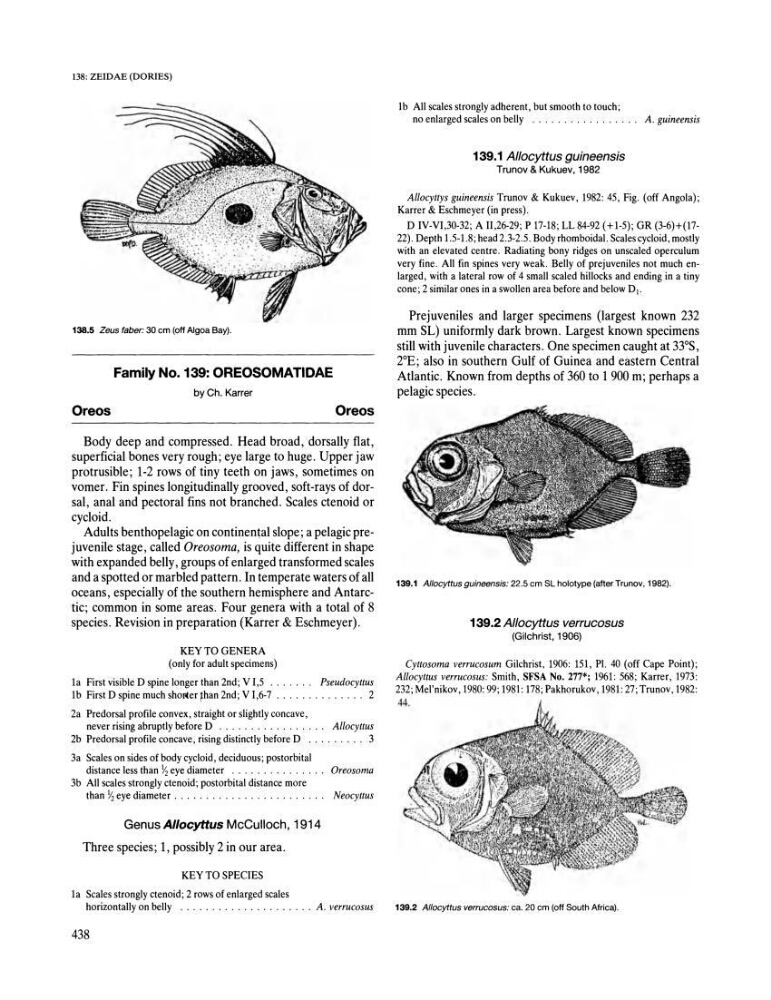
138.5 Zeus faber: 30 cm (off Algoa Bay).
Family No. 139: OREOSOMATIDAE
by Ch. Karrer
Oreos
Oreos
Body deep and compressed. Head broad, dorsally flat,
superficial bones very rough; eye large to huge. Upper jaw
protrusible; 1-2 rows of tiny teeth on jaws, sometimes on
vomer. Fin spines longitudinally grooved, soft-rays of dorsal, anal and pectoral fins not branched. Scales ctenoid or
cycloid.
Adults benthopelagic on continental slope; a pelagic prejuvenile stage, called Oreosoma, is quite different in shape
with expanded belly, groups of enlarged transformed scales
and a spotted or marbled pattern. In temperate waters of all
oceans, especially of the southern hemisphere and Antarctic; common in some areas. Four genera with a total of 8
species. Revision in preparation (Karrer & Eschmeyer).
KEY TO GENERA
(only for adult specimens)
1a First visible D spine longer than 2nd; VI,S ..... " Pseudocyttus
1b First D spine much shoNer than 2nd; V 1,6-7 .............. 2
2a Predorsal profile convex, straight or slightly concave,
never rising abruptly before D . . . . . . . . . . . . . . . .. Allocyttus
2b Predorsal profile concave, rising distinctly before D ......... 3
3a Scales on sides of body cycloid, deciduous; postorbital
distance less than ~ eye diameter ............... Oreosoma
3b All scales strongly ctenoid; postorbital distance more
than ~ eye diameter. . . . . . . . . . . . . . . . . . . . . . .. Neocyttus
Genus Allocyttus McCulloch, 1914
Three species; 1, possibly 2 in our area.
KEY TO SPECIES
1a Scales strongly ctenoid; 2 rows of enlarged scales
horizontally on belly ..................... A. verrucosus
438
1b All scales strongly adherent, but smooth to touch;
no enlarged scales on belly ................. A. guineensis
139.1 Allocyttus guineensis
Trunov & Kukuev, 1982
Allocyttys guineensis Trunov & Kukuev, 1982: 45, Fig. (off Angola);
Karrer & Eschmeyer (in press).
D IV-VI,30-32; A II,26-29; P 17-18; LL 84-92 (+ 1-5); GR (3-6)+(1722). Depth 1.5-1.8; head 2.3-2.5. Body rhomboidal. Scales cycloid, mostly
with an elevated centre. Radiating bony ridges on un scaled operculum
very fine. All fin spines very weak. Belly of prejuveniles not much enlarged, with a lateral row of 4 small scaled hillocks and ending in a tiny
cone; 2 similar ones in a swollen area before and below D 1•
Prejuveniles and larger specimens (largest known 232
mm SL) uniformly dark brown. Largest known specimens
still with juvenile characters. One specimen caught at 33°S,
2°E; also in southern Gulf of Guinea and eastern Central
Atlantic. Known from depths of 360 to 1 900 m; perhaps a
pelagic species.
139.1 Allocyttus guineensis: 22.5 cm SL holotype (after Trunov, 1982).
139.2 Allocyttus verrucosus
(Gilchrist, 1906)
Cyttosoma verrucosum Gilchrist, 1906: 151, PI. 40 (off Cape Point);
Allocyttus verrucosus: Smith, SFSA No. 277*; 1961: 568; Karrer, 1973:
232; Mel'nikov, 1980: 99; 1981: 178; Pakhorukov, 1981: 27; Trunov, 1982:
44 .
139.2 Allocyttus verrucosus: ca. 20 cm (off South Africa).
138.5 Zeus faber: 30 cm (off Algoa Bay).
Family No. 139: OREOSOMATIDAE
by Ch. Karrer
Oreos
Oreos
Body deep and compressed. Head broad, dorsally flat,
superficial bones very rough; eye large to huge. Upper jaw
protrusible; 1-2 rows of tiny teeth on jaws, sometimes on
vomer. Fin spines longitudinally grooved, soft-rays of dorsal, anal and pectoral fins not branched. Scales ctenoid or
cycloid.
Adults benthopelagic on continental slope; a pelagic prejuvenile stage, called Oreosoma, is quite different in shape
with expanded belly, groups of enlarged transformed scales
and a spotted or marbled pattern. In temperate waters of all
oceans, especially of the southern hemisphere and Antarctic; common in some areas. Four genera with a total of 8
species. Revision in preparation (Karrer & Eschmeyer).
KEY TO GENERA
(only for adult specimens)
1a First visible D spine longer than 2nd; VI,S ..... " Pseudocyttus
1b First D spine much shoNer than 2nd; V 1,6-7 .............. 2
2a Predorsal profile convex, straight or slightly concave,
never rising abruptly before D . . . . . . . . . . . . . . . .. Allocyttus
2b Predorsal profile concave, rising distinctly before D ......... 3
3a Scales on sides of body cycloid, deciduous; postorbital
distance less than ~ eye diameter ............... Oreosoma
3b All scales strongly ctenoid; postorbital distance more
than ~ eye diameter. . . . . . . . . . . . . . . . . . . . . . .. Neocyttus
Genus Allocyttus McCulloch, 1914
Three species; 1, possibly 2 in our area.
KEY TO SPECIES
1a Scales strongly ctenoid; 2 rows of enlarged scales
horizontally on belly ..................... A. verrucosus
438
1b All scales strongly adherent, but smooth to touch;
no enlarged scales on belly ................. A. guineensis
139.1 Allocyttus guineensis
Trunov & Kukuev, 1982
Allocyttys guineensis Trunov & Kukuev, 1982: 45, Fig. (off Angola);
Karrer & Eschmeyer (in press).
D IV-VI,30-32; A II,26-29; P 17-18; LL 84-92 (+ 1-5); GR (3-6)+(1722). Depth 1.5-1.8; head 2.3-2.5. Body rhomboidal. Scales cycloid, mostly
with an elevated centre. Radiating bony ridges on un scaled operculum
very fine. All fin spines very weak. Belly of prejuveniles not much enlarged, with a lateral row of 4 small scaled hillocks and ending in a tiny
cone; 2 similar ones in a swollen area before and below D 1•
Prejuveniles and larger specimens (largest known 232
mm SL) uniformly dark brown. Largest known specimens
still with juvenile characters. One specimen caught at 33°S,
2°E; also in southern Gulf of Guinea and eastern Central
Atlantic. Known from depths of 360 to 1 900 m; perhaps a
pelagic species.
139.1 Allocyttus guineensis: 22.5 cm SL holotype (after Trunov, 1982).
139.2 Allocyttus verrucosus
(Gilchrist, 1906)
Cyttosoma verrucosum Gilchrist, 1906: 151, PI. 40 (off Cape Point);
Allocyttus verrucosus: Smith, SFSA No. 277*; 1961: 568; Karrer, 1973:
232; Mel'nikov, 1980: 99; 1981: 178; Pakhorukov, 1981: 27; Trunov, 1982:
44 .
139.2 Allocyttus verrucosus: ca. 20 cm (off South Africa).