

Main depth range of adults: 500 - 700 m; eurytropical in all
oceans.
130.2 Diretmus argenteus: 8+ em.
Family No. 131: ANOPLOGASTERIDAE
by PA Hulley
Fangtooth
Skerptand
Body deep, posteriorly compressed; caudal peduncle
slender and tapering. Head deeper than long, with welldeveloped mucous cavities, covered by skin; opercular
bones small. Eye small, subocular shelf absent. Mouth
oblique, about as long as head; teeth fixed, fang-like and
widely spaced (depressible in juveniles); largest fangs on
each side of symphyses of jaws, those of lower jaw fitting
into sockets in palate. Gill-rakers long and slender in
juveniles, short, comprising groups of 1-3 spinules in adults.
Branchiostegal rays 8-9. No fin spines, except at base of
caudal fin. Scales thin, with numerous spines, on short
pedicel embedded in skin.
Feeds on small fish and crustaceans. Worldwide pelagic
distribution in 100 - 1 000 m; fairly common. One genus,
Anoplogaster Gunther, 1859, with 1 species.
Fangtooth
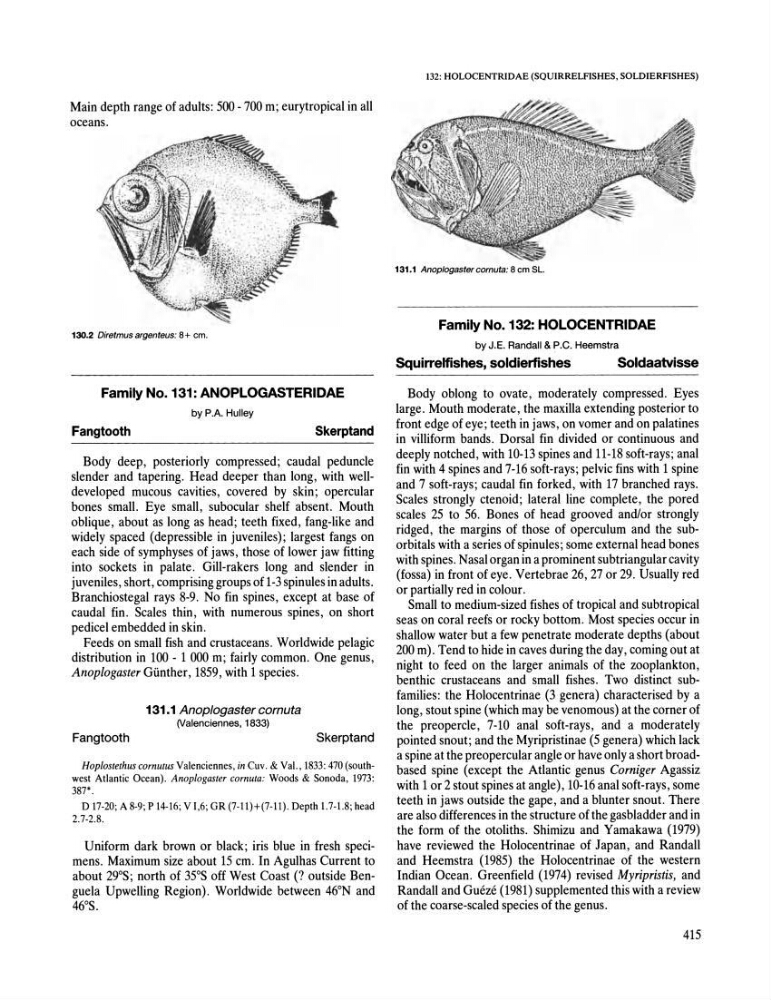
131.1 Anop/ogaster cornuta
(Valenciennes, 1833)
Skerptand
HoploSle/hus cornu/us Valenciennes, in Cuv. & Val. , 1833: 470 (southwest Atlantic Ocean) . Anoplogas/er cornu/a: Woods & Sonoda, 1973:
387* .
D 17-20; A 8-9; P 14-16; V 1,6; GR (7-11)+(7-11). Depth 1.7-1.8; head
2.7-2.8.
Uniform dark brown or black; iris blue in fresh specimens. Maximum size about 15 cm. In Agulhas Current to
about 29°S; north of 35°S off West Coast (? outside Benguela Upwelling Region). Worldwide between 46°N and
46°S.
132: HOLOCENTRIDAE (SQUIRRELFISHES, SOLDIERFISHES)
131.1 Anoplogaster cornuta: 8 em Sl.
Family No. 132: HOLOCENTRIDAE
by J.E. Randall & P.C. Heemstra
Squirrelfishes, soldierfishes
Soldaatvisse
Body oblong to ovate, moderately compressed. Eyes
large. Mouth moderate, the maxilla extending posterior to
front edge of eye; teeth in jaws, on vomer and on palatines
in villiform bands. Dorsal fin divided or continuous and
deeply notched, with 10-13 spines and 11-18 soft-rays; anal
fin with 4 spines and 7-16 soft-rays; pelvic fins with 1 spine
and 7 soft-rays; caudal fin forked, with 17 branched rays.
Scales strongly ctenoid; lateral line complete, the pored
scales 25 to 56. Bones of head grooved and/or strongly
ridged, the margins of those of operculum and the suborbitals with a series of spinules; some external head bones
with spines. Nasal organ in a prominent subtriangular cavity
(fossa) in front of eye. Vertebrae 26, 27 or 29. Usually red
or partially red in colour.
Small to medium-sized fishes of tropical and subtropical
seas on coral reefs or rocky bottom. Most species occur in
shallow water but a few penetrate moderate depths (about
200 m) . Tend to hide in caves during the day, coming out at
night to feed on the larger animals of the zooplankton,
benthic crustaceans and small fishes. Two distinct subfamilies: the Holocentrinae (3 genera) characterised by a
long, stout spine (which may be venomous) at the corner of
the preopercle, 7-10 anal soft-rays, and a moderately
pointed snout; and the Myripristinae (5 genera) which lack
a spine at the pre opercular angle or have only a short broadbased spine (except the Atlantic genus Corniger Agassiz
with 1 or 2 stout spines at angle), 10-16 anal soft-rays, some
teeth in jaws outside the gape, and a blunter snout. There
are also differences in the structure of the gasbladder and in
the form of the otoliths. Shimizu and Yamakawa (1979)
have reviewed the Holocentrinae of Japan, and Randall
and Heemstra (1985) the Holocentrinae of the western
Indian Ocean. Greenfield (1974) revised Myripristis, and
Randall and Gueze (1981) supplemented this with a review
of the coarse-scaled species of the genus.
415
oceans.
130.2 Diretmus argenteus: 8+ em.
Family No. 131: ANOPLOGASTERIDAE
by PA Hulley
Fangtooth
Skerptand
Body deep, posteriorly compressed; caudal peduncle
slender and tapering. Head deeper than long, with welldeveloped mucous cavities, covered by skin; opercular
bones small. Eye small, subocular shelf absent. Mouth
oblique, about as long as head; teeth fixed, fang-like and
widely spaced (depressible in juveniles); largest fangs on
each side of symphyses of jaws, those of lower jaw fitting
into sockets in palate. Gill-rakers long and slender in
juveniles, short, comprising groups of 1-3 spinules in adults.
Branchiostegal rays 8-9. No fin spines, except at base of
caudal fin. Scales thin, with numerous spines, on short
pedicel embedded in skin.
Feeds on small fish and crustaceans. Worldwide pelagic
distribution in 100 - 1 000 m; fairly common. One genus,
Anoplogaster Gunther, 1859, with 1 species.
Fangtooth
131.1 Anop/ogaster cornuta
(Valenciennes, 1833)
Skerptand
HoploSle/hus cornu/us Valenciennes, in Cuv. & Val. , 1833: 470 (southwest Atlantic Ocean) . Anoplogas/er cornu/a: Woods & Sonoda, 1973:
387* .
D 17-20; A 8-9; P 14-16; V 1,6; GR (7-11)+(7-11). Depth 1.7-1.8; head
2.7-2.8.
Uniform dark brown or black; iris blue in fresh specimens. Maximum size about 15 cm. In Agulhas Current to
about 29°S; north of 35°S off West Coast (? outside Benguela Upwelling Region). Worldwide between 46°N and
46°S.
132: HOLOCENTRIDAE (SQUIRRELFISHES, SOLDIERFISHES)
131.1 Anoplogaster cornuta: 8 em Sl.
Family No. 132: HOLOCENTRIDAE
by J.E. Randall & P.C. Heemstra
Squirrelfishes, soldierfishes
Soldaatvisse
Body oblong to ovate, moderately compressed. Eyes
large. Mouth moderate, the maxilla extending posterior to
front edge of eye; teeth in jaws, on vomer and on palatines
in villiform bands. Dorsal fin divided or continuous and
deeply notched, with 10-13 spines and 11-18 soft-rays; anal
fin with 4 spines and 7-16 soft-rays; pelvic fins with 1 spine
and 7 soft-rays; caudal fin forked, with 17 branched rays.
Scales strongly ctenoid; lateral line complete, the pored
scales 25 to 56. Bones of head grooved and/or strongly
ridged, the margins of those of operculum and the suborbitals with a series of spinules; some external head bones
with spines. Nasal organ in a prominent subtriangular cavity
(fossa) in front of eye. Vertebrae 26, 27 or 29. Usually red
or partially red in colour.
Small to medium-sized fishes of tropical and subtropical
seas on coral reefs or rocky bottom. Most species occur in
shallow water but a few penetrate moderate depths (about
200 m) . Tend to hide in caves during the day, coming out at
night to feed on the larger animals of the zooplankton,
benthic crustaceans and small fishes. Two distinct subfamilies: the Holocentrinae (3 genera) characterised by a
long, stout spine (which may be venomous) at the corner of
the preopercle, 7-10 anal soft-rays, and a moderately
pointed snout; and the Myripristinae (5 genera) which lack
a spine at the pre opercular angle or have only a short broadbased spine (except the Atlantic genus Corniger Agassiz
with 1 or 2 stout spines at angle), 10-16 anal soft-rays, some
teeth in jaws outside the gape, and a blunter snout. There
are also differences in the structure of the gasbladder and in
the form of the otoliths. Shimizu and Yamakawa (1979)
have reviewed the Holocentrinae of Japan, and Randall
and Heemstra (1985) the Holocentrinae of the western
Indian Ocean. Greenfield (1974) revised Myripristis, and
Randall and Gueze (1981) supplemented this with a review
of the coarse-scaled species of the genus.
415