

129: ANOMALOPIDAE (FLASHLIGHT FISH)
steinitzi). The analysis of further specimens may warrant full species
recognition of these 2 taxa.
Body and fins dark brown to grey-black. Attains 10 cm.
Although not yet recorded from southern Africa, flashlight
fish may be found on coral reefs in our area.
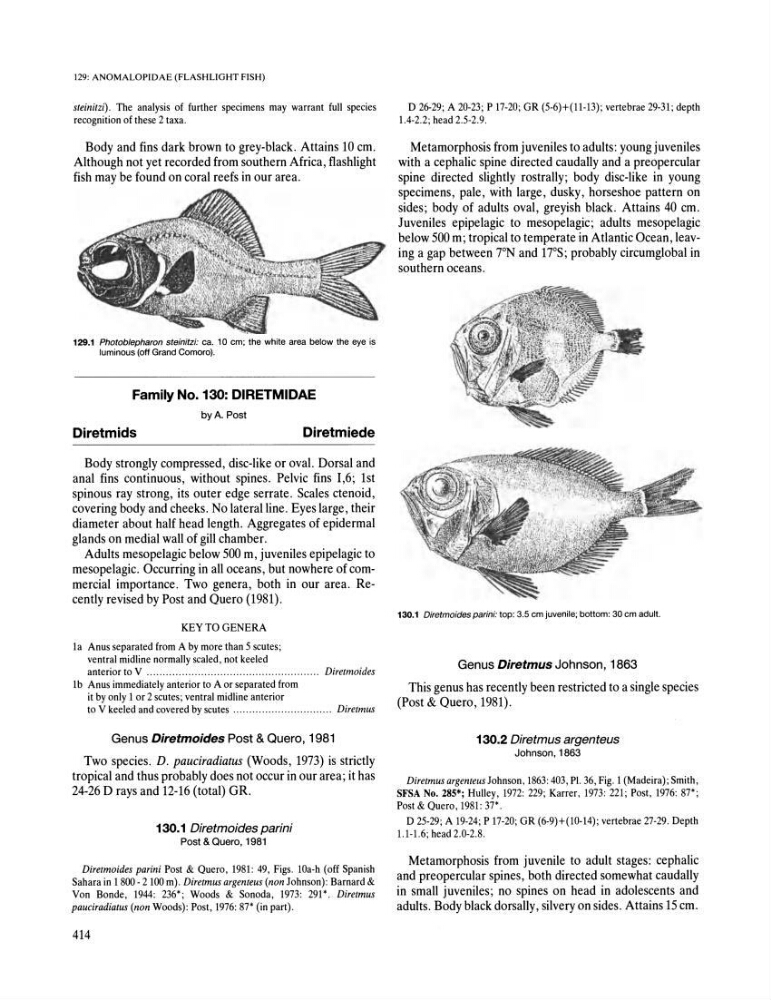
129.1 Photoblepharon steinitzi: ea. 10 em; the white area below the eye is
luminous (off Grand Comoro).
Family No. 130: DIRETMIDAE
by A. Post
Diretmids
Diretmiede
Body strongly compressed, disc-like or oval. Dorsal and
anal fins continuous, without spines. Pelvic fins 1,6; 1st
spinous ray strong, its outer edge serrate. Scales ctenoid,
covering body and cheeks. No lateral line. Eyes large, their
diameter about half head length. Aggregates of epidermal
glands on medial wall of gill chamber.
Adults mesopelagic below 500 m, juveniles epipelagic to
mesopelagic. Occurring in all oceans, but nowhere of commercial importance. Two genera, both in our area. Recently revised by Post and Quero (1981).
KEY TO GENERA
la Anus separated from A by more than 5 scutes;
ventral midline normally scaled, not keeled
anterior to V ...................................................... Diretmoides
Ib Anus immediately anterior to A or separated from
it by only 1 or 2 scutes; ventral midline anterior
to V keeled and covered by scutes ............................... Diretmus
Genus Diretmoides Post & Quero, 1981
Two species. D. pauciradiatus (Woods, 1973) is strictly
tropical and thus probably does not occur in our area; it has
24-26 D rays and 12-16 (total) GR.
130.1 Diretmoides parini
Post & Quero, 1981
Diretmoides parini Post & Quero, 1981: 49, Figs. lOa-h (off Spanish
Sahara in 1 800 - 2100 m). Diretmus argenteus (non Johnson): Barnard &
Von Bonde, 1944: 236*; Woods & Sonoda, 1973: 291*. Diretmus
pauciradiatus (non Woods): Post, 1976: 87* (in part).
414
D 26-29; A 20-23; P 17-20; GR (5-6)+(11-13); vertebrae 29-31; depth
1.4-2.2; head 2.5-2.9.
Metamorphosis from juveniles to adults: young juveniles
with a cephalic spine directed caudally and a preopercular
spine directed slightly rostrally; body disc-like in young
specimens, pale, with large, dusky, horseshoe pattern on
sides; body of adults oval, greyish black. Attains 40 cm.
Juveniles epipelagic to mesopelagic; adults mesopelagic
below 500 m; tropical to temperate in Atlantic Ocean, leaving a gap between 7°N and 17°S; probably circum global in
southern oceans.
130.1 Diretmoides parini: top: 3.5 em juvenile; bottom: 30 em adult.
Genus Diretmus Johnson, 1863
This genus has recently been restricted to a single species
(Post & Quero, 1981).
130.2 Diretmus argenteus
Johnson, 1863
Diretmus argenteus Johnson, 1863: 403, PI. 36, Fig. 1 (Madeira); Smith,
SFSA No. 285*; Hulley, 1972: 229; Karrer, 1973: 221; Post, 1976: 87*;
Post & Quero, 1981: 37*.
D 25-29; A 19-24; P 17-20; GR (6-9)+(10-14); vertebrae 27-29. Depth
1.1-1.6; head 2.0-2.8.
Metamorphosis from juvenile to adult stages: cephalic
and preopercular spines, both directed somewhat caudally
in small juveniles; no spines on head in adolescents and
adults. Body black dorsally, silvery on sides. Attains 15 cm.
steinitzi). The analysis of further specimens may warrant full species
recognition of these 2 taxa.
Body and fins dark brown to grey-black. Attains 10 cm.
Although not yet recorded from southern Africa, flashlight
fish may be found on coral reefs in our area.
129.1 Photoblepharon steinitzi: ea. 10 em; the white area below the eye is
luminous (off Grand Comoro).
Family No. 130: DIRETMIDAE
by A. Post
Diretmids
Diretmiede
Body strongly compressed, disc-like or oval. Dorsal and
anal fins continuous, without spines. Pelvic fins 1,6; 1st
spinous ray strong, its outer edge serrate. Scales ctenoid,
covering body and cheeks. No lateral line. Eyes large, their
diameter about half head length. Aggregates of epidermal
glands on medial wall of gill chamber.
Adults mesopelagic below 500 m, juveniles epipelagic to
mesopelagic. Occurring in all oceans, but nowhere of commercial importance. Two genera, both in our area. Recently revised by Post and Quero (1981).
KEY TO GENERA
la Anus separated from A by more than 5 scutes;
ventral midline normally scaled, not keeled
anterior to V ...................................................... Diretmoides
Ib Anus immediately anterior to A or separated from
it by only 1 or 2 scutes; ventral midline anterior
to V keeled and covered by scutes ............................... Diretmus
Genus Diretmoides Post & Quero, 1981
Two species. D. pauciradiatus (Woods, 1973) is strictly
tropical and thus probably does not occur in our area; it has
24-26 D rays and 12-16 (total) GR.
130.1 Diretmoides parini
Post & Quero, 1981
Diretmoides parini Post & Quero, 1981: 49, Figs. lOa-h (off Spanish
Sahara in 1 800 - 2100 m). Diretmus argenteus (non Johnson): Barnard &
Von Bonde, 1944: 236*; Woods & Sonoda, 1973: 291*. Diretmus
pauciradiatus (non Woods): Post, 1976: 87* (in part).
414
D 26-29; A 20-23; P 17-20; GR (5-6)+(11-13); vertebrae 29-31; depth
1.4-2.2; head 2.5-2.9.
Metamorphosis from juveniles to adults: young juveniles
with a cephalic spine directed caudally and a preopercular
spine directed slightly rostrally; body disc-like in young
specimens, pale, with large, dusky, horseshoe pattern on
sides; body of adults oval, greyish black. Attains 40 cm.
Juveniles epipelagic to mesopelagic; adults mesopelagic
below 500 m; tropical to temperate in Atlantic Ocean, leaving a gap between 7°N and 17°S; probably circum global in
southern oceans.
130.1 Diretmoides parini: top: 3.5 em juvenile; bottom: 30 em adult.
Genus Diretmus Johnson, 1863
This genus has recently been restricted to a single species
(Post & Quero, 1981).
130.2 Diretmus argenteus
Johnson, 1863
Diretmus argenteus Johnson, 1863: 403, PI. 36, Fig. 1 (Madeira); Smith,
SFSA No. 285*; Hulley, 1972: 229; Karrer, 1973: 221; Post, 1976: 87*;
Post & Quero, 1981: 37*.
D 25-29; A 19-24; P 17-20; GR (6-9)+(10-14); vertebrae 27-29. Depth
1.1-1.6; head 2.0-2.8.
Metamorphosis from juvenile to adult stages: cephalic
and preopercular spines, both directed somewhat caudally
in small juveniles; no spines on head in adolescents and
adults. Body black dorsally, silvery on sides. Attains 15 cm.