

Body, head and fins dark grey. Attains 21 cm. A doubtful
species known from only 1 specimen collected off southern
Mozambique.
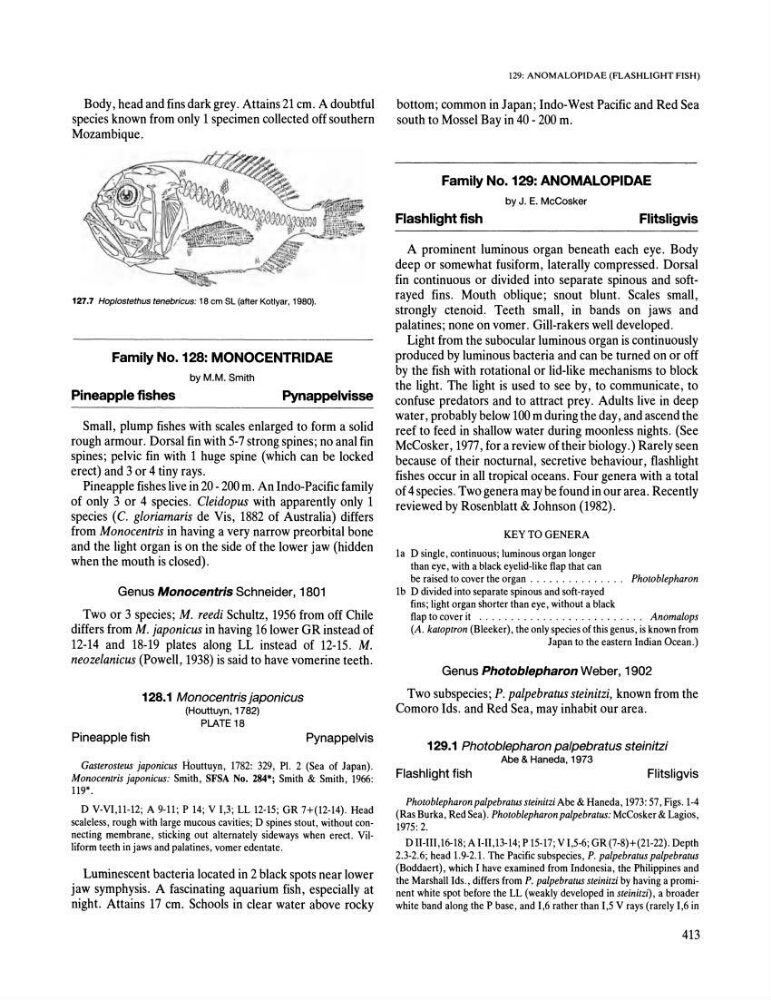
127.7 Hoplostethus tenebricus: 18 em SL (after Kotlyar, 1980).
Family No. 128: MONOCENTRIDAE
by M.M. Smith
Pineapple fishes
Pynappelvisse
Small, plump fishes with scales enlarged to form a solid
rough armour. Dorsal fin with 5-7 strong spines; no anal fin
spines; pelvic fin with 1 huge spine (which can be locked
erect) and 3 or 4 tiny rays.
Pineapple fishes live in 20 - 200 m. An Indo-Pacific family
of only 3 or 4 species. Cleidopus with apparently only 1
species (c. gloriamaris de Vis, 1882 of Australia) differs
from Monocentris in having a very narrow preorbital bone
and the light organ is on the side of the lower jaw (hidden
when the mouth is closed).
Genus Monocentris Schneider, 1801
Two or 3 species; M. reedi Schultz, 1956 from off Chile
differs from M. japonicus in having 16 lower GR instead of
12-14 and 18-19 plates along LL instead of 12-15. M.
neozelanicus (Powell, 1938) is said to have vomerine teeth.
128.1 Monocentris japonicus
(Houttuyn, 1782)
PLATE 18
Pineapple fish
Pynappelvis
Gasterosteus japonicus I-iouttuyn, 1782: 329, PI. 2 (Sea of Japan).
Monocentris japonicus: Smith, SFSA No. 284*; Smith & Smith, 1966:
119*.
D V-VI,11-12; A 9-11; P 14; V 1,3; LL 12-15; GR 7+(12-14). Head
scaleless, rough with large mucous cavities; D spines stout, without connecting membrane, sticking out alternately sideways when erect. VilIiform teeth in jaws and palatines, vomer edentate.
Luminescent bacteria located in 2 black spots near lower
jaw symphysis. A fascinating aquarium fish, especially at
night. Attains 17 cm. Schools in clear water above rocky
129: ANOMALOPIDAE (FLASHLIGHT FISH)
bottom; common in Japan; Indo-West Pacific and Red Sea
south to Mossel Bay in 40 - 200 m.
Family No. 129: ANOMALOPIDAE
by J. E. McCosker
Flashlight fish
Flitsligvis
A prominent luminous organ beneath each eye. Body
deep or somewhat fusiform, laterally compressed. Dorsal
fin continuous or divided into separate spinous and softrayed fins. Mouth oblique; snout blunt. Scales small,
strongly ctenoid. Teeth small, in bands on jaws and
palatines; none on vomer. Gill-rakers well developed.
Light from the sub ocular luminous organ is continuously
produced by luminous bacteria and can be turned on or off
by the fish with rotational or lid-like mechanisms to block
the light. The light is used to see by, to communicate, to
confuse predators and to attract prey. Adults live in deep
water, probably below 100 m during the day, and ascend the
reef to feed in shallow water during moonless nights. (See
McCosker, 1977, for a review of their biology.) Rarely seen
because of their nocturnal, secretive behaviour, flashlight
fishes occur in all tropical oceans. Four genera with a total
of 4 species. Two genera may be found in our area. Recently
reviewed by Rosenblatt & Johnson (1982).
KEY TO GENERA
1a D single, continuous; luminous organ longer
than eye, with a black eyelid-like flap that can
be raised to cover the organ . . . . . . . . . . . . . .. Photoblepharon
1b D divided into separate spinous and soft-rayed
fins; light organ shorter than eye, without a black
flap to cover it ................ . ......... Anomalops
(A. katoptron (Bleeker), the only species of this genus, is known from
Japan to the eastern Indian Ocean.)
Genus Photoblepharon Weber, 1902
Two subspecies; P. palpebratus steinitzi, known from the
Comoro Ids. and Red Sea, may inhabit our area.
129.1 Photoblepharon palpebratus steinitzi
Abe & Haneda, 1973
Flashlight fish
Flitsligvis
Photoblepharon palpebratus steinitzi Abe & Haneda, 1973: 57, Figs. 1-4
(Ras Burka, Red Sea). Photoblepharon palpebratus: McCosker & Lagios,
1975: 2.
D II-III,16-18; A I-II,13-14; P 15-17; V 1,5-6; GR (7-8)+(21-22). Depth
2.3-2.6; head 1.9-2.1. The Pacific subspecies, P. palpebratus palpebratus
(Boddaert), which I have examined from Indonesia, the Philippines and
the Marshall Ids., differs from P. palpebratus steinitzi by having a prominent white spot before the LL (weakly developed in steinitzi), a broader
white band along the P base, and 1,6 rather than 1,5 V rays (rarely 1,6 in
413
species known from only 1 specimen collected off southern
Mozambique.
127.7 Hoplostethus tenebricus: 18 em SL (after Kotlyar, 1980).
Family No. 128: MONOCENTRIDAE
by M.M. Smith
Pineapple fishes
Pynappelvisse
Small, plump fishes with scales enlarged to form a solid
rough armour. Dorsal fin with 5-7 strong spines; no anal fin
spines; pelvic fin with 1 huge spine (which can be locked
erect) and 3 or 4 tiny rays.
Pineapple fishes live in 20 - 200 m. An Indo-Pacific family
of only 3 or 4 species. Cleidopus with apparently only 1
species (c. gloriamaris de Vis, 1882 of Australia) differs
from Monocentris in having a very narrow preorbital bone
and the light organ is on the side of the lower jaw (hidden
when the mouth is closed).
Genus Monocentris Schneider, 1801
Two or 3 species; M. reedi Schultz, 1956 from off Chile
differs from M. japonicus in having 16 lower GR instead of
12-14 and 18-19 plates along LL instead of 12-15. M.
neozelanicus (Powell, 1938) is said to have vomerine teeth.
128.1 Monocentris japonicus
(Houttuyn, 1782)
PLATE 18
Pineapple fish
Pynappelvis
Gasterosteus japonicus I-iouttuyn, 1782: 329, PI. 2 (Sea of Japan).
Monocentris japonicus: Smith, SFSA No. 284*; Smith & Smith, 1966:
119*.
D V-VI,11-12; A 9-11; P 14; V 1,3; LL 12-15; GR 7+(12-14). Head
scaleless, rough with large mucous cavities; D spines stout, without connecting membrane, sticking out alternately sideways when erect. VilIiform teeth in jaws and palatines, vomer edentate.
Luminescent bacteria located in 2 black spots near lower
jaw symphysis. A fascinating aquarium fish, especially at
night. Attains 17 cm. Schools in clear water above rocky
129: ANOMALOPIDAE (FLASHLIGHT FISH)
bottom; common in Japan; Indo-West Pacific and Red Sea
south to Mossel Bay in 40 - 200 m.
Family No. 129: ANOMALOPIDAE
by J. E. McCosker
Flashlight fish
Flitsligvis
A prominent luminous organ beneath each eye. Body
deep or somewhat fusiform, laterally compressed. Dorsal
fin continuous or divided into separate spinous and softrayed fins. Mouth oblique; snout blunt. Scales small,
strongly ctenoid. Teeth small, in bands on jaws and
palatines; none on vomer. Gill-rakers well developed.
Light from the sub ocular luminous organ is continuously
produced by luminous bacteria and can be turned on or off
by the fish with rotational or lid-like mechanisms to block
the light. The light is used to see by, to communicate, to
confuse predators and to attract prey. Adults live in deep
water, probably below 100 m during the day, and ascend the
reef to feed in shallow water during moonless nights. (See
McCosker, 1977, for a review of their biology.) Rarely seen
because of their nocturnal, secretive behaviour, flashlight
fishes occur in all tropical oceans. Four genera with a total
of 4 species. Two genera may be found in our area. Recently
reviewed by Rosenblatt & Johnson (1982).
KEY TO GENERA
1a D single, continuous; luminous organ longer
than eye, with a black eyelid-like flap that can
be raised to cover the organ . . . . . . . . . . . . . .. Photoblepharon
1b D divided into separate spinous and soft-rayed
fins; light organ shorter than eye, without a black
flap to cover it ................ . ......... Anomalops
(A. katoptron (Bleeker), the only species of this genus, is known from
Japan to the eastern Indian Ocean.)
Genus Photoblepharon Weber, 1902
Two subspecies; P. palpebratus steinitzi, known from the
Comoro Ids. and Red Sea, may inhabit our area.
129.1 Photoblepharon palpebratus steinitzi
Abe & Haneda, 1973
Flashlight fish
Flitsligvis
Photoblepharon palpebratus steinitzi Abe & Haneda, 1973: 57, Figs. 1-4
(Ras Burka, Red Sea). Photoblepharon palpebratus: McCosker & Lagios,
1975: 2.
D II-III,16-18; A I-II,13-14; P 15-17; V 1,5-6; GR (7-8)+(21-22). Depth
2.3-2.6; head 1.9-2.1. The Pacific subspecies, P. palpebratus palpebratus
(Boddaert), which I have examined from Indonesia, the Philippines and
the Marshall Ids., differs from P. palpebratus steinitzi by having a prominent white spot before the LL (weakly developed in steinitzi), a broader
white band along the P base, and 1,6 rather than 1,5 V rays (rarely 1,6 in
413