

132: HOLOCENTRIDAE (SQUIRRELFISHES, SOLDIERFISHES)
Subfamily HOLOCENTRINAE
Squirrelfishes
KEY TO GENERA
1a Last D spine about equidistant from penultimate
spine and 1st soft-ray; jaws about equal
(rarely with lower jaw slightly protruding);
Soldaatvisse
body depth 2.3-3.5 in SL ...................................... Sargocentron
1b Last D spine much closer to 1st soft-ray than to
penultimate spine; lower jaw projecting;
body depth 2.9-3.7 in SL ........................................ Neoniphon
Genus Neoniphon Castelnau, 1875
Most authors have used the name Flammeo Jordan &
Evermann (1898) for this genus. Randall & Heemstra
(1985) have shown that it must be replaced by Neoniphon
Caste In au (1875); the type-species, N. armatus Castelnau,
is a synonym of N. sammara (Forsskill). Neoniphon contains 5 species, 1 of which is restricted to the Atlantic. Ofthe
4 Indo-Pacific species, only N. sammara is known from
southern Africa; 3 other species are included in this account, as they may be found here.
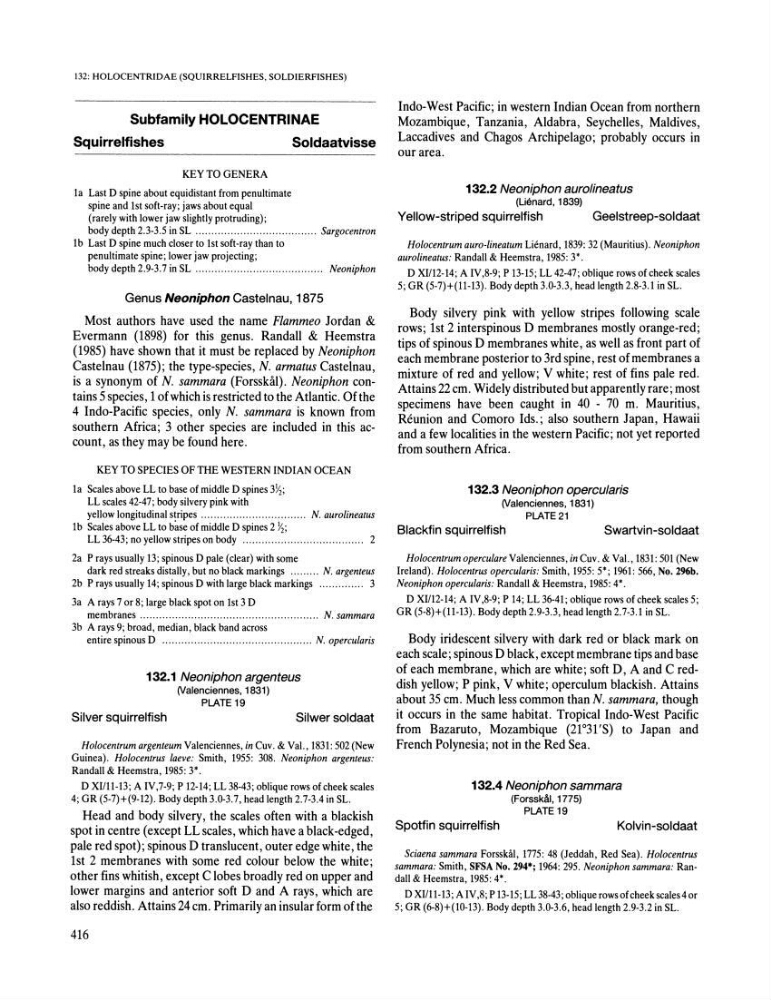
KEY TO SPECIES OF THE WESTERN INDIAN OCEAN
1a Scales above LL to base of middle D spines 3Yz;
LL scales 42-47; body silvery pink with
yellow longitudinal stripes ................................. N. aurolineatus
1 b Scales above LL to base of middle D spines 2 Yz;
LL 36-43; no yellow stripes on body ...................................... 2
2a P rays usually 13; spinous D pale (clear) with some
dark red streaks distally, but no black markings ......... N. argenteus
2b P rays usually 14; spinous D with large black markings .............. 3
3a A rays 7 or 8; large black spot on 1st 3 D
membranes ........................................................ N. sammara
3b A rays 9; broad, median, black band across
entire spinous D ............................................... N. opercularis
132.1 Neoniphon argenteus
(Valenciennes, 1831)
PLATE 19
Silver squirrelfish
Silwer soldaat
Holocentrum argenteum Valenciennes, in Cuv. & Val., 1831: 502 (New
Guinea). Holocentrus laeve: Smith, 1955: 308. Neoniphon argenteus:
Randall & Heemstra, 1985: 3*.
D XIIl1-13; A IV,7-9; P 12-14; LL 38-43; oblique rows of cheek scales
4; GR (5-7)+(9-12). Body depth 3.0-3.7, head length 2.7-3.4 in SL.
Head and body silvery, the scales often with a blackish
spot in centre (except LL scales, which have a black-edged,
pale red spot); spinous D translucent, outer edge white, the
1st 2 membranes with some red colour below the white;
other fins whitish, except C lobes broadly red on upper and
lower margins and anterior soft D and A rays, which are
also reddish. Attains 24 cm. Primarily an insular form of the
416
Indo-West Pacific; in western Indian Ocean from northern
Mozambique, Tanzania, Aldabra, Seychelles, Maldives,
Laccadives and Chagos Archipelago; probably occurs in
our area.
132.2 Neoniphon aurolineatus
(Lienard, 1839)
Yellow-striped squirrelfish
Geelstreep-soldaat
Holocentrum auro-lineatum Lienard, 1839: 32 (Mauritius). Neoniphon
aurolineatus: Randall & Heemstra, 1985: 3*.
D XII12-14; A IV,8-9; P 13-15; LL 42-47; oblique rows of cheek scales
5; OR (5-7)+(11-13). Body depth 3.0-3.3, head length 2.8-3.1 in SL.
Body silvery pink with yellow stripes following scale
rows; 1st 2 interspinous D membranes mostly orange-red;
tips of spinous D membranes white, as well as front part of
each membrane posterior to 3rd spine, rest of membranes a
mixture of red and yellow; V white; rest of fins pale red.
Attains 22 cm. Widely distributed but apparently rare; most
specimens have been caught in 40 - 70 m. Mauritius,
Reunion and Comoro Ids.; also southern Japan, Hawaii
and a few localities in the western Pacific; not yet reported
from southern Africa.
132.3 Neoniphon opercularis
(Valenciennes, 1831)
PLATE 21
Blackfin squirrelfish
Swartvin-soldaat
Holocentrum operculare Valenciennes, in Cuv. & Val., 1831: 501 (New
Ireland). Holocentrus opercularis: Smith, 1955: 5*; 1961: 566, No. 296b.
Neoniphon opercularis: Randall & Heemstra, 1985: 4*.
D XII12-14; A IV,8-9; P 14; LL 36-41; oblique rows of cheek scales 5;
GR (5-8)+(11-13). Body depth 2.9-3.3, head length 2.7-3.1 in SL.
Body iridescent silvery with dark red or black mark on
each scale; spinous D black, except membrane tips and base
of each membrane, which are white; soft D, A and C reddish yellow; P pink, V white; operculum blackish. Attains
about 35 cm. Much less common than N. sammara, though
it occurs in the same habitat. Tropical Indo-West Pacific
from Bazaruto, Mozambique (21°31'S) to Japan and
French Polynesia; not in the Red Sea.
132.4 Neoniphon sammara
(Forsskal, 1775)
PLATE 19
Spotfin squirrelfish
Kolvin-soldaat
Sciaena sammara Forsskal, 1775: 48 (Jeddah, Red Sea). Holocentrus
sammara: Smith, SFSA No. 294*; 1964: 295. Neoniphon sammara: Randall & Heemstra, 1985: 4*.
D XIIl1-13; A IV,8; P 13-15; LL38-43; oblique rows of cheek scales 40r
5; GR (6-8)+(10-13). Body depth 3.0-3.6, head length 2.9-3.2 in SL.
Subfamily HOLOCENTRINAE
Squirrelfishes
KEY TO GENERA
1a Last D spine about equidistant from penultimate
spine and 1st soft-ray; jaws about equal
(rarely with lower jaw slightly protruding);
Soldaatvisse
body depth 2.3-3.5 in SL ...................................... Sargocentron
1b Last D spine much closer to 1st soft-ray than to
penultimate spine; lower jaw projecting;
body depth 2.9-3.7 in SL ........................................ Neoniphon
Genus Neoniphon Castelnau, 1875
Most authors have used the name Flammeo Jordan &
Evermann (1898) for this genus. Randall & Heemstra
(1985) have shown that it must be replaced by Neoniphon
Caste In au (1875); the type-species, N. armatus Castelnau,
is a synonym of N. sammara (Forsskill). Neoniphon contains 5 species, 1 of which is restricted to the Atlantic. Ofthe
4 Indo-Pacific species, only N. sammara is known from
southern Africa; 3 other species are included in this account, as they may be found here.
KEY TO SPECIES OF THE WESTERN INDIAN OCEAN
1a Scales above LL to base of middle D spines 3Yz;
LL scales 42-47; body silvery pink with
yellow longitudinal stripes ................................. N. aurolineatus
1 b Scales above LL to base of middle D spines 2 Yz;
LL 36-43; no yellow stripes on body ...................................... 2
2a P rays usually 13; spinous D pale (clear) with some
dark red streaks distally, but no black markings ......... N. argenteus
2b P rays usually 14; spinous D with large black markings .............. 3
3a A rays 7 or 8; large black spot on 1st 3 D
membranes ........................................................ N. sammara
3b A rays 9; broad, median, black band across
entire spinous D ............................................... N. opercularis
132.1 Neoniphon argenteus
(Valenciennes, 1831)
PLATE 19
Silver squirrelfish
Silwer soldaat
Holocentrum argenteum Valenciennes, in Cuv. & Val., 1831: 502 (New
Guinea). Holocentrus laeve: Smith, 1955: 308. Neoniphon argenteus:
Randall & Heemstra, 1985: 3*.
D XIIl1-13; A IV,7-9; P 12-14; LL 38-43; oblique rows of cheek scales
4; GR (5-7)+(9-12). Body depth 3.0-3.7, head length 2.7-3.4 in SL.
Head and body silvery, the scales often with a blackish
spot in centre (except LL scales, which have a black-edged,
pale red spot); spinous D translucent, outer edge white, the
1st 2 membranes with some red colour below the white;
other fins whitish, except C lobes broadly red on upper and
lower margins and anterior soft D and A rays, which are
also reddish. Attains 24 cm. Primarily an insular form of the
416
Indo-West Pacific; in western Indian Ocean from northern
Mozambique, Tanzania, Aldabra, Seychelles, Maldives,
Laccadives and Chagos Archipelago; probably occurs in
our area.
132.2 Neoniphon aurolineatus
(Lienard, 1839)
Yellow-striped squirrelfish
Geelstreep-soldaat
Holocentrum auro-lineatum Lienard, 1839: 32 (Mauritius). Neoniphon
aurolineatus: Randall & Heemstra, 1985: 3*.
D XII12-14; A IV,8-9; P 13-15; LL 42-47; oblique rows of cheek scales
5; OR (5-7)+(11-13). Body depth 3.0-3.3, head length 2.8-3.1 in SL.
Body silvery pink with yellow stripes following scale
rows; 1st 2 interspinous D membranes mostly orange-red;
tips of spinous D membranes white, as well as front part of
each membrane posterior to 3rd spine, rest of membranes a
mixture of red and yellow; V white; rest of fins pale red.
Attains 22 cm. Widely distributed but apparently rare; most
specimens have been caught in 40 - 70 m. Mauritius,
Reunion and Comoro Ids.; also southern Japan, Hawaii
and a few localities in the western Pacific; not yet reported
from southern Africa.
132.3 Neoniphon opercularis
(Valenciennes, 1831)
PLATE 21
Blackfin squirrelfish
Swartvin-soldaat
Holocentrum operculare Valenciennes, in Cuv. & Val., 1831: 501 (New
Ireland). Holocentrus opercularis: Smith, 1955: 5*; 1961: 566, No. 296b.
Neoniphon opercularis: Randall & Heemstra, 1985: 4*.
D XII12-14; A IV,8-9; P 14; LL 36-41; oblique rows of cheek scales 5;
GR (5-8)+(11-13). Body depth 2.9-3.3, head length 2.7-3.1 in SL.
Body iridescent silvery with dark red or black mark on
each scale; spinous D black, except membrane tips and base
of each membrane, which are white; soft D, A and C reddish yellow; P pink, V white; operculum blackish. Attains
about 35 cm. Much less common than N. sammara, though
it occurs in the same habitat. Tropical Indo-West Pacific
from Bazaruto, Mozambique (21°31'S) to Japan and
French Polynesia; not in the Red Sea.
132.4 Neoniphon sammara
(Forsskal, 1775)
PLATE 19
Spotfin squirrelfish
Kolvin-soldaat
Sciaena sammara Forsskal, 1775: 48 (Jeddah, Red Sea). Holocentrus
sammara: Smith, SFSA No. 294*; 1964: 295. Neoniphon sammara: Randall & Heemstra, 1985: 4*.
D XIIl1-13; A IV,8; P 13-15; LL38-43; oblique rows of cheek scales 40r
5; GR (6-8)+(10-13). Body depth 3.0-3.6, head length 2.9-3.2 in SL.