

116: EXOCOETIDAE (FL YINGFISHES)
Maximum sizes range from 11 to 38 cm. No recent revision
of entire family, but Atlantic species reviewed by Bruun
(1935; for additions see Gibbs & Staiger, 1970) and western
Pacific species by Parin (1960, 1961); generic classification
revised by Parin (1961). The taxonomy of the Indo-Pacific
species is in need of revision, and the account given here
must be considered provisional.
KEY TO GENERA
la P not reaching past A base; LL with a branch
extending upwards to P base; upper jaw
protrusile ......................................................... Parexocoetus
Ib P reaching past A base; LL without a branch to P
origin; upper jaw not protrusile ................................... ......... 2
2a V not reaching A origin (barely reaching in
juveniles); V origin closer to P base than to A
origin .................................................................. Exocoetus
2b V reaching beyond A origin; V origin closer to A
origin than to P base .............................................. ...... ...... 3
3a A origin anterior to 3rd Dray; D rays usually fewer
or the same number (rarely with I or 2 more) as in
A; no chin barbels in juveniles ............................ Hirundichthys
3b A origin under or behind 3rd Dray; D rays usually
2-4 (rarely I) more than in A; juveniles with or
without chin barbels ........................................ ............ ...... 4
4a First 2-4 P rays unbranched; no chin barbels in
juveniles .......................................................... Prognichthys
4b Only 1st P ray unbranched; juveniles with or
without chin barbels ........................................... ............... 5
5a Lower jaw usually a little shorter than upper; at
least some jaw teeth tricuspid; juveniles with single
chin barbel or without barbels .................................. Cypselurus
5b Jaws subequal, or lower a little longer than upper;
jaw teeth mostly unicuspid or with smaller
supplementary cusps laterally; juveniles with 2
barbels (fused into a napkin-like fringed appendage
in Ch. pinnatibarbatus) ........................................ Cheilopogon
Genus Cheilopogon Lowe, 1840
About 25-30 species; 4 species in our area. Two IndoPacific species, Ch. atrisignis (Jenkins, 1904) and Ch. suttoni (Whitley & Colefax, 1938), recorded from the western
Indian Ocean just to the north of our area, and Ch. milleri
(Gibbs & Staiger, 1970) from off Baia dos Tigres, Angola
(17°S) may also extend into our area; these 3 extralimital
species are thus included in the following Key.
KEY TO SPECIES
la Predorsal scales 39-45; head 4.5-5.0 in SL; juveniles
with wide, napkin-like, fringed chin
barbel ....................................... Ch. pinnatibarbatus altipennis
Ib Predorsal scales 24-45; head 4.0-4.6 in SL; juveniles
with a pair of chin barbels ................................................... 2
2a Predorsal scales 24-33; P dark with pale, triangular
cross band ....................................................................... 3
2b Predorsal scales 33-45; P not as above .................................... 4
392
3a D with prominent black spot; palatine teeth
present; jaw teeth noticeable (with magnification);
juveniles with a fold of barbels with flap-like
appendage proximally ......................................... Ch. Iligricans
3b D uniformly pale; palatine teeth absent; jaw teeth
barely visible; juveniles with a fold of chin barbels
without flap-like appendage .................................. Ch. jurcatlls
4a P of adults (> 20 cm SL) uniformly dark ................................. 6
4b P of adults with small dark spots on pale
background ......................................................... ... ... ...... 5
5a Head distinctly shorter than distance from D origin
to C base; V origin nearer head than C base;
D 12-14 ............................................................ Ch. atrisignis
(Tropical Indo-West Pacific, not yet known south of 20 0 S)
5b Head subequal to distance from D origin to C base;
V origin midway between head and C base; D 12-14 ..... Ch. suttoni
(Tropical Indo-West Pacific, not yet known south of 2(rS)
6a D of adults low (longest ray 8.4-11.2% SL), without
black spot; juveniles at 7 em SL with chin barbels
shorter than head and dark blotches on body ............... Ch. milleri
(Tropical eastern Atlantic)
6b D of adults high (longest ray 10.1-14% SL), with a
prominent black spot; juveniles without dark
blotches on body and chin barbels usually much
longer than head ............................................ Ch. cyanopterlls
116.1 Cheilopogon cyanopterus
(Valenciennes, 1846)
Blackwing flyingfish
Swartvlerk-vlieende vis
Exocoetus cyanopterlls Valenciennes, in Cuv. & Val., 1846: 97 (Brazil).
?Cypseilirus hewitti Smith, 1935: 181 (Port Alfred); SFSA No. 214. Cypseilirus cyanopterlls: Parin, 1960: 44; Gibbs & Staiger, 1970: 449*; Gibbs,
1981: Cyp 2*. Cheilopogon cyanopterlls: Parin, 1984: 7*.
D 12-14; A 9-11; P i,12-14; predorsal scales 33-41; vertebrae 42-46; total
GR 21-28. Head 4.0-4.5, P length 1.3-1.5 in SL. Palatine teeth usually
present. A origin below 4th to 6th D rays; V reaching beyond middle of A
base, their origin much nearer than to C.
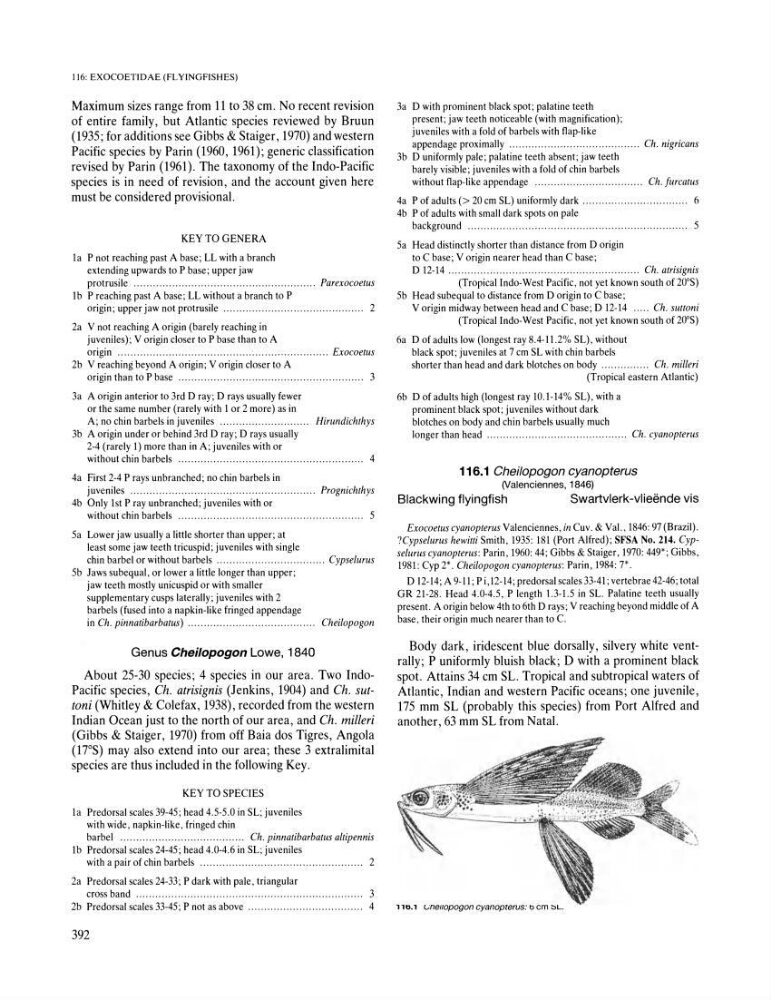
Body dark, iridescent blue dorsally, silvery white ventrally; P uniformly bluish black; 0 with a prominent black
spot. Attains 34 cm SL. Tropical and subtropical waters of
Atlantic, Indian and western Pacific oceans; one juvenile,
175 mm SL (probably this species) from Port Alfred and
another, 63 mm SL from Natal.
111>.1 <.-neJlopogon cyanoprerus: b em ::;L.
Maximum sizes range from 11 to 38 cm. No recent revision
of entire family, but Atlantic species reviewed by Bruun
(1935; for additions see Gibbs & Staiger, 1970) and western
Pacific species by Parin (1960, 1961); generic classification
revised by Parin (1961). The taxonomy of the Indo-Pacific
species is in need of revision, and the account given here
must be considered provisional.
KEY TO GENERA
la P not reaching past A base; LL with a branch
extending upwards to P base; upper jaw
protrusile ......................................................... Parexocoetus
Ib P reaching past A base; LL without a branch to P
origin; upper jaw not protrusile ................................... ......... 2
2a V not reaching A origin (barely reaching in
juveniles); V origin closer to P base than to A
origin .................................................................. Exocoetus
2b V reaching beyond A origin; V origin closer to A
origin than to P base .............................................. ...... ...... 3
3a A origin anterior to 3rd Dray; D rays usually fewer
or the same number (rarely with I or 2 more) as in
A; no chin barbels in juveniles ............................ Hirundichthys
3b A origin under or behind 3rd Dray; D rays usually
2-4 (rarely I) more than in A; juveniles with or
without chin barbels ........................................ ............ ...... 4
4a First 2-4 P rays unbranched; no chin barbels in
juveniles .......................................................... Prognichthys
4b Only 1st P ray unbranched; juveniles with or
without chin barbels ........................................... ............... 5
5a Lower jaw usually a little shorter than upper; at
least some jaw teeth tricuspid; juveniles with single
chin barbel or without barbels .................................. Cypselurus
5b Jaws subequal, or lower a little longer than upper;
jaw teeth mostly unicuspid or with smaller
supplementary cusps laterally; juveniles with 2
barbels (fused into a napkin-like fringed appendage
in Ch. pinnatibarbatus) ........................................ Cheilopogon
Genus Cheilopogon Lowe, 1840
About 25-30 species; 4 species in our area. Two IndoPacific species, Ch. atrisignis (Jenkins, 1904) and Ch. suttoni (Whitley & Colefax, 1938), recorded from the western
Indian Ocean just to the north of our area, and Ch. milleri
(Gibbs & Staiger, 1970) from off Baia dos Tigres, Angola
(17°S) may also extend into our area; these 3 extralimital
species are thus included in the following Key.
KEY TO SPECIES
la Predorsal scales 39-45; head 4.5-5.0 in SL; juveniles
with wide, napkin-like, fringed chin
barbel ....................................... Ch. pinnatibarbatus altipennis
Ib Predorsal scales 24-45; head 4.0-4.6 in SL; juveniles
with a pair of chin barbels ................................................... 2
2a Predorsal scales 24-33; P dark with pale, triangular
cross band ....................................................................... 3
2b Predorsal scales 33-45; P not as above .................................... 4
392
3a D with prominent black spot; palatine teeth
present; jaw teeth noticeable (with magnification);
juveniles with a fold of barbels with flap-like
appendage proximally ......................................... Ch. Iligricans
3b D uniformly pale; palatine teeth absent; jaw teeth
barely visible; juveniles with a fold of chin barbels
without flap-like appendage .................................. Ch. jurcatlls
4a P of adults (> 20 cm SL) uniformly dark ................................. 6
4b P of adults with small dark spots on pale
background ......................................................... ... ... ...... 5
5a Head distinctly shorter than distance from D origin
to C base; V origin nearer head than C base;
D 12-14 ............................................................ Ch. atrisignis
(Tropical Indo-West Pacific, not yet known south of 20 0 S)
5b Head subequal to distance from D origin to C base;
V origin midway between head and C base; D 12-14 ..... Ch. suttoni
(Tropical Indo-West Pacific, not yet known south of 2(rS)
6a D of adults low (longest ray 8.4-11.2% SL), without
black spot; juveniles at 7 em SL with chin barbels
shorter than head and dark blotches on body ............... Ch. milleri
(Tropical eastern Atlantic)
6b D of adults high (longest ray 10.1-14% SL), with a
prominent black spot; juveniles without dark
blotches on body and chin barbels usually much
longer than head ............................................ Ch. cyanopterlls
116.1 Cheilopogon cyanopterus
(Valenciennes, 1846)
Blackwing flyingfish
Swartvlerk-vlieende vis
Exocoetus cyanopterlls Valenciennes, in Cuv. & Val., 1846: 97 (Brazil).
?Cypseilirus hewitti Smith, 1935: 181 (Port Alfred); SFSA No. 214. Cypseilirus cyanopterlls: Parin, 1960: 44; Gibbs & Staiger, 1970: 449*; Gibbs,
1981: Cyp 2*. Cheilopogon cyanopterlls: Parin, 1984: 7*.
D 12-14; A 9-11; P i,12-14; predorsal scales 33-41; vertebrae 42-46; total
GR 21-28. Head 4.0-4.5, P length 1.3-1.5 in SL. Palatine teeth usually
present. A origin below 4th to 6th D rays; V reaching beyond middle of A
base, their origin much nearer than to C.
Body dark, iridescent blue dorsally, silvery white ventrally; P uniformly bluish black; 0 with a prominent black
spot. Attains 34 cm SL. Tropical and subtropical waters of
Atlantic, Indian and western Pacific oceans; one juvenile,
175 mm SL (probably this species) from Port Alfred and
another, 63 mm SL from Natal.
111>.1 <.-neJlopogon cyanoprerus: b em ::;L.