

116.2 Cheilopogon furcatus
(Mitchill, 1815)
Spotfin flyingfish
Kolvin-vlieende vis
Exocoetus furcatus Mitchill, 181S: 449 (New York, U.S.A.). Cypselurusfurcatus: Smith, SFSA No. 211*; Parin, 1960: 3S; Staiger, 1965: 697*;
Gibbs, 1981: Cyp 4*. Cheilopogon unicolor: Parin, 1961: 82*;
Kovalevskaya, 1980: 237'. Cheilopogon furcatus: Parin, 1984: 9*.
D 12-14; A 9-11; P i,13-16; predorsal scales 26-33; vertebrae 44-46; total
GR 18-24. Depth S.4-6.1, head 4.3-4.S, P 1.4-1.7 in SL. A origin below Sth
to 7th D rays; V reaching well past middle of A base, their origin much
nearer head than to C.
Body dark iridescent blue dorsally, silvery white ventrally; P dark grey, with a broad pale margin, the central portion crossed by pale stripe becoming narrower toward anterior fin margin; V pale. In small juveniles, body with 6
dark bars and the paired fins variegated; chin barbels
paired, tapering, with a pale fleshy shaft and dark membrane, retained up to 10-19 cm SL. Attains 30 cm SL. An
offshore species in all tropical seas; off our coast from the
Cape ea twards.
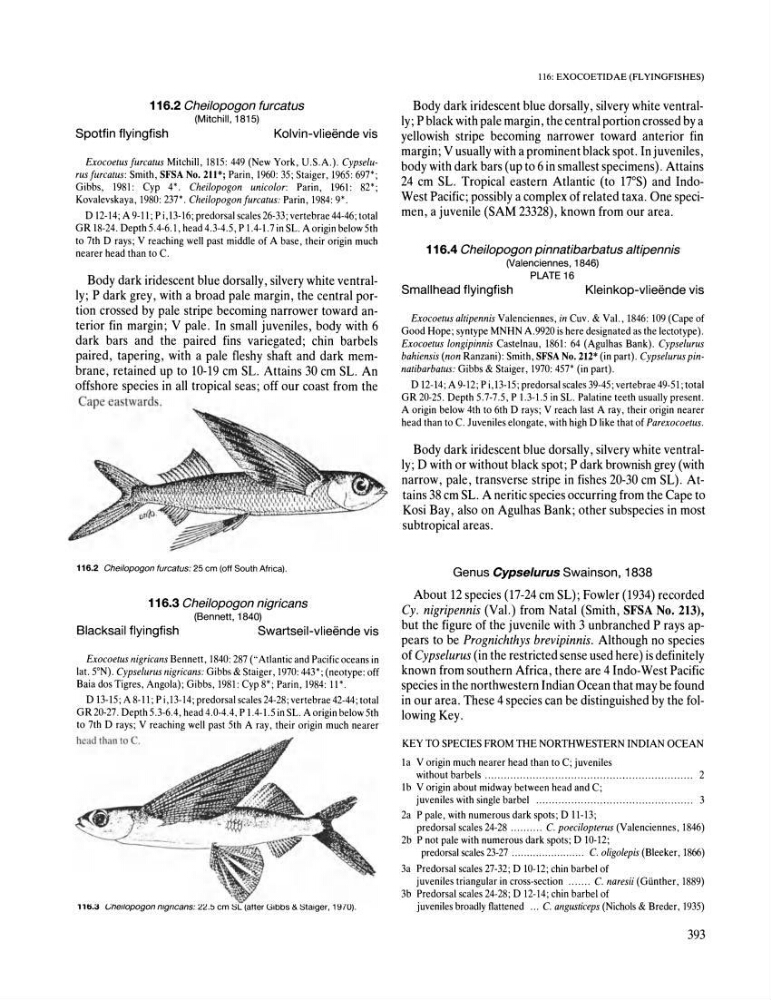
116.2 Cheilopogon fureatus: 25 cm (off South Africa).
116.3 Cheilopogon nigricans
(Bennett, 1840)
Blacksail flyingfish
Swartseil-vlieende vis
Exocoetus nigricans Bennett, 1840: 287 (" Atlantic and Pacific oceans in
lat. SON). Cypselurus nigricans: Gibbs & Staiger, 1970: 443*; (neotype: off
Baia dos Tigres, Angola); Gibbs, 1981: Cyp 8*; Parin, 1984: II *.
D 13-IS; A 8-11; P i, 13-14; predorsal scales 24-28; vertebrae 42-44; total
GR 20-27. Depth S.3-6.4, head 4.0-4.4, P 1.4-1.5 in SL. A origin below 5th
to 7th D rays; V reaching well past Sth A ray, their origin much nearer
head th an to C.
115.3 c;nellopogon mgneans: 22.5 cm
116: EXOCOETIDAE (FL YINGFISHES)
Body dark iridescent blue dorsally, silvery white ventrally; P black with pale margin, the central portion crossed by a
yellowish stripe becoming narrower toward anterior fin
margin; V usually with a prominent black spot. In juveniles,
body with dark bars (up to 6 in smallest specimens). Attains
24 cm SL. Tropical eastern Atlantic (to 17°S) and IndoWest Pacific; possibly a complex of related taxa. One specimen, a juvenile (SAM 23328), known from our area.
116.4 Cheilopogon pinnatibarbatus altipennis
(Valenciennes, 1846)
PLATE 16
Small head flyingfish
Kleinkop-vlieende vis
Exocoetus altipennis ValencienRes, in Cuv. & Val., 1846: 109 (Cape of
Good Hope; syntype MNHN A.9920 is here designated as the lectotype).
Exocoetus longipinnis Castelnau, 1861: 64 (Agulhas Bank). Cypselurus
bahiensis (non Ranzani): Smith, SFSA No. 212* (in part). Cypselurus pinnatibarbatus: Gibbs & Staiger, 1970: 457* (in part).
D 12-14; A 9-12; P i, 13-15; predorsal scales 39-45; vertebrae 49-51; total
GR 20-2S. Depth 5.7-7.S, P 1.3-1.5 in SL. Palatine teeth usually present.
A origin below 4th to 6th D rays; V reach last A ray, their origin nearer
head than to C. Juveniles elongate, with high D like that of Parexocoetus.
Body dark iridescent blue dorsally, silvery white ventrally; D with or without black spot; P dark brownish grey (with
narrow, pale, transverse stripe in fishes 20-30 cm SL). Attains 38 cm SL. A neritic species occurring from the Cape to
Kosi Bay, also on Agulhas Bank; other subspecies in most
subtropical areas.
Genus Cypse!urus Swainson, 1838
About 12 species (17-24 cm SL); Fowler (1934) recorded
Cy. nigripennis (Val.) from Natal (Smith, SFSA No. 213),
but the figure of the juvenile with 3 unbranched P rays appears to be Prognichthys brevipinnis. Although no species
of Cypselurus (in the restricted sense used here) is definitely
known from southern Africa, there are 4 Indo-West Pacific
species in the northwestern Indian Ocean that may be found
in our area. These 4 species can be distinguished by the following Key.
KEY TO SPECIES FROM THE NORTHWESTERN INDIAN OCEAN
la V origin much nearer head than to C; juveniles
without barbels................................................................. 2
Ib V origin about midway between head and C;
juveniles with single barbel .. ............................................... 3
2a P pale, with numerous dark spots; D 11-13;
pre dorsal scales 24-28 .......... C. poecilopterus (Valenciennes, 1846)
2b P not pale with numerous dark spots; D 10-12;
predorsal scales 23-27 ........................ C. oligolepis (Bleeker, 1866)
3a Predorsal scales 27-32; D 10-12; chin barbel of
juveniles triangular in cross-section ....... C. naresii (Gunther, 1889)
3b Pre dorsal scales 24-28; D 12-14; chin barbel of
juveniles broadly flattened ... C. angusticeps (Nichols & Breder, 1935)
393
(Mitchill, 1815)
Spotfin flyingfish
Kolvin-vlieende vis
Exocoetus furcatus Mitchill, 181S: 449 (New York, U.S.A.). Cypselurusfurcatus: Smith, SFSA No. 211*; Parin, 1960: 3S; Staiger, 1965: 697*;
Gibbs, 1981: Cyp 4*. Cheilopogon unicolor: Parin, 1961: 82*;
Kovalevskaya, 1980: 237'. Cheilopogon furcatus: Parin, 1984: 9*.
D 12-14; A 9-11; P i,13-16; predorsal scales 26-33; vertebrae 44-46; total
GR 18-24. Depth S.4-6.1, head 4.3-4.S, P 1.4-1.7 in SL. A origin below Sth
to 7th D rays; V reaching well past middle of A base, their origin much
nearer head than to C.
Body dark iridescent blue dorsally, silvery white ventrally; P dark grey, with a broad pale margin, the central portion crossed by pale stripe becoming narrower toward anterior fin margin; V pale. In small juveniles, body with 6
dark bars and the paired fins variegated; chin barbels
paired, tapering, with a pale fleshy shaft and dark membrane, retained up to 10-19 cm SL. Attains 30 cm SL. An
offshore species in all tropical seas; off our coast from the
Cape ea twards.
116.2 Cheilopogon fureatus: 25 cm (off South Africa).
116.3 Cheilopogon nigricans
(Bennett, 1840)
Blacksail flyingfish
Swartseil-vlieende vis
Exocoetus nigricans Bennett, 1840: 287 (" Atlantic and Pacific oceans in
lat. SON). Cypselurus nigricans: Gibbs & Staiger, 1970: 443*; (neotype: off
Baia dos Tigres, Angola); Gibbs, 1981: Cyp 8*; Parin, 1984: II *.
D 13-IS; A 8-11; P i, 13-14; predorsal scales 24-28; vertebrae 42-44; total
GR 20-27. Depth S.3-6.4, head 4.0-4.4, P 1.4-1.5 in SL. A origin below 5th
to 7th D rays; V reaching well past Sth A ray, their origin much nearer
head th an to C.
115.3 c;nellopogon mgneans: 22.5 cm
116: EXOCOETIDAE (FL YINGFISHES)
Body dark iridescent blue dorsally, silvery white ventrally; P black with pale margin, the central portion crossed by a
yellowish stripe becoming narrower toward anterior fin
margin; V usually with a prominent black spot. In juveniles,
body with dark bars (up to 6 in smallest specimens). Attains
24 cm SL. Tropical eastern Atlantic (to 17°S) and IndoWest Pacific; possibly a complex of related taxa. One specimen, a juvenile (SAM 23328), known from our area.
116.4 Cheilopogon pinnatibarbatus altipennis
(Valenciennes, 1846)
PLATE 16
Small head flyingfish
Kleinkop-vlieende vis
Exocoetus altipennis ValencienRes, in Cuv. & Val., 1846: 109 (Cape of
Good Hope; syntype MNHN A.9920 is here designated as the lectotype).
Exocoetus longipinnis Castelnau, 1861: 64 (Agulhas Bank). Cypselurus
bahiensis (non Ranzani): Smith, SFSA No. 212* (in part). Cypselurus pinnatibarbatus: Gibbs & Staiger, 1970: 457* (in part).
D 12-14; A 9-12; P i, 13-15; predorsal scales 39-45; vertebrae 49-51; total
GR 20-2S. Depth 5.7-7.S, P 1.3-1.5 in SL. Palatine teeth usually present.
A origin below 4th to 6th D rays; V reach last A ray, their origin nearer
head than to C. Juveniles elongate, with high D like that of Parexocoetus.
Body dark iridescent blue dorsally, silvery white ventrally; D with or without black spot; P dark brownish grey (with
narrow, pale, transverse stripe in fishes 20-30 cm SL). Attains 38 cm SL. A neritic species occurring from the Cape to
Kosi Bay, also on Agulhas Bank; other subspecies in most
subtropical areas.
Genus Cypse!urus Swainson, 1838
About 12 species (17-24 cm SL); Fowler (1934) recorded
Cy. nigripennis (Val.) from Natal (Smith, SFSA No. 213),
but the figure of the juvenile with 3 unbranched P rays appears to be Prognichthys brevipinnis. Although no species
of Cypselurus (in the restricted sense used here) is definitely
known from southern Africa, there are 4 Indo-West Pacific
species in the northwestern Indian Ocean that may be found
in our area. These 4 species can be distinguished by the following Key.
KEY TO SPECIES FROM THE NORTHWESTERN INDIAN OCEAN
la V origin much nearer head than to C; juveniles
without barbels................................................................. 2
Ib V origin about midway between head and C;
juveniles with single barbel .. ............................................... 3
2a P pale, with numerous dark spots; D 11-13;
pre dorsal scales 24-28 .......... C. poecilopterus (Valenciennes, 1846)
2b P not pale with numerous dark spots; D 10-12;
predorsal scales 23-27 ........................ C. oligolepis (Bleeker, 1866)
3a Predorsal scales 27-32; D 10-12; chin barbel of
juveniles triangular in cross-section ....... C. naresii (Gunther, 1889)
3b Pre dorsal scales 24-28; D 12-14; chin barbel of
juveniles broadly flattened ... C. angusticeps (Nichols & Breder, 1935)
393