

116: EXOCOETIDAE (FL YINGFISHES)
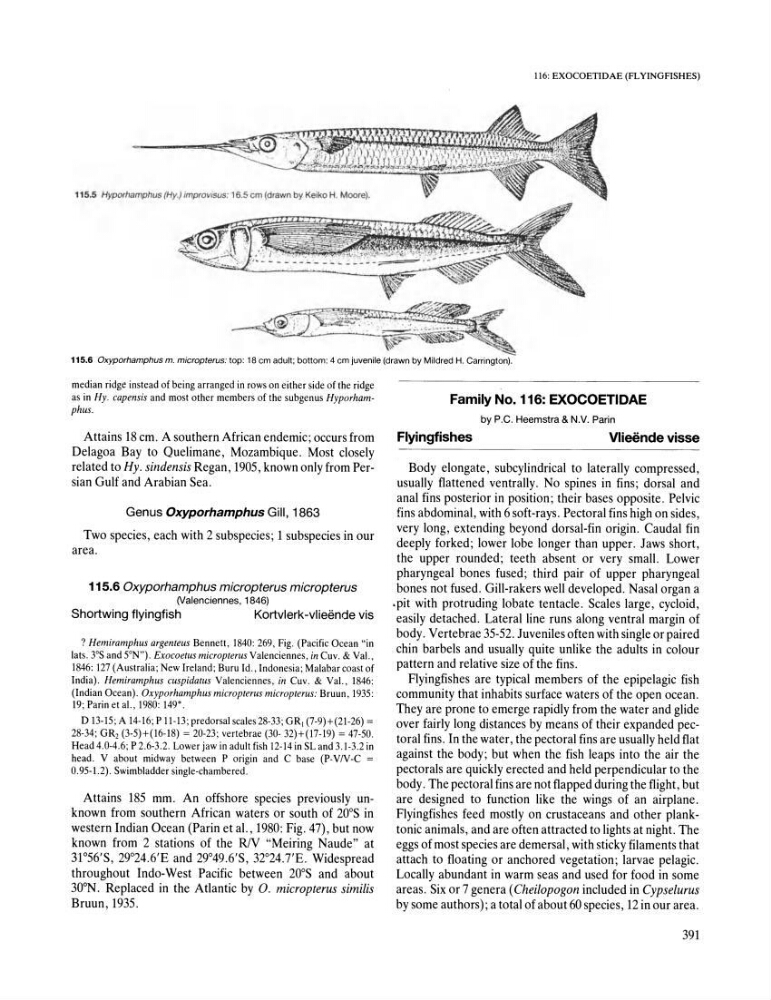
115.5 Hyporhamphus (Hy.) improvisus: 16.5 em (drawn by Keiko H. Moore).
115.6 Oxyporhamphus m. mieropterus: top: 18 em adult; bottom: 4 em juvenile (drawn by Mildred H. Carrington).
median ridge instead of being arranged in rows on either side of the ridge
as in Hy. capensis and most other members of the subgenus Hyporhamphus.
Attains 18 cm. A southern African endemic; occurs from
Delagoa Bay to Quelimane, Mozambique. Most closely
related to Hy. sindensis Regan, 1905, known only from Persian Gulf and Arabian Sea.
Genus Oxyporhamphus Gill, 1863
Two species, each with 2 subspecies; 1 subspecies in our
area.
115.6 Oxyporhamphus micropterus micropterus
(ValenCiennes, 1846)
Shortwing flyingfish
Kortvlerk-vlieende vis
? Hemiramphus argenteus Bennett , 1840: 269 , Fig. (Pacific Ocean "in
lats. 3°S and SO N"). Exocoetus micropterus Valenciennes, in Cuv. & Val.,
1846: 127 (Australia; New Ireland; Buru Id., Indonesia; Malabar coast of
India). Hemiramphus cuspidatus Valenciennes , in Cuv. & Val. , 1846:
(Indian Ocean). Oxyporhamphus micropterus micropterus: Bruun , 1935:
19; Parin et aI., 1980: 149*.
013-15; A 14-16; P 11-13; predorsal scales 28-33; GR1 (7-9)+(21-26) =
28-34; GR2 (3-5)+(16-18) = 20-23; vertebrae (30- 32)+(17-19) = 47-50.
Head 4.0-4.6; P 2.6-3.2. Lower jaw in adult fish 12-14 in SL and 3.1-3.2 in
head. V about midway between P origin and C base (P-VN-C =
0.95-1.2). Swimbladder single-chambered.
Attains 185 mm. An offshore species previously unknown from southern African waters or south of 20
0
S in
western Indian Ocean (Parin et aI., 1980: Fig. 47), but now
known from 2 stations of the RlV "Meiring Naude" at
31°56'S, 29°24.6'E and 29°49.6'S, 32°24.7'E. Widespread
throughout Indo-West Pacific between 20
0
S and about
30 0 N. Replaced in the Atlantic by O. micropterus similis
Bruun, 1935.
Family No. 116: EXOCOETIDAE
by P.C. Heemstra & N.V. Parin
Flyingfishes
Vlieende visse
Body elongate, subcylindrical to laterally compressed,
usually flattened ventrally. No spines in fins; dorsal and
anal fins posterior in position; their bases opposite. Pelvic
fins abdominal, with 6 soft-rays. Pectoral fins high on sides,
very long, extending beyond dorsal-fin origin. Caudal fin
deeply forked; lower lobe longer than upper. Jaws short,
the upper rounded; teeth absent or very small. Lower
pharyngeal bones fused; third pair of upper pharyngeal
bones not fused. Gill-rakers well developed. Nasal organ a
. pit with protruding lobate tentacle. Scales large, cycloid,
easily detached. Lateral line runs along ventral margin of
body. Vertebrae 35-52. Juveniles often with single or paired
chin barbels and usually quite unlike the adults in colour
pattern and relative size of the fins.
Flyingfishes are typical members of the epipelagic fish
community that inhabits surface waters of the open ocean.
They are prone to emerge rapidly from the water and glide
over fairly long distances by means of their expanded pectoral fins. In the water, the pectoral fins are usually held flat
against the body; but when the fish leaps into the air the
pectorals are quickly erected and held perpendicular to the
body. The pectoral fins are not flapped during the flight, but
are designed to function like the wings of an airplane.
Flyingfishes feed mostly on crustaceans and other planktonic animals, and are often attracted to lights at night. The
eggs of most species are demersal, with sticky filaments that
attach to floating or anchored vegetation; larvae pelagic.
Locally abundant in warm seas and used for food in some
areas. Six or 7 genera (Cheilopogon included in Cypselurus
by some authors); a total of about 60 species, 12 in our area.
391
115.5 Hyporhamphus (Hy.) improvisus: 16.5 em (drawn by Keiko H. Moore).
115.6 Oxyporhamphus m. mieropterus: top: 18 em adult; bottom: 4 em juvenile (drawn by Mildred H. Carrington).
median ridge instead of being arranged in rows on either side of the ridge
as in Hy. capensis and most other members of the subgenus Hyporhamphus.
Attains 18 cm. A southern African endemic; occurs from
Delagoa Bay to Quelimane, Mozambique. Most closely
related to Hy. sindensis Regan, 1905, known only from Persian Gulf and Arabian Sea.
Genus Oxyporhamphus Gill, 1863
Two species, each with 2 subspecies; 1 subspecies in our
area.
115.6 Oxyporhamphus micropterus micropterus
(ValenCiennes, 1846)
Shortwing flyingfish
Kortvlerk-vlieende vis
? Hemiramphus argenteus Bennett , 1840: 269 , Fig. (Pacific Ocean "in
lats. 3°S and SO N"). Exocoetus micropterus Valenciennes, in Cuv. & Val.,
1846: 127 (Australia; New Ireland; Buru Id., Indonesia; Malabar coast of
India). Hemiramphus cuspidatus Valenciennes , in Cuv. & Val. , 1846:
(Indian Ocean). Oxyporhamphus micropterus micropterus: Bruun , 1935:
19; Parin et aI., 1980: 149*.
013-15; A 14-16; P 11-13; predorsal scales 28-33; GR1 (7-9)+(21-26) =
28-34; GR2 (3-5)+(16-18) = 20-23; vertebrae (30- 32)+(17-19) = 47-50.
Head 4.0-4.6; P 2.6-3.2. Lower jaw in adult fish 12-14 in SL and 3.1-3.2 in
head. V about midway between P origin and C base (P-VN-C =
0.95-1.2). Swimbladder single-chambered.
Attains 185 mm. An offshore species previously unknown from southern African waters or south of 20
0
S in
western Indian Ocean (Parin et aI., 1980: Fig. 47), but now
known from 2 stations of the RlV "Meiring Naude" at
31°56'S, 29°24.6'E and 29°49.6'S, 32°24.7'E. Widespread
throughout Indo-West Pacific between 20
0
S and about
30 0 N. Replaced in the Atlantic by O. micropterus similis
Bruun, 1935.
Family No. 116: EXOCOETIDAE
by P.C. Heemstra & N.V. Parin
Flyingfishes
Vlieende visse
Body elongate, subcylindrical to laterally compressed,
usually flattened ventrally. No spines in fins; dorsal and
anal fins posterior in position; their bases opposite. Pelvic
fins abdominal, with 6 soft-rays. Pectoral fins high on sides,
very long, extending beyond dorsal-fin origin. Caudal fin
deeply forked; lower lobe longer than upper. Jaws short,
the upper rounded; teeth absent or very small. Lower
pharyngeal bones fused; third pair of upper pharyngeal
bones not fused. Gill-rakers well developed. Nasal organ a
. pit with protruding lobate tentacle. Scales large, cycloid,
easily detached. Lateral line runs along ventral margin of
body. Vertebrae 35-52. Juveniles often with single or paired
chin barbels and usually quite unlike the adults in colour
pattern and relative size of the fins.
Flyingfishes are typical members of the epipelagic fish
community that inhabits surface waters of the open ocean.
They are prone to emerge rapidly from the water and glide
over fairly long distances by means of their expanded pectoral fins. In the water, the pectoral fins are usually held flat
against the body; but when the fish leaps into the air the
pectorals are quickly erected and held perpendicular to the
body. The pectoral fins are not flapped during the flight, but
are designed to function like the wings of an airplane.
Flyingfishes feed mostly on crustaceans and other planktonic animals, and are often attracted to lights at night. The
eggs of most species are demersal, with sticky filaments that
attach to floating or anchored vegetation; larvae pelagic.
Locally abundant in warm seas and used for food in some
areas. Six or 7 genera (Cheilopogon included in Cypselurus
by some authors); a total of about 60 species, 12 in our area.
391