

115: HEMIRAMPHIDAE (HALFBEAKS)
other estuaries. Widespread throughout tropical and subtropical waters of Indo-West Pacific.
Genus Hyporhamphus Gill, 1859
Two subgenera were recognised by Parin, Collette &
Shcherbachev (1980): Hyporhamphus for inshore and
estuarine species with a simple preorbital canal and an
emarginate C, and Reporhamphus Whitley for more strictly
marine species with a posterior branch to the preorbital
canal and a deeply forked C. There are about 23 species in
the subgenus Hyporhamphus, with 2 endemic to southern
Africa. Of the 11 species in the subgenus Reporhamphus, 1
extends into the northern part of our area.
KEY TO SPECIES
la Preorbital canal simple, without posterior branch;
C emarginate or weakly forked ..... (Subgenus Hyporhamphus) .... 2
I b Preorbital canal with posterior branch; C forked,
lower lobe longer than upper lobe ...... Hy. (Reporhamphus) affinis
2a Preorbital distance short, 1.9-2.0 in orbit; teeth
mostly tricuspid; 24-30 GR on 1st arch .......... Hy. (Hy.) improvisus
2b Preorbital distance longer, 1.5-1.7 in orbit;
teeth mostly unicuspid, except for a few
tricuspid teeth near base of upper jaw;
30-37 GR on 1st arch ................................... Hy. (Hy.) capensis
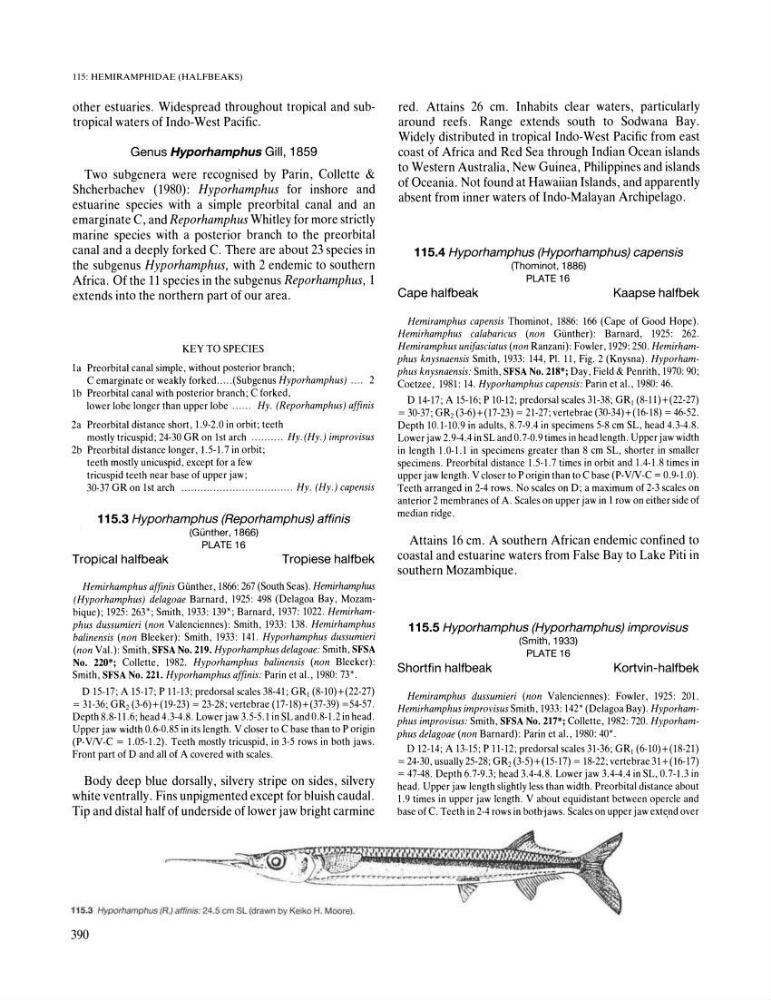
115.3 Hyporhamphus (Reporhamphus) affinis
(Gunther, 186.6)
PLATE 16
Tropical halfbeak
Tropiese halfbek
Hemirhamphus affinis Giinther, 1866: 267 (South Seas). Hemirhamphus
(Hyporhamphus) delagoae Barnard, 1925: 498 (Oelagoa Bay, Mozambique); 1925: 263*; Smith, 1933: 139*; Barnard, 1937: 1022. Hemirhamphus dussumieri (non Valenciennes): Smith, 1933: 138. Hemirhamphus
balinensis (non Bleeker): Smith, 1933: 141. Hyporhamphus dussumieri
(non Val.): Smith, SFSA No. 219. Hyporhamphus delagoae: Smith, SFSA
No. 220*; Collette, 1982. Hyporhamphus balinensis (non Bleeker):
Smith, SFSA No. 221. Hyporhamphus affinis: Parin et aI., 1980: 73*
D 15-17; A 15-17; P 11-13; predorsal scales 38-41; GRr (8-10)+(22-27)
= 31-36; GR2 (3-6)+(19-23) = 23-28; vertebrae (17-18)+(37-39) =54-57.
Depth 8.8-11.6; head 4.3-4.8. Lower jaw 3.5-5.1 in SL and 0.8-1.2 in head.
Upper jaw width 0.6-0.85 in its length. V closer to C base than to P origin
(P-VN-C = 1.05-1.2). Teeth mostly tricuspid, in 3-5 rows in both jaws.
Front part of 0 and all of A covered with scales.
Body deep blue dorsally, silvery stripe on sides, silvery
white ventrally. Fins unpigmented except for bluish caudal.
Tip and distal half of underside of lower jaw bright carmine
115.3 Hyporhamphus (R,) affinis: 24.5 em SL (drawn by Keiko H. Moore).
390
red. Attains 26 cm. Inhabits clear waters, particularly
around reefs. Range extends south to Sodwana Bay.
Widely distributed in tropical Indo-West Pacific from east
coast of Africa and Red Sea through Indian Ocean islands
to Western Australia, New Guinea, Philippines and islands
of Oceania. Not found at Hawaiian Islands, and apparently
absent from inner waters of Indo-Malayan Archipelago.
115.4 Hyporhamphus (Hyporhamphus) capensis
(Thominot, 1886)
PLATE 16
Cape halfbeak
Kaapse halfbek
Hemiramphus capensis Thominot, 1886: 166 (Cape of Good Hope).
Hemirhamphus calabaricus (non Giinther): Barnard, 1925: 262.
Hemiramphus unifasciatus (non Ranzani): Fowler, 1929: 250. Hemirhamphus knysnaensis Smith, 1933: 144, PI. 11, Fig. 2 (Knysna). Hyporhamphus knysnaensis: Smith, SFSA No. 218*; Day, Field & Penrith, 1970: 90;
Coetzee, 1981: 14. Hyporhamphus capensis: Parin et aI., 1980: 46.
014-17; A 15-16; P 10-12; pre dorsal scales 31-38; GRr (8-11)+(22-27)
= 30-37; GR2 (3-6)+(17-23) = 21-27; vertebrae (30-34)+(16-18) = 46-52.
Depth 10.1-10.9 in adults, 8.7-9.4 in specimens 5-8 em SL, head 4.3-4.8.
Lower jaw 2.9-4.4 in SL and 0.7-0.9 times in head length. Upper jaw width
in length 1.0-1.1 in specimens greater than 8 em SL, shorter in smaller
specimens. Preorbital distance 1.5-1. 7 times in orbit and 1.4-1.8 times in
upper jaw length. V closer to P origin than to C base (P-VN -C = 0.9-1.0).
Teeth arranged in 2-4 rows. No scales on 0; a maximum of2-3 scales on
anterior 2 membranes of A. Scales on upper jaw in 1 row on either side of
median ridge.
Attains 16 cm. A southern African endemic confined to
coastal and estuarine waters from False Bay to Lake Piti in
southern Mozambique.
115.5 Hyporhamphus (Hyporhamphus) improvisus
(Smith,1933)
PLATE 16
Shortfin halfbeak
Kortvin-halfbek
Hemiramphus dussumieri (non Valenciennes): Fowler, 1925: 201.
Hemirhamphus improvisus Smith, 1933: 142* (Oelagoa Bay). Hyporhamphus improvisus: Smith, SFSA No. 217*; Collette, 1982: 720. Hyporhamphus delagoae (non Barnard): Parin et aI., 1980: 40*.
012-14; A 13-15; P 11-12; predorsal scales 31-36; GR1 (6-10)+(18-21)
= 24-30, usually 25-28; GR2 (3-5)+(15-17) = 18-22; vertebrae 31 +(16-17)
= 47-48. Depth 6.7-9.3; head 3.4-4.8. Lower jaw 3.4-4.4 in SL, 0.7-1.3 in
head. Upper jaw length slightly less than width. Preorbital distance about
I. 9 times in upper jaw length. V about equidistant between opercle and
base of C. Teeth in 2-4 rows in both'jaws. Scales on upper jaw exte:nd over
other estuaries. Widespread throughout tropical and subtropical waters of Indo-West Pacific.
Genus Hyporhamphus Gill, 1859
Two subgenera were recognised by Parin, Collette &
Shcherbachev (1980): Hyporhamphus for inshore and
estuarine species with a simple preorbital canal and an
emarginate C, and Reporhamphus Whitley for more strictly
marine species with a posterior branch to the preorbital
canal and a deeply forked C. There are about 23 species in
the subgenus Hyporhamphus, with 2 endemic to southern
Africa. Of the 11 species in the subgenus Reporhamphus, 1
extends into the northern part of our area.
KEY TO SPECIES
la Preorbital canal simple, without posterior branch;
C emarginate or weakly forked ..... (Subgenus Hyporhamphus) .... 2
I b Preorbital canal with posterior branch; C forked,
lower lobe longer than upper lobe ...... Hy. (Reporhamphus) affinis
2a Preorbital distance short, 1.9-2.0 in orbit; teeth
mostly tricuspid; 24-30 GR on 1st arch .......... Hy. (Hy.) improvisus
2b Preorbital distance longer, 1.5-1.7 in orbit;
teeth mostly unicuspid, except for a few
tricuspid teeth near base of upper jaw;
30-37 GR on 1st arch ................................... Hy. (Hy.) capensis
115.3 Hyporhamphus (Reporhamphus) affinis
(Gunther, 186.6)
PLATE 16
Tropical halfbeak
Tropiese halfbek
Hemirhamphus affinis Giinther, 1866: 267 (South Seas). Hemirhamphus
(Hyporhamphus) delagoae Barnard, 1925: 498 (Oelagoa Bay, Mozambique); 1925: 263*; Smith, 1933: 139*; Barnard, 1937: 1022. Hemirhamphus dussumieri (non Valenciennes): Smith, 1933: 138. Hemirhamphus
balinensis (non Bleeker): Smith, 1933: 141. Hyporhamphus dussumieri
(non Val.): Smith, SFSA No. 219. Hyporhamphus delagoae: Smith, SFSA
No. 220*; Collette, 1982. Hyporhamphus balinensis (non Bleeker):
Smith, SFSA No. 221. Hyporhamphus affinis: Parin et aI., 1980: 73*
D 15-17; A 15-17; P 11-13; predorsal scales 38-41; GRr (8-10)+(22-27)
= 31-36; GR2 (3-6)+(19-23) = 23-28; vertebrae (17-18)+(37-39) =54-57.
Depth 8.8-11.6; head 4.3-4.8. Lower jaw 3.5-5.1 in SL and 0.8-1.2 in head.
Upper jaw width 0.6-0.85 in its length. V closer to C base than to P origin
(P-VN-C = 1.05-1.2). Teeth mostly tricuspid, in 3-5 rows in both jaws.
Front part of 0 and all of A covered with scales.
Body deep blue dorsally, silvery stripe on sides, silvery
white ventrally. Fins unpigmented except for bluish caudal.
Tip and distal half of underside of lower jaw bright carmine
115.3 Hyporhamphus (R,) affinis: 24.5 em SL (drawn by Keiko H. Moore).
390
red. Attains 26 cm. Inhabits clear waters, particularly
around reefs. Range extends south to Sodwana Bay.
Widely distributed in tropical Indo-West Pacific from east
coast of Africa and Red Sea through Indian Ocean islands
to Western Australia, New Guinea, Philippines and islands
of Oceania. Not found at Hawaiian Islands, and apparently
absent from inner waters of Indo-Malayan Archipelago.
115.4 Hyporhamphus (Hyporhamphus) capensis
(Thominot, 1886)
PLATE 16
Cape halfbeak
Kaapse halfbek
Hemiramphus capensis Thominot, 1886: 166 (Cape of Good Hope).
Hemirhamphus calabaricus (non Giinther): Barnard, 1925: 262.
Hemiramphus unifasciatus (non Ranzani): Fowler, 1929: 250. Hemirhamphus knysnaensis Smith, 1933: 144, PI. 11, Fig. 2 (Knysna). Hyporhamphus knysnaensis: Smith, SFSA No. 218*; Day, Field & Penrith, 1970: 90;
Coetzee, 1981: 14. Hyporhamphus capensis: Parin et aI., 1980: 46.
014-17; A 15-16; P 10-12; pre dorsal scales 31-38; GRr (8-11)+(22-27)
= 30-37; GR2 (3-6)+(17-23) = 21-27; vertebrae (30-34)+(16-18) = 46-52.
Depth 10.1-10.9 in adults, 8.7-9.4 in specimens 5-8 em SL, head 4.3-4.8.
Lower jaw 2.9-4.4 in SL and 0.7-0.9 times in head length. Upper jaw width
in length 1.0-1.1 in specimens greater than 8 em SL, shorter in smaller
specimens. Preorbital distance 1.5-1. 7 times in orbit and 1.4-1.8 times in
upper jaw length. V closer to P origin than to C base (P-VN -C = 0.9-1.0).
Teeth arranged in 2-4 rows. No scales on 0; a maximum of2-3 scales on
anterior 2 membranes of A. Scales on upper jaw in 1 row on either side of
median ridge.
Attains 16 cm. A southern African endemic confined to
coastal and estuarine waters from False Bay to Lake Piti in
southern Mozambique.
115.5 Hyporhamphus (Hyporhamphus) improvisus
(Smith,1933)
PLATE 16
Shortfin halfbeak
Kortvin-halfbek
Hemiramphus dussumieri (non Valenciennes): Fowler, 1925: 201.
Hemirhamphus improvisus Smith, 1933: 142* (Oelagoa Bay). Hyporhamphus improvisus: Smith, SFSA No. 217*; Collette, 1982: 720. Hyporhamphus delagoae (non Barnard): Parin et aI., 1980: 40*.
012-14; A 13-15; P 11-12; predorsal scales 31-36; GR1 (6-10)+(18-21)
= 24-30, usually 25-28; GR2 (3-5)+(15-17) = 18-22; vertebrae 31 +(16-17)
= 47-48. Depth 6.7-9.3; head 3.4-4.8. Lower jaw 3.4-4.4 in SL, 0.7-1.3 in
head. Upper jaw length slightly less than width. Preorbital distance about
I. 9 times in upper jaw length. V about equidistant between opercle and
base of C. Teeth in 2-4 rows in both'jaws. Scales on upper jaw exte:nd over