

ments which attach to floating or anchored vegetation; larvae are pelagic. Locally abundant in warm waters. The flesh
is excellent and halfbeaks are utilised as food in some parts
of the world.
Twelve genera and about 80 species. Maximum size 5-40
cm. No recent revision of entire family, but the eastern
Atlantic species were treated by Collette (1965) and the
Indo-West Pacific marine species were reviewed by Parin,
Collette & Shcherbachev (1980). GRI is the count of gillrakers on the 1st gill arch, and GR 2 those on the 2nd arch.
KEY TO GENERA
la Front margin of upper jaw straight, not forming
a prominent triangular projection; P long
(30-33% SL) ........... ................... ....... .. ...... .. . Oxyporhamphus
I b Front margin of upper jaw forming prominent
triangular projection; P not more than 28% SL .... .. .. ........... ..... 2
2a Body highly compressed, ribbon-shaped; teeth
present on vomer and tongue; D 20-25 .. ............ Euleptorhamphus
2b Body not much compressed; no teeth on vomer or
tongue; D \3-18 ... .... .... ... ......... .. ... .. .......... ........ .... .. .... .. .... 3
3a Preorbital ridge absent; upper jaw naked ;
swimbladder alveolar ............................... ......... Hemiramphus
(
\
3a. Hemiramphus
3a. Hemiramphus
caudal fin
:;~~
~ dorsal view
of head
of head
3b. Hyporamphus
3b. Hyporamphus
caudal fin
3b Preorbital ridge present ; upper jaw covered with
scales ; swim bladder simple (single-chambered) ...... Hyporhamphus
Genus Euleptorhamphus Gill, 1860
Two species. The Atlantic species E. velox Poey, 1868
has 7 or 7Yz P rays; it may extend south to Walvis Bay, but
the identification of the specimen is not certain.
115.1 Euleptorhamphus viridis
(van Hasselt, 1823)
Ribbon halfbeak
Lint-halfbek
Hemiramphus viridis van Hasselt, 1823: \31 (based on the figure and
description of "Kuddera C" Russell, 1803: 62, PI. 178; Vizigapatam,
India) . Hemiramphus longirostris Cuvier, 1829: 286 (also based on
"Kuddera C" of Russell, 1803: 62). Euleptorhamphus longirostris: Barnard, 1937: 50; Smith, SFSA No. 216*. Euleplorhamphus viridis: Parin,
1964: 185; Parin et aI., 1980: 140* .
115: HEMIRAMPHIDAE (HALFBEAKS)
D 21-25, rarely 20; A 20-24, rarely 25; P 8 (not counting short ray that is
sometimes present) ; predorsal scales 48-72; GR1 (6-9)+(18-23) = 25-32;
GR 2 (3-5)+(\3-19) = 16-24; vertebrae (44-46)+(26-29) = 70-75. Depth
16.1-23.5; head 6.3-7.4; P 3.6- 4.0. Lower jaw 2.2-2.7 in SL and 0.3-0.4 in
head length .
Fins unpigmented. Fold of skin at edges oflower jaw grey
with transverse black bands. Attains 40 cm. Previously reported from Table Bay; additional specimens now known
from Algoa Bay and Kei River mouth. Tropical and temperate waters of Indo-Pacific.
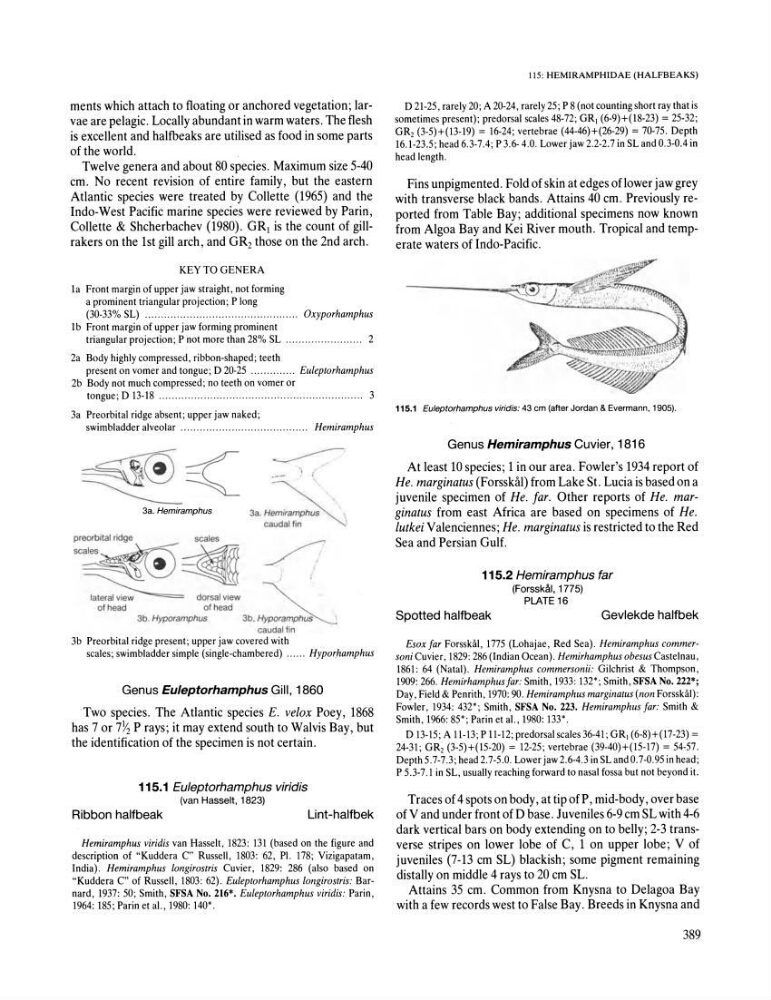
115.1 Euleptorhamphus viridis: 43 cm (after Jordan & Evermann, 1905).
Genus Hemiramphus Cuvier, 1816
At least 10 species; 1 in our area. Fowler's 1934 report of
He. marginatus (Forsskai) from Lake St. Lucia is based on a
juvenile specimen of He. far. Other reports of He. marginatus from east Africa are based on specimens of He.
lutkei Valenciennes ; He. marginatus is restricted to the Red
Sea and Persian Gulf.
115.2 Hemiramphus far
(Forsskal, 1775)
PLATE 16
Spotted halfbeak
Gevlekde halfbek
Esox far Forsskal, 1775 (Lohajae, Red Sea). Hemiramphus commersoni Cuvier, 1829: 286 (Indian Ocean). Hemirhamphus obesusCastelnau,
1861 : 64 (Natal). Hemiramphus commersonii: Gilchrist & Thompson,
1909: 266. Hemirhamphus far: Smith, 1933: 132*; Smith , SFSA No. 222*;
Day, Field & Penrith , 1970: 90. Hemiramphus marginalus (non Forsskal):
Fowler, 1934: 432* ; Smith, SFSA No. 223. Hemiramphus far: Smith &
Smith , 1966: 85*; Parin et aI., 1980: 133* .
D 13-15; A 11-13; P 11-12; pre dorsal scales 36-41; GR1 (6-8)+(17-23) =
24-31; GR2 (3-5)+(15-20) = 12-25 ; vertebrae (39-40)+(15-17) = 54-57.
Depth 5.7-7.3; head 2.7-5.0. Lower jaw2.6-4.3 in SLandO.7-0.95 in head;
P 5.3-7.1 in SL, usually reaching forward to nasal fossa but not beyond it.
Traces of 4 spots on body, at tip of P, mid-body, over base
of V and under front ofD base. Juveniles 6-9 cm SL with 4-6
dark vertical bars on body extending on to belly; 2-3 transverse stripes on lower lobe of C, 1 on upper lobe; V of
juveniles (7-13 cm SL) blackish; some pigment remaining
distally on middle 4 rays to 20 cm SL.
Attains 35 cm. Common from Knysna to Delagoa Bay
with a few records west to False Bay. Breeds in Knysna and
389
is excellent and halfbeaks are utilised as food in some parts
of the world.
Twelve genera and about 80 species. Maximum size 5-40
cm. No recent revision of entire family, but the eastern
Atlantic species were treated by Collette (1965) and the
Indo-West Pacific marine species were reviewed by Parin,
Collette & Shcherbachev (1980). GRI is the count of gillrakers on the 1st gill arch, and GR 2 those on the 2nd arch.
KEY TO GENERA
la Front margin of upper jaw straight, not forming
a prominent triangular projection; P long
(30-33% SL) ........... ................... ....... .. ...... .. . Oxyporhamphus
I b Front margin of upper jaw forming prominent
triangular projection; P not more than 28% SL .... .. .. ........... ..... 2
2a Body highly compressed, ribbon-shaped; teeth
present on vomer and tongue; D 20-25 .. ............ Euleptorhamphus
2b Body not much compressed; no teeth on vomer or
tongue; D \3-18 ... .... .... ... ......... .. ... .. .......... ........ .... .. .... .. .... 3
3a Preorbital ridge absent; upper jaw naked ;
swimbladder alveolar ............................... ......... Hemiramphus
(
\
3a. Hemiramphus
3a. Hemiramphus
caudal fin
:;~~
~ dorsal view
of head
of head
3b. Hyporamphus
3b. Hyporamphus
caudal fin
3b Preorbital ridge present ; upper jaw covered with
scales ; swim bladder simple (single-chambered) ...... Hyporhamphus
Genus Euleptorhamphus Gill, 1860
Two species. The Atlantic species E. velox Poey, 1868
has 7 or 7Yz P rays; it may extend south to Walvis Bay, but
the identification of the specimen is not certain.
115.1 Euleptorhamphus viridis
(van Hasselt, 1823)
Ribbon halfbeak
Lint-halfbek
Hemiramphus viridis van Hasselt, 1823: \31 (based on the figure and
description of "Kuddera C" Russell, 1803: 62, PI. 178; Vizigapatam,
India) . Hemiramphus longirostris Cuvier, 1829: 286 (also based on
"Kuddera C" of Russell, 1803: 62). Euleptorhamphus longirostris: Barnard, 1937: 50; Smith, SFSA No. 216*. Euleplorhamphus viridis: Parin,
1964: 185; Parin et aI., 1980: 140* .
115: HEMIRAMPHIDAE (HALFBEAKS)
D 21-25, rarely 20; A 20-24, rarely 25; P 8 (not counting short ray that is
sometimes present) ; predorsal scales 48-72; GR1 (6-9)+(18-23) = 25-32;
GR 2 (3-5)+(\3-19) = 16-24; vertebrae (44-46)+(26-29) = 70-75. Depth
16.1-23.5; head 6.3-7.4; P 3.6- 4.0. Lower jaw 2.2-2.7 in SL and 0.3-0.4 in
head length .
Fins unpigmented. Fold of skin at edges oflower jaw grey
with transverse black bands. Attains 40 cm. Previously reported from Table Bay; additional specimens now known
from Algoa Bay and Kei River mouth. Tropical and temperate waters of Indo-Pacific.
115.1 Euleptorhamphus viridis: 43 cm (after Jordan & Evermann, 1905).
Genus Hemiramphus Cuvier, 1816
At least 10 species; 1 in our area. Fowler's 1934 report of
He. marginatus (Forsskai) from Lake St. Lucia is based on a
juvenile specimen of He. far. Other reports of He. marginatus from east Africa are based on specimens of He.
lutkei Valenciennes ; He. marginatus is restricted to the Red
Sea and Persian Gulf.
115.2 Hemiramphus far
(Forsskal, 1775)
PLATE 16
Spotted halfbeak
Gevlekde halfbek
Esox far Forsskal, 1775 (Lohajae, Red Sea). Hemiramphus commersoni Cuvier, 1829: 286 (Indian Ocean). Hemirhamphus obesusCastelnau,
1861 : 64 (Natal). Hemiramphus commersonii: Gilchrist & Thompson,
1909: 266. Hemirhamphus far: Smith, 1933: 132*; Smith , SFSA No. 222*;
Day, Field & Penrith , 1970: 90. Hemiramphus marginalus (non Forsskal):
Fowler, 1934: 432* ; Smith, SFSA No. 223. Hemiramphus far: Smith &
Smith , 1966: 85*; Parin et aI., 1980: 133* .
D 13-15; A 11-13; P 11-12; pre dorsal scales 36-41; GR1 (6-8)+(17-23) =
24-31; GR2 (3-5)+(15-20) = 12-25 ; vertebrae (39-40)+(15-17) = 54-57.
Depth 5.7-7.3; head 2.7-5.0. Lower jaw2.6-4.3 in SLandO.7-0.95 in head;
P 5.3-7.1 in SL, usually reaching forward to nasal fossa but not beyond it.
Traces of 4 spots on body, at tip of P, mid-body, over base
of V and under front ofD base. Juveniles 6-9 cm SL with 4-6
dark vertical bars on body extending on to belly; 2-3 transverse stripes on lower lobe of C, 1 on upper lobe; V of
juveniles (7-13 cm SL) blackish; some pigment remaining
distally on middle 4 rays to 20 cm SL.
Attains 35 cm. Common from Knysna to Delagoa Bay
with a few records west to False Bay. Breeds in Knysna and
389