

114: SCOMBERESOCIDAE (SAURIES)
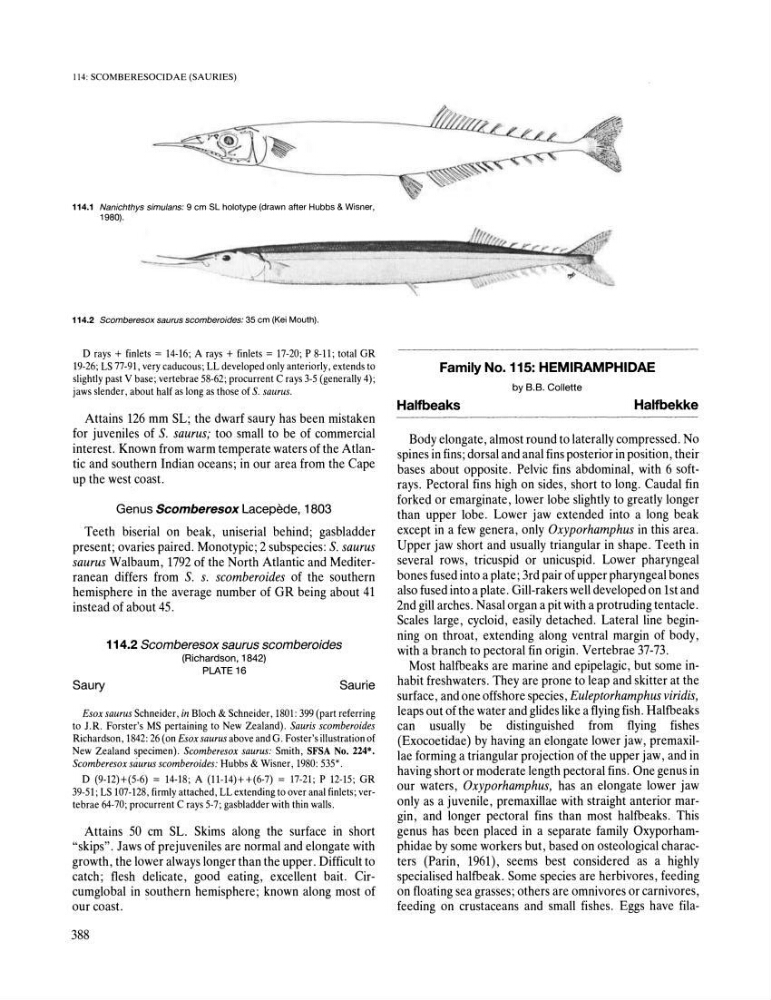
114.1 Nanichthys simulans: 9 em SL holotype (drawn after Hubbs & Wisner.
1980).
114.2 Scomberesox saurus scomberoides: 35 em (Kei Mouth).
Drays + finlets = 14-16; A rays + finlets = 17-20; P 8-11; total GR
19-26; LS 77-91, very caducous; LL developed only anteriorly, extends to
slightly past V base; vertebrae 58-62; procurrent Crays 3-5 (generally 4);
jaws slender, about half as long as those of S. saurus.
Attains 126 mm SL; the dwarf saury has been mistaken
for juveniles of S. saurus; too small to be of commercial
interest. Known from warm temperate waters of the Atlantic and southern Indian oceans; in our area from the Cape
up the west coast.
Genus Scomberesox Lacepede, 1803
Teeth biserial on beak, uniserial behind; gasbladder
present; ovaries paired. Monotypic; 2 subspecies: S. saurus
saurus Walbaum, 1792 of the North Atlantic and Mediterranean differs from S. s. scomberoides of the southern
hemisphere in the average number of GR being about 41
instead of about 45.
Saury
114.2 Scomberesox saurus scomberoides
(Richardson, 1842)
PLATE 16
Saurie
Esox saurus Schneider, in Bloch & Schneider, 180 I: 399 (part referring
to l.R. Forster's MS pertaining to New Zealand). Sa uris scomberoides
Richardson, 1842: 26 (on Esox saurus above and G. Foster's illustration of
New Zealand specimen). Scomberesox saurus: Smith, SFSA No. 224*.
Scomberesox saurus scomberoides: Hubbs & Wisner, 1980: 535*.
o (9-12)+(5-6) = 14-18; A (11-14)++(6-7) = 17-21; P 12-15; GR
39-51; LS 107-128, firmly attached, LL extending to over anal finlets; vertebrae 64-70; procurrent Crays 5-7; gasbladder with thin walls.
Attains 50 cm SL. Skims along the surface in short
"skips". Jaws of prejuveniles are normal and elongate with
growth, the lower always longer than the upper. Difficult to
catch; flesh delicate, good eating, excellent bait. Circumglobal in southern hemisphere; known along most of
our coast.
388
Family No. 115: HEMIRAMPHIDAE
by B.B. Collette
Halfbeaks
Halfbekke
Body elongate, almost round to laterally compressed. No
spines in fins; dorsal and anal fins posterior in position, their
bases about opposite. Pelvic fins abdominal, with 6 softrays. Pectoral fins high on sides, short to long. Caudal fin
forked or emarginate, lower lobe slightly to greatly longer
than upper lobe. Lower jaw extended into a long beak
except in a few genera, only Oxyporhamphus in this area.
Upper jaw short and usually triangular in shape. Teeth in
several rows, tricuspid or unicuspid. Lower pharyngeal
bones fused into a plate; 3rd pair of upper pharyngeal bones
also fused into a plate. Gill-rakers well developed on 1st and
2nd gill arches. Nasal organ a pit with a protruding tentacle.
Scales large, cycloid, easily detached. Lateral line beginning on throat, extending along ventral margin of body,
with a branch to pectoral fin origin. Vertebrae 37-73.
Most halfbeaks are marine and epipelagic, but some inhabit freshwaters. They are prone to leap and skitter at the
surface, and one offshore species, Euleptorhamphus viridis,
leaps out of the water and glides like a flying fish. Halfbeaks
can usually be distinguished from flying fishes
(Exocoetidae) by having an elongate lower jaw, premaxillae forming a triangular projection of the upper jaw, and in
having short or moderate length pectoral fins. One genus in
our waters, Oxyporhamphus,has an elongate lower jaw
only as a juvenile, premaxillae with straight anterior margin, and longer pectoral fins than most halfbeaks. This
genus has been placed in a separate family Oxyporhamphidae by some workers but, based on osteological characters (Parin, 1961), seems best considered as a highly
specialised halfbeak. Some species are herbivores, feeding
on floating sea grasses; others are omnivores or carnivores,
feeding on crustaceans and small fishes. Eggs have fila-
114.1 Nanichthys simulans: 9 em SL holotype (drawn after Hubbs & Wisner.
1980).
114.2 Scomberesox saurus scomberoides: 35 em (Kei Mouth).
Drays + finlets = 14-16; A rays + finlets = 17-20; P 8-11; total GR
19-26; LS 77-91, very caducous; LL developed only anteriorly, extends to
slightly past V base; vertebrae 58-62; procurrent Crays 3-5 (generally 4);
jaws slender, about half as long as those of S. saurus.
Attains 126 mm SL; the dwarf saury has been mistaken
for juveniles of S. saurus; too small to be of commercial
interest. Known from warm temperate waters of the Atlantic and southern Indian oceans; in our area from the Cape
up the west coast.
Genus Scomberesox Lacepede, 1803
Teeth biserial on beak, uniserial behind; gasbladder
present; ovaries paired. Monotypic; 2 subspecies: S. saurus
saurus Walbaum, 1792 of the North Atlantic and Mediterranean differs from S. s. scomberoides of the southern
hemisphere in the average number of GR being about 41
instead of about 45.
Saury
114.2 Scomberesox saurus scomberoides
(Richardson, 1842)
PLATE 16
Saurie
Esox saurus Schneider, in Bloch & Schneider, 180 I: 399 (part referring
to l.R. Forster's MS pertaining to New Zealand). Sa uris scomberoides
Richardson, 1842: 26 (on Esox saurus above and G. Foster's illustration of
New Zealand specimen). Scomberesox saurus: Smith, SFSA No. 224*.
Scomberesox saurus scomberoides: Hubbs & Wisner, 1980: 535*.
o (9-12)+(5-6) = 14-18; A (11-14)++(6-7) = 17-21; P 12-15; GR
39-51; LS 107-128, firmly attached, LL extending to over anal finlets; vertebrae 64-70; procurrent Crays 5-7; gasbladder with thin walls.
Attains 50 cm SL. Skims along the surface in short
"skips". Jaws of prejuveniles are normal and elongate with
growth, the lower always longer than the upper. Difficult to
catch; flesh delicate, good eating, excellent bait. Circumglobal in southern hemisphere; known along most of
our coast.
388
Family No. 115: HEMIRAMPHIDAE
by B.B. Collette
Halfbeaks
Halfbekke
Body elongate, almost round to laterally compressed. No
spines in fins; dorsal and anal fins posterior in position, their
bases about opposite. Pelvic fins abdominal, with 6 softrays. Pectoral fins high on sides, short to long. Caudal fin
forked or emarginate, lower lobe slightly to greatly longer
than upper lobe. Lower jaw extended into a long beak
except in a few genera, only Oxyporhamphus in this area.
Upper jaw short and usually triangular in shape. Teeth in
several rows, tricuspid or unicuspid. Lower pharyngeal
bones fused into a plate; 3rd pair of upper pharyngeal bones
also fused into a plate. Gill-rakers well developed on 1st and
2nd gill arches. Nasal organ a pit with a protruding tentacle.
Scales large, cycloid, easily detached. Lateral line beginning on throat, extending along ventral margin of body,
with a branch to pectoral fin origin. Vertebrae 37-73.
Most halfbeaks are marine and epipelagic, but some inhabit freshwaters. They are prone to leap and skitter at the
surface, and one offshore species, Euleptorhamphus viridis,
leaps out of the water and glides like a flying fish. Halfbeaks
can usually be distinguished from flying fishes
(Exocoetidae) by having an elongate lower jaw, premaxillae forming a triangular projection of the upper jaw, and in
having short or moderate length pectoral fins. One genus in
our waters, Oxyporhamphus,has an elongate lower jaw
only as a juvenile, premaxillae with straight anterior margin, and longer pectoral fins than most halfbeaks. This
genus has been placed in a separate family Oxyporhamphidae by some workers but, based on osteological characters (Parin, 1961), seems best considered as a highly
specialised halfbeak. Some species are herbivores, feeding
on floating sea grasses; others are omnivores or carnivores,
feeding on crustaceans and small fishes. Eggs have fila-