

102.8 Antennarius tuberosus
(Cuvier, 1817)
PLATE 13
Pygmy angler
Hengelaartjie
?Lophius bigibbus Latreille, 1804: 73 (nomen dubium). Chironectes
tuberosus Cuvier, 1817: 432 (Mauritius). Antennarius bigibbus: Regan,
1918: 77; Barnard, 1927: 1001; Smith, SFSA No. 1235*. Antennarius
tuberosus: Smith, 1958: 60*
o I+I+I,12; A 7; P 9-12. Illicium slightly longer than 2nd 0 spine,
tapering to a fine point, without an esca. Second 0 spine more or less
straight, tapering to a point, with only a tiny membranous connection to
head. Third 0 spine immobile, tightly bound down to head by thick,
spinulose skin. C peduncle absent or nearly so, the soft 0 and A connected to C base.
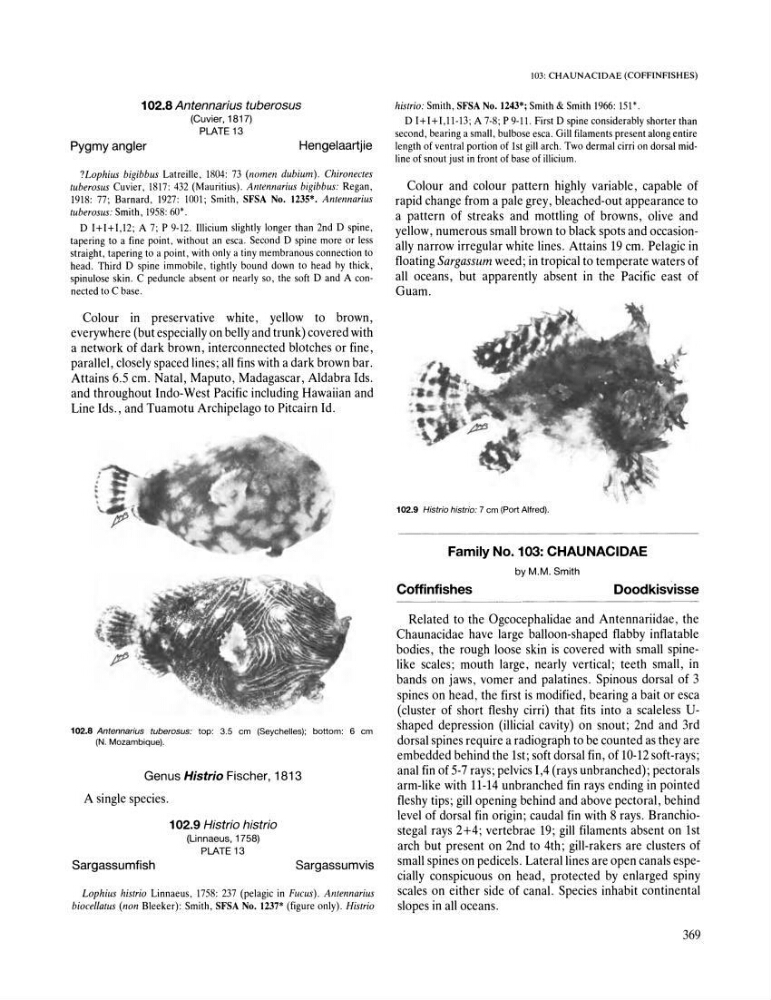
Colour in preservative white, yellow to brown,
everywhere (but especially on belly and trunk) covered with
a network of dark brown, interconnected blotches or fine,
parallel, closely spaced lines; all fins with a dark brown bar.
Attains 6.5 cm. Natal, Maputo, Madagascar, Aldabra Ids.
and throughout Indo-West Pacific including Hawaiian and
Line Ids., and Tuamotu Archipelago to Pitcairn Id.
102.8 Antennarius tuberosus: top: 3.5 cm (Seychelles); bottom: 6 cm
(N. Mozambique).
Genus Histrio Fischer, 1813
A single species.
Sargassumfish
102.9 Histrio his trio
(linnaeus, 1758)
PLATE 13
Sargassumvis
Lophius histrio Linnaeus, 1758: 237 (pelagic in Fucus). Alltennarius
biocellatus (lion Bleeker): Smith, SFSA No. 1237* (figure only). Histrio
103: CHAUNACIDAE (COFFIN FISHES)
histrio: Smith, SFSA No. 1243*; Smith & Smith 1966: 151 *.
o I+ I+ I, 11-13; A 7-8; P 9-11. First 0 spine considerably shorter than
second, bearing a small, bulbose esca. Gill filaments present along entire
length of ventral portion of 1st gill arch. Two dermal cirri on dorsal midline of snout just in front of base of illicium.
Colour and colour pattern highly variable, capable of
rapid change from a pale grey, bleached-out appearance to
a pattern of streaks and mottling of browns, olive and
yellow, numerous small brown to black spots and occasionally narrow irregular white lines. Attains 19 cm. Pelagic in
floating Sargassum weed; in tropical to temperate waters of
all oceans, but apparently absent in the Pacific east of
Guam.
102.9 Histrio histrio: 7 cm (Port Alfred).
Family No. 103: CHAUNACIDAE
by M.M. Smith
Coffinfishes
Doodkisvisse
Related to the Ogcocephalidae and Antennariidae, the
Chaunacidae have large balloon-shaped flabby inflatable
bodies, the rough loose skin is covered with small spinelike scales; mouth large, nearly vertical; teeth small, in
bands on jaws, vomer and palatines. Spinous dorsal of 3
spines on head, the first is modified, bearing a bait or esca
(cluster of short fleshy cirri) that fits into a scaleless Ushaped depression (illicial cavity) on snout; 2nd and 3rd
dorsal spines require a radiograph to be counted as they are
embedded behind the 1st; soft dorsal fin, of 10-12 soft-rays;
anal fin of 5-7 rays; pelvics 1,4 (rays unbranched); pectorals
arm-like with 11-14 unbranched fin rays ending in pointed
fleshy tips; gill opening behind and above pectoral, behind
level of dorsal fin origin; caudal fin with 8 rays. Branchiostegal rays 2+4; vertebrae 19; gill filaments absent on 1st
arch but present on 2nd to 4th; gill-rakers are clusters of
small spines on pedicels. Lateral lines are open canals especially conspicuous on head, protected by enlarged spiny
scales on either side of canal. Species inhabit continental
slopes in all oceans.
369
(Cuvier, 1817)
PLATE 13
Pygmy angler
Hengelaartjie
?Lophius bigibbus Latreille, 1804: 73 (nomen dubium). Chironectes
tuberosus Cuvier, 1817: 432 (Mauritius). Antennarius bigibbus: Regan,
1918: 77; Barnard, 1927: 1001; Smith, SFSA No. 1235*. Antennarius
tuberosus: Smith, 1958: 60*
o I+I+I,12; A 7; P 9-12. Illicium slightly longer than 2nd 0 spine,
tapering to a fine point, without an esca. Second 0 spine more or less
straight, tapering to a point, with only a tiny membranous connection to
head. Third 0 spine immobile, tightly bound down to head by thick,
spinulose skin. C peduncle absent or nearly so, the soft 0 and A connected to C base.
Colour in preservative white, yellow to brown,
everywhere (but especially on belly and trunk) covered with
a network of dark brown, interconnected blotches or fine,
parallel, closely spaced lines; all fins with a dark brown bar.
Attains 6.5 cm. Natal, Maputo, Madagascar, Aldabra Ids.
and throughout Indo-West Pacific including Hawaiian and
Line Ids., and Tuamotu Archipelago to Pitcairn Id.
102.8 Antennarius tuberosus: top: 3.5 cm (Seychelles); bottom: 6 cm
(N. Mozambique).
Genus Histrio Fischer, 1813
A single species.
Sargassumfish
102.9 Histrio his trio
(linnaeus, 1758)
PLATE 13
Sargassumvis
Lophius histrio Linnaeus, 1758: 237 (pelagic in Fucus). Alltennarius
biocellatus (lion Bleeker): Smith, SFSA No. 1237* (figure only). Histrio
103: CHAUNACIDAE (COFFIN FISHES)
histrio: Smith, SFSA No. 1243*; Smith & Smith 1966: 151 *.
o I+ I+ I, 11-13; A 7-8; P 9-11. First 0 spine considerably shorter than
second, bearing a small, bulbose esca. Gill filaments present along entire
length of ventral portion of 1st gill arch. Two dermal cirri on dorsal midline of snout just in front of base of illicium.
Colour and colour pattern highly variable, capable of
rapid change from a pale grey, bleached-out appearance to
a pattern of streaks and mottling of browns, olive and
yellow, numerous small brown to black spots and occasionally narrow irregular white lines. Attains 19 cm. Pelagic in
floating Sargassum weed; in tropical to temperate waters of
all oceans, but apparently absent in the Pacific east of
Guam.
102.9 Histrio histrio: 7 cm (Port Alfred).
Family No. 103: CHAUNACIDAE
by M.M. Smith
Coffinfishes
Doodkisvisse
Related to the Ogcocephalidae and Antennariidae, the
Chaunacidae have large balloon-shaped flabby inflatable
bodies, the rough loose skin is covered with small spinelike scales; mouth large, nearly vertical; teeth small, in
bands on jaws, vomer and palatines. Spinous dorsal of 3
spines on head, the first is modified, bearing a bait or esca
(cluster of short fleshy cirri) that fits into a scaleless Ushaped depression (illicial cavity) on snout; 2nd and 3rd
dorsal spines require a radiograph to be counted as they are
embedded behind the 1st; soft dorsal fin, of 10-12 soft-rays;
anal fin of 5-7 rays; pelvics 1,4 (rays unbranched); pectorals
arm-like with 11-14 unbranched fin rays ending in pointed
fleshy tips; gill opening behind and above pectoral, behind
level of dorsal fin origin; caudal fin with 8 rays. Branchiostegal rays 2+4; vertebrae 19; gill filaments absent on 1st
arch but present on 2nd to 4th; gill-rakers are clusters of
small spines on pedicels. Lateral lines are open canals especially conspicuous on head, protected by enlarged spiny
scales on either side of canal. Species inhabit continental
slopes in all oceans.
369