

102: ANTENNARIIDAE (ANGLERS)
102.5 Antennarius nummifer
(Cuvier, 1817)
Spotfin angler
Kolvin-hengelaar
Chironectes nummifer Cuvier , 1817: 430, PI. 17, Fig. 4 (locality
unknown). Antennarius nummifer: Schultz, 1957: 102*.
D 1+ 1+ 1,12; A 7; P 10-11. First D spine as long as 2nd; esca usually consisting of a cluster of spherical , darkly pigmented swellings associated with
a variable number of thin cylindrical filaments, and a large, usually
anteriorly directed, pleated appendage . Second D spine more or less
straight , without membranous connection to surface of head. C peduncle
distinct.
Colour in preservative beige, pink, brown to black;
lighter-coloured phases often with dark irregularly shaped
patches over entire body; soft D, A and C often peppered
with numerous, small dark spots; a conspicuous, dark, basidorsal spot nearly always present; black phases with tips of
P rays white. Attains 13 cm. Delagoa Bay to Zanzibar, Red
Sea and throughout Indo-West Pacific.
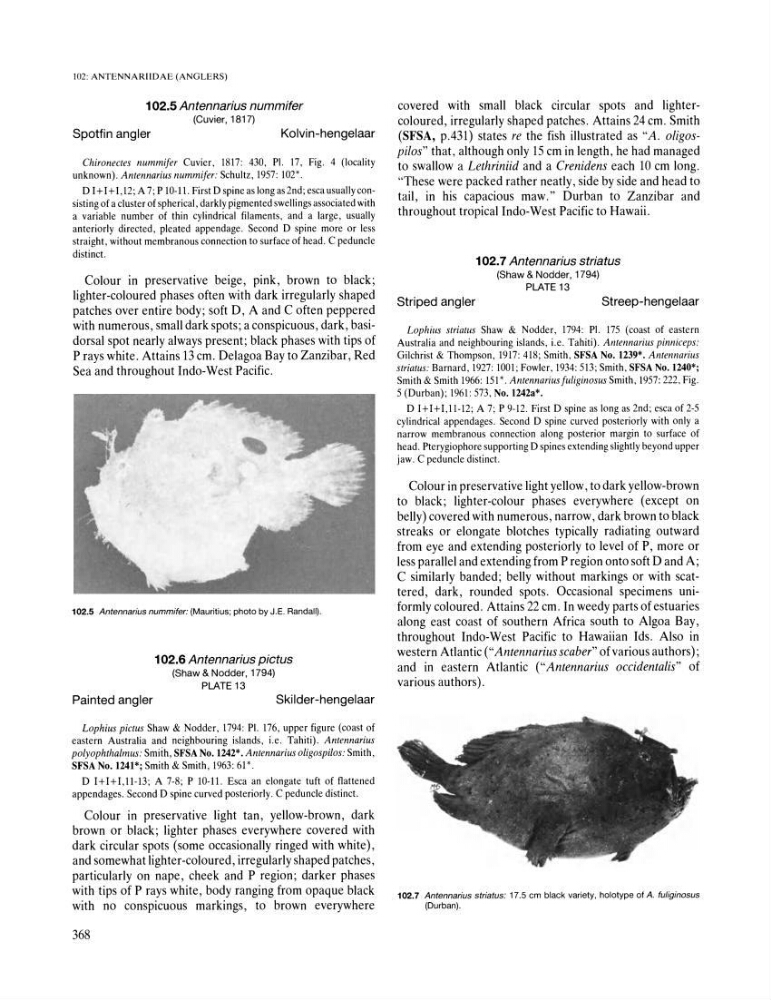
102.5 Antennarius nummifer: (Mauritius; photo by J.E. Randall).
Painted angler
102.6 Antennarius pictus
(Shaw & Nodder, 1794)
PLATE 13
Skilder-hengelaar
Lophius pictus Shaw & Nodder, 1794: PI. 176, upper figure (coast of
eastern Australia and neighbouring islands, i.e. Tahiti). Antennarius
polyophthalmus: Smith , SFSA No. 1242*. Antennarius oligospilos: Smith,
SFSA No. 1241*; Smith & Smith , 1963: 61 *.
D 1+1+1 ,11-13; A 7-8 ; P 10-11 . Esca an elongate tuft of flattened
appendages. Second D spine curved posteriorly. C peduncle distinct.
Colour in preservative light tan, yellow-brown, dark
brown or black; lighter phases everywhere covered with
dark circular spots (some occasionally ringed with white),
and somewhat lighter-coloured, irregularly shaped patches,
particularly on nape, cheek and P region; darker phases
with tips of P rays white, body ranging from opaque black
with no conspicuous markings, to brown everywhere
368
covered with small black circular spots and lightercoloured, irregularly shaped patches. Attains 24 cm . Smith
(SFSA, p.431) states re the fish illustrated as "A . oligospi/os" that, although only 15 cm in length, he had managed
to swallow a Lethriniid and a Crenidens each 10 cm long.
"These were packed rather neatly, side by side and head to
tail, in his capacious maw." Durban to Zanzibar and
throughout tropical Indo-West Pacific to Hawaii .
Striped angler
102.7 Antennarius striatus
(Shaw & Nodder, 1794)
PLATE 13
Streep-hengelaar
Lophius striatus Shaw & Nodder, 1794: PI. 175 (coast of eastern
Australia and neighbouring islands, i.e. Tahiti) . Alllennarius pinniceps:
Gilchrist & Thompson , 1917: 418; Smith, SFSA No. 1239*. Alltennarius
striatus: Barnard , 1927: 1001; Fowler, 1934: 513; Smith, SFSA No. 1240*;
Smith & Smith 1966: 151 *. Antennarius fu/igillosus Smith , 1957: 222. Fig.
5 (Durban) ; 1961: 573, No. 1242a*.
D [+ 1+ I, 11-12; A 7; P 9-12. First D spine as long as 2nd; esca of 2-5
cylindrical appendages. Second D spine curved posteriorly with only a
narrow membranous connection along posterior margin to surface of
head. Pterygiophore supporting D spines extending slightly beyond upper
jaw. C peduncle distinct.
Colour in preservative light yellow, to dark yellow-brown
to black; lighter-colour phases everywhere (except on
belly) covered with numerous, narrow, dark brown to black
streaks or elongate blotches typically radiating outward
from eye and extending posteriorly to level of P, more or
less parallel and extending from P region onto soft D and A;
C similarly banded; belly without markings or with scattered, dark, rounded spots. Occasional specimens uniformly coloured. Attains 22 cm. In weedy parts of estuaries
along east coast of southern Africa south to Algoa Bay,
throughout Indo-West Pacific to Hawaiian Ids. Also in
western Atlantic ("Antennarius scaber" of various authors);
and in eastern Atlantic (" Antennarius occidentalis" of
various authors).
102.7 Antennarius striatus: 17.5 em black variety, holotype of A. fuliginosus
(Durban).
102.5 Antennarius nummifer
(Cuvier, 1817)
Spotfin angler
Kolvin-hengelaar
Chironectes nummifer Cuvier , 1817: 430, PI. 17, Fig. 4 (locality
unknown). Antennarius nummifer: Schultz, 1957: 102*.
D 1+ 1+ 1,12; A 7; P 10-11. First D spine as long as 2nd; esca usually consisting of a cluster of spherical , darkly pigmented swellings associated with
a variable number of thin cylindrical filaments, and a large, usually
anteriorly directed, pleated appendage . Second D spine more or less
straight , without membranous connection to surface of head. C peduncle
distinct.
Colour in preservative beige, pink, brown to black;
lighter-coloured phases often with dark irregularly shaped
patches over entire body; soft D, A and C often peppered
with numerous, small dark spots; a conspicuous, dark, basidorsal spot nearly always present; black phases with tips of
P rays white. Attains 13 cm. Delagoa Bay to Zanzibar, Red
Sea and throughout Indo-West Pacific.
102.5 Antennarius nummifer: (Mauritius; photo by J.E. Randall).
Painted angler
102.6 Antennarius pictus
(Shaw & Nodder, 1794)
PLATE 13
Skilder-hengelaar
Lophius pictus Shaw & Nodder, 1794: PI. 176, upper figure (coast of
eastern Australia and neighbouring islands, i.e. Tahiti). Antennarius
polyophthalmus: Smith , SFSA No. 1242*. Antennarius oligospilos: Smith,
SFSA No. 1241*; Smith & Smith , 1963: 61 *.
D 1+1+1 ,11-13; A 7-8 ; P 10-11 . Esca an elongate tuft of flattened
appendages. Second D spine curved posteriorly. C peduncle distinct.
Colour in preservative light tan, yellow-brown, dark
brown or black; lighter phases everywhere covered with
dark circular spots (some occasionally ringed with white),
and somewhat lighter-coloured, irregularly shaped patches,
particularly on nape, cheek and P region; darker phases
with tips of P rays white, body ranging from opaque black
with no conspicuous markings, to brown everywhere
368
covered with small black circular spots and lightercoloured, irregularly shaped patches. Attains 24 cm . Smith
(SFSA, p.431) states re the fish illustrated as "A . oligospi/os" that, although only 15 cm in length, he had managed
to swallow a Lethriniid and a Crenidens each 10 cm long.
"These were packed rather neatly, side by side and head to
tail, in his capacious maw." Durban to Zanzibar and
throughout tropical Indo-West Pacific to Hawaii .
Striped angler
102.7 Antennarius striatus
(Shaw & Nodder, 1794)
PLATE 13
Streep-hengelaar
Lophius striatus Shaw & Nodder, 1794: PI. 175 (coast of eastern
Australia and neighbouring islands, i.e. Tahiti) . Alllennarius pinniceps:
Gilchrist & Thompson , 1917: 418; Smith, SFSA No. 1239*. Alltennarius
striatus: Barnard , 1927: 1001; Fowler, 1934: 513; Smith, SFSA No. 1240*;
Smith & Smith 1966: 151 *. Antennarius fu/igillosus Smith , 1957: 222. Fig.
5 (Durban) ; 1961: 573, No. 1242a*.
D [+ 1+ I, 11-12; A 7; P 9-12. First D spine as long as 2nd; esca of 2-5
cylindrical appendages. Second D spine curved posteriorly with only a
narrow membranous connection along posterior margin to surface of
head. Pterygiophore supporting D spines extending slightly beyond upper
jaw. C peduncle distinct.
Colour in preservative light yellow, to dark yellow-brown
to black; lighter-colour phases everywhere (except on
belly) covered with numerous, narrow, dark brown to black
streaks or elongate blotches typically radiating outward
from eye and extending posteriorly to level of P, more or
less parallel and extending from P region onto soft D and A;
C similarly banded; belly without markings or with scattered, dark, rounded spots. Occasional specimens uniformly coloured. Attains 22 cm. In weedy parts of estuaries
along east coast of southern Africa south to Algoa Bay,
throughout Indo-West Pacific to Hawaiian Ids. Also in
western Atlantic ("Antennarius scaber" of various authors);
and in eastern Atlantic (" Antennarius occidentalis" of
various authors).
102.7 Antennarius striatus: 17.5 em black variety, holotype of A. fuliginosus
(Durban).