

103: CHAUNACIDAE (COFFINFISHES)
A single genus, Chaunax Lowe, 1846, with about 12
species, although Ie Danois' world revision (1979) recognises only 9 species; 2 species from our area, but Caruso's
world revision of Chaunax is awaited before the common
South African species can properly be named. In the meantime it is referred to C. pictus.
KEY TO SPECIES
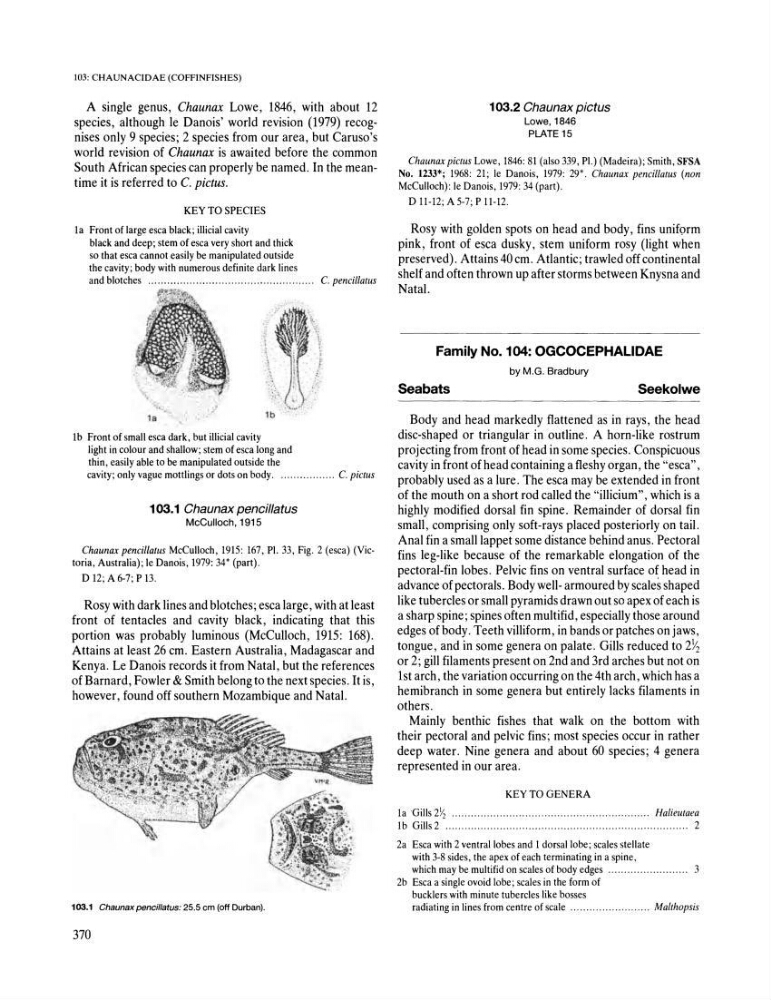
la Front of large esca black; iIIicial cavity
black and deep; stem of esca very short and thick
so that esca cannot easily be manipulated outside
the cavity; body with numerous definite dark lines
and blotches .................................. , .. . . . .. .. . .. . . . .. C. pencillatus
' ,.
1a
Ib Front of small esca dark, but iIIicial cavity
light in colour and shallow; stem of esca long and
thin, easily able to be manipulated outside the
cavity; only vague mottlings or dots on body. . .......... ,., .. , C. pictus
103.1 Chaunax pencillatus
McCulloch, 1915
Chaunax pencillatus McCulloch, 1915: 167, PI. 33, Fig. 2 (esca) (Victoria, Australia); Ie Danois, 1979: 34* (part).
D 12; A 6-7; P 13.
Rosy with dark lines and blotches; esca large, with at least
front of tentacles and cavity black, indicating that this
portion was probably luminous (McCulloch, 1915: 168).
Attains at least 26 cm. Eastern Australia, Madagascar and
Kenya. Le Danois records it from Natal, but the references
of Barnard, Fowler & Smith belong to the next species. It is,
however, found off southern Mozambique and Natal.
103.1 Chaunax pencil/atus: 25.5 em (off Durban).
370
103.2 Chaunax pictus
Lowe, 1846
PLATE 15
Chaunax pictus Lowe, 1846: 81 (also 339, Pl.) (Madeira); Smith, SFSA
No. 1233*; 1968: 21; Ie Danois, 1979: 29*, Chaunax pencillatus (non
McCulloch): Ie Danois, 1979: 34 (part).
D 11-12; A5-7; P 11-12.
Rosy with golden spots on head and body, fins unif9rm
pink, front of esca dusky, stem uniform rosy (light when
preserved). Attains 40 cm. Atlantic; trawled off continental
shelf and often thrown up after storms between Knysna and
Natal.
Family No. 104: OGCOCEPHALIDAE
by M.G. Bradbury
Seabats
Seekolwe
Body and head markedly flattened as in rays, the head
disc-shaped or triangular in outline. A horn-like rostrum
projecting from front of head in some species. Conspicuous
cavity in front of head containing a fleshy organ, the "esca" ,
probably used as a lure. The esca may be extended in front
of the mouth on a short rod called the "illicium", which is a
highly modified dorsal fin spine. Remainder of dorsal fin
small, comprising only soft-rays placed posteriorly on tail.
Anal fin a small lappet some distance behind anus. Pectoral
fins leg-like because of the remarkable elongation of the
pectoral-fin lobes. Pelvic fins on ventral surface of head in
advance of pectorals. Body well- armoured by scales shaped
like tubercles or small pyramids drawn out so apex of each is
a sharp spine; spines often multifid, especially those around
edges of body. Teeth villiform, in bands or patches on jaws,
tongue, and in some genera on palate. Gills reduced to 2Y;
or 2; gill filaments present on 2nd and 3rd arches but not on
1st arch, the variation occurring on the 4th arch, which has a
hemibranch in some genera but entirely lacks filaments in
others.
Mainly benthic fishes that walk on the bottom with
their pectoral and pelvic fins; most species occur in rather
deep water. Nine genera and about 60 species; 4 genera
represented in our area.
KEY TO GENERA
la 'Gills 21z ,.", ...... '.".'." ... '."' .. '."" ... '.".'., .. , ... ".'."" Halieutaea
I b Gills 2 .,"",','.,",." .. ',.,." ... , .... ,.,.,., .. ,., .. ,.,.,",.".,.,'.,., .. ,.,., 2
2a Esca with 2 ventral lobes and 1 dorsal lobe ; scales stellate
with 3-8 sides, the apex of each terminating in a spine,
which may be multifid on scales of body edges ,.,"'., .. ,""'.',."'" 3
2b Esca a single ovoid lobe; scales in the form of
bucklers with minute tubercles like bosses
radiating in lines from centre of scale ",""",",,.,,"""" Malthopsis
A single genus, Chaunax Lowe, 1846, with about 12
species, although Ie Danois' world revision (1979) recognises only 9 species; 2 species from our area, but Caruso's
world revision of Chaunax is awaited before the common
South African species can properly be named. In the meantime it is referred to C. pictus.
KEY TO SPECIES
la Front of large esca black; iIIicial cavity
black and deep; stem of esca very short and thick
so that esca cannot easily be manipulated outside
the cavity; body with numerous definite dark lines
and blotches .................................. , .. . . . .. .. . .. . . . .. C. pencillatus
' ,.
1a
Ib Front of small esca dark, but iIIicial cavity
light in colour and shallow; stem of esca long and
thin, easily able to be manipulated outside the
cavity; only vague mottlings or dots on body. . .......... ,., .. , C. pictus
103.1 Chaunax pencillatus
McCulloch, 1915
Chaunax pencillatus McCulloch, 1915: 167, PI. 33, Fig. 2 (esca) (Victoria, Australia); Ie Danois, 1979: 34* (part).
D 12; A 6-7; P 13.
Rosy with dark lines and blotches; esca large, with at least
front of tentacles and cavity black, indicating that this
portion was probably luminous (McCulloch, 1915: 168).
Attains at least 26 cm. Eastern Australia, Madagascar and
Kenya. Le Danois records it from Natal, but the references
of Barnard, Fowler & Smith belong to the next species. It is,
however, found off southern Mozambique and Natal.
103.1 Chaunax pencil/atus: 25.5 em (off Durban).
370
103.2 Chaunax pictus
Lowe, 1846
PLATE 15
Chaunax pictus Lowe, 1846: 81 (also 339, Pl.) (Madeira); Smith, SFSA
No. 1233*; 1968: 21; Ie Danois, 1979: 29*, Chaunax pencillatus (non
McCulloch): Ie Danois, 1979: 34 (part).
D 11-12; A5-7; P 11-12.
Rosy with golden spots on head and body, fins unif9rm
pink, front of esca dusky, stem uniform rosy (light when
preserved). Attains 40 cm. Atlantic; trawled off continental
shelf and often thrown up after storms between Knysna and
Natal.
Family No. 104: OGCOCEPHALIDAE
by M.G. Bradbury
Seabats
Seekolwe
Body and head markedly flattened as in rays, the head
disc-shaped or triangular in outline. A horn-like rostrum
projecting from front of head in some species. Conspicuous
cavity in front of head containing a fleshy organ, the "esca" ,
probably used as a lure. The esca may be extended in front
of the mouth on a short rod called the "illicium", which is a
highly modified dorsal fin spine. Remainder of dorsal fin
small, comprising only soft-rays placed posteriorly on tail.
Anal fin a small lappet some distance behind anus. Pectoral
fins leg-like because of the remarkable elongation of the
pectoral-fin lobes. Pelvic fins on ventral surface of head in
advance of pectorals. Body well- armoured by scales shaped
like tubercles or small pyramids drawn out so apex of each is
a sharp spine; spines often multifid, especially those around
edges of body. Teeth villiform, in bands or patches on jaws,
tongue, and in some genera on palate. Gills reduced to 2Y;
or 2; gill filaments present on 2nd and 3rd arches but not on
1st arch, the variation occurring on the 4th arch, which has a
hemibranch in some genera but entirely lacks filaments in
others.
Mainly benthic fishes that walk on the bottom with
their pectoral and pelvic fins; most species occur in rather
deep water. Nine genera and about 60 species; 4 genera
represented in our area.
KEY TO GENERA
la 'Gills 21z ,.", ...... '.".'." ... '."' .. '."" ... '.".'., .. , ... ".'."" Halieutaea
I b Gills 2 .,"",','.,",." .. ',.,." ... , .... ,.,.,., .. ,., .. ,.,.,",.".,.,'.,., .. ,.,., 2
2a Esca with 2 ventral lobes and 1 dorsal lobe ; scales stellate
with 3-8 sides, the apex of each terminating in a spine,
which may be multifid on scales of body edges ,.,"'., .. ,""'.',."'" 3
2b Esca a single ovoid lobe; scales in the form of
bucklers with minute tubercles like bosses
radiating in lines from centre of scale ",""",",,.,,"""" Malthopsis