

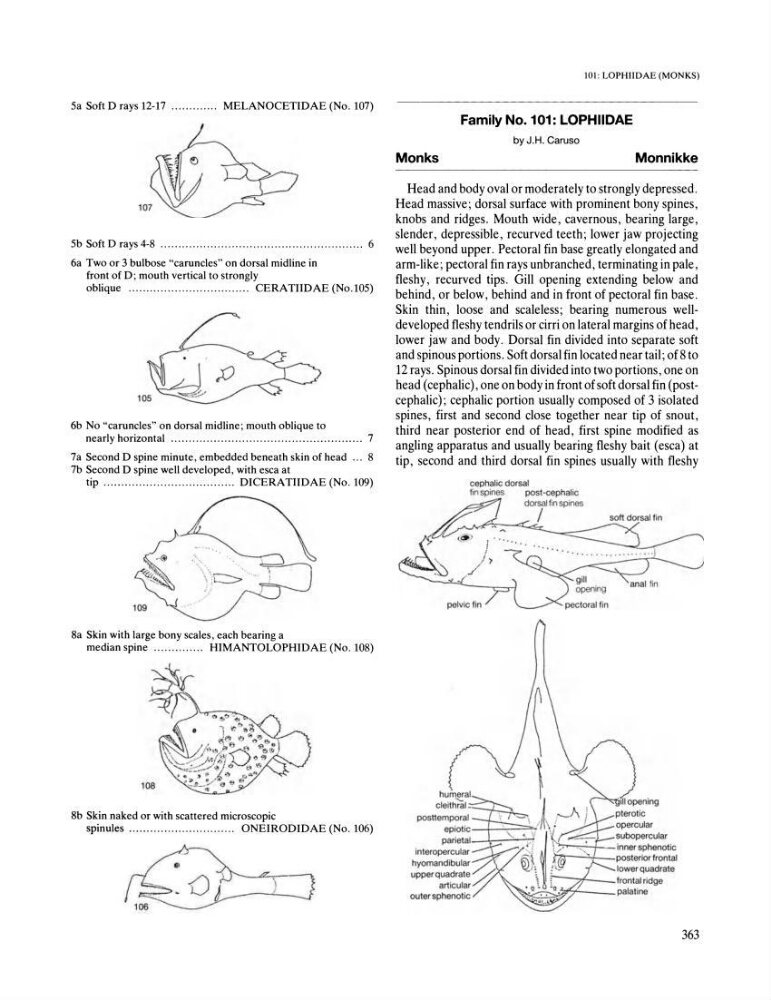
5a Soft Drays 12-17 ............. MELANOCETIDAE (No. 107)
5b Soft Drays 4-8 ......................................................... 6
6a Two or 3 bulbose "caruncles" on dorsal midline in
front of D; mouth vertical to strongly
oblique .................................. CERATIIDAE (No. 105)
6b No "caruncles" on dorsal midline; mouth oblique to
nearly horizontal ...................................................... 7
7a Second D spine minute, embedded beneath skin of head ... 8
7b Second D spine well developed, with esca at
tip ..................................... DICERATIIDAE (No. 109)
8a Skin with large bony scales, each bearing a
median spine .............. HIMANTOLOPHIDAE (No. 108)
8b Skin naked or with scattered microscopic
spinules .............................. ONEIRODIDAE (No. 106)
)
101: LOPHIIDAE (MONKS)
Family No. 101: LOPHIIDAE
by J.H. Caruso
Monks
Monnikke
Head and body oval or moderately to strongly depressed.
Head massive; dorsal surface with prominent bony spines,
knobs and ridges. Mouth wide, cavernous, bearing large,
slender, depressible, recurved teeth; lower jaw projecting
well beyond upper. Pectoral fin base greatly elongated and
arm-like; pectoral fin rays unbranched, terminating in pale,
fleshy, recurved tips. Gill opening extending below and
behind, or below, behind and in front of pectoral fin base.
Skin thin, loose and scaleless; bearing numerous welldeveloped fleshy tendrils or cirri on lateral margins of head,
lower jaw and body. Dorsal fin divided into separate soft
and spinous portions. Soft dorsal fin located near tail; of 8 to
12 rays. Spinous dorsal fin divided into two portions, one on
head (cephalic), one on body in front of soft dorsal fin (postcephalic); cephalic portion usually composed of 3 isolated
spines, first and second close together near tip of snout,
third near posterior end of head, first spine modified as
angling apparatus and usually bearing fleshy bait (esca) at
tip, second and third dorsal fin spines usually with fleshy
cephalic dorsal
fin spines
post-cephalic
dorsa! fin spines
pelvic fin
epiotic -+-..:..,.--=,..,
parietal_...I,-- = -:-:;
interopercular
hyomandibular
upper quadrate ./ /articular/"/
outer sphenotic
/
soft dorsal fin
pterotic
opercular
subopercular
.-"-~-J-_ inner sphenotic
ti::1:---'.1--_ posteriorfrontal
lower quadrate
363
5b Soft Drays 4-8 ......................................................... 6
6a Two or 3 bulbose "caruncles" on dorsal midline in
front of D; mouth vertical to strongly
oblique .................................. CERATIIDAE (No. 105)
6b No "caruncles" on dorsal midline; mouth oblique to
nearly horizontal ...................................................... 7
7a Second D spine minute, embedded beneath skin of head ... 8
7b Second D spine well developed, with esca at
tip ..................................... DICERATIIDAE (No. 109)
8a Skin with large bony scales, each bearing a
median spine .............. HIMANTOLOPHIDAE (No. 108)
8b Skin naked or with scattered microscopic
spinules .............................. ONEIRODIDAE (No. 106)
)
101: LOPHIIDAE (MONKS)
Family No. 101: LOPHIIDAE
by J.H. Caruso
Monks
Monnikke
Head and body oval or moderately to strongly depressed.
Head massive; dorsal surface with prominent bony spines,
knobs and ridges. Mouth wide, cavernous, bearing large,
slender, depressible, recurved teeth; lower jaw projecting
well beyond upper. Pectoral fin base greatly elongated and
arm-like; pectoral fin rays unbranched, terminating in pale,
fleshy, recurved tips. Gill opening extending below and
behind, or below, behind and in front of pectoral fin base.
Skin thin, loose and scaleless; bearing numerous welldeveloped fleshy tendrils or cirri on lateral margins of head,
lower jaw and body. Dorsal fin divided into separate soft
and spinous portions. Soft dorsal fin located near tail; of 8 to
12 rays. Spinous dorsal fin divided into two portions, one on
head (cephalic), one on body in front of soft dorsal fin (postcephalic); cephalic portion usually composed of 3 isolated
spines, first and second close together near tip of snout,
third near posterior end of head, first spine modified as
angling apparatus and usually bearing fleshy bait (esca) at
tip, second and third dorsal fin spines usually with fleshy
cephalic dorsal
fin spines
post-cephalic
dorsa! fin spines
pelvic fin
epiotic -+-..:..,.--=,..,
parietal_...I,-- = -:-:;
interopercular
hyomandibular
upper quadrate ./ /articular/"/
outer sphenotic
/
soft dorsal fin
pterotic
opercular
subopercular
.-"-~-J-_ inner sphenotic
ti::1:---'.1--_ posteriorfrontal
lower quadrate
363