

IO\: LOPHIIDAE (MONKS)
tendrils along entire lengtH; postcephalic portion of 1-3
spines, some or all of which may be embedded or absent.
Anal fin below soft dorsal, of 6 to 10 rays. Pelvic fins on ventral surface of head anterior to pectoral fins. Gills present
on first 3 branchial arches, absent on fourth.
Occurring in all oceans; commercially important in some
areas. Four genera with a total of25 species. Recent generic
revisions by Caruso & Bullis, 1976; Caruso, 1977, 1981,
1983. To ensure accurate counts of D and A rays, make an
incision at base of each fin, so that the proximal part of each
ray can be seen; the last 2 rays arise from the same base.
Since P rays are unbranched, accurate counts can be made
by counting projecting tips of rays.
KEY TO GENERA
la Head and body depressed (flattened); 3rd cephalic
D spine present; humeral, articular, quadrate and
subopercular spines present ..................................... ............ 2
Ib Head and body not depressed; 3rd cephalic D spine
absent; humeral, articular, quadrate and subopercular
spines absent ........................................................... Sladenia
(Not reported from our area)
2a Frontal ridge smooth (can be felt through skin);
gill opening extending well in front of P base;
articular with a spine before and 1 after jaw joint;
sphenotic with 1 spine ............................................ Lophiodes
2b Frontal ridge rugose, bearing knobs, spines or ridges (can
be felt through skin); gill opening not extending in front
of P base; articular with a single spine before jaw joint;
sphenotic with 2 or 3 spines ....................................... .......... 3
3a Soft Drays 8; A rays 6; floor of mouth with dark
reticulations; quadrate with one spine; interopercle
with 2 spines; frontal ridge, outer surface of
maxilla and lower jaw bearing low, sharp spines;
vertebrae 19 ........................................................ Lophiomus
3b Soft Drays 9-12; A rays 8-10; floor of mouth
without dark reticulations; quadrate with 2 spines;
interopercle with 1 spine; vertebrae 26-31 ...................... Lophius
Genus Lophiodes Goode & Bean, 1896
Thirteen species; 2 in our area.
KEY TO SPECIES
la Three long postcephalic D spines; inner
sphenotic spines recurved; 2nd cephalic D spine
26-48% SL; distance between frontal spines
30-35% HL (premaxillary symphysis to
posteromedial end of cranium); esca with
translucent bulb, cirri and pennant-like flap .............. L. insidiator
Ib One or 2 reduced or embedded post cephalic D
spines; inner sphenotic spines straight, not
recurved; 2nd cephalic D spine 20-30% SL;
distance between frontal spines 36-46% HL;
esca a simple pigmented bulb .................................... L. mutilus
364
Natal monk
101.1 Lophiodes insidiator
(Regan, 1921)
Natalse monnik
Chirolophius insidiator Regan, 1921: 418 (off Natal). Chirolophius
crosnieri Le Danois, 1974: 77, Figs. 51 & 52 (Indian Ocean north of
Madagascar). Chirolophius phycoides Le Danois, 1974: 82, Figs. 54 & 55
(Indian Ocean off Madagascar). Lophiodes insidiator: Smith, SFSA No.
1223; 1968: 21; Caruso, 1981: 527*.
D I+I+I+III+8; A 6; P 14-18. Head 2.6-3.0. Cephalic and postcephalic D spines well developed. Supraorbital crests elevated, interorbital area forming deep U-shaped trough between eyes. Inner frontal
spines absent. Esca (bait) with pennant-like flap, long cirri, translucent
bulb and frequently with dark, stalked, bulb-like appendages that resemble shrimp eyes.
Head and body uniform light to dark brown above,
lighter below; P and median fins pigmented as adjacent
areas of body, A darker distally, soft D and C with interradial membranes lightly pigmented or unpigmented; D
spines 2-6 pigmented as dorsal body surface, with numerous
dark tendrils; inside of mouth pale except for dark patch on
floor behind lower pharyngeal tooth plate and mottled dark
brown on tongue; peritoneum solid black. Attains 30 cm.
Natal to northern Madagascar at depths of 200 - 600 m.
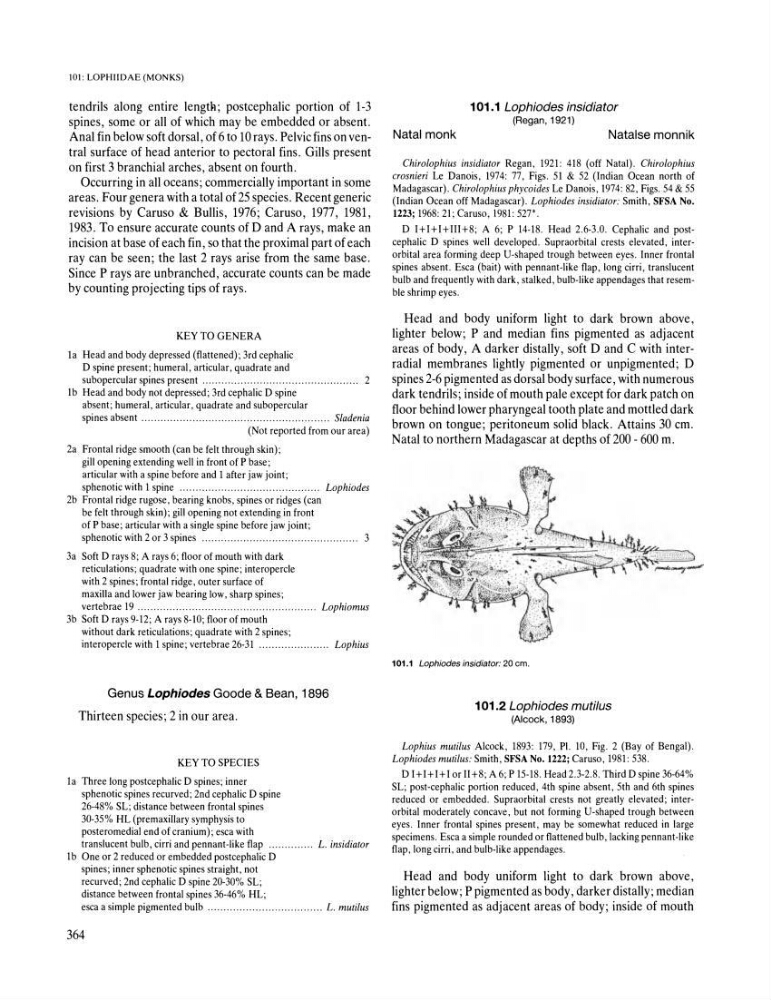
101.1 Lophiodes insidiator: 20 em.
101.2 Lophiodes mutilus
(Alcock, 1893)
Lophius mutilus Alcock, 1893: 179, PI. 10, Fig. 2 (Bay of Bengal).
Lophiodes mutilus: Smith, SFSA No. 1222; Caruso, 1981: 538.
D I + I + I + lor II +8; A 6; P 15-18. Head 2.3-2.8. Third D spine 36-64%
SL; post-cephalic portion reduced, 4th spine absent, 5th and 6th spines
reduced or embedded. Supraorbital crests not greatly elevated; interorbital moderately concave, but not forming U-shaped trough between
eyes. Inner frontal spines present, may be somewhat reduced in large
specimens. Esca a simple rounded or flattened bulb, lacking pennant-like
flap, long cirri, and bulb-like appendages.
Head and body uniform light to dark brown above,
lighter below; P pigmented as body, darker distally; median
fins pigmented as adjacent areas of body; inside of mouth
tendrils along entire lengtH; postcephalic portion of 1-3
spines, some or all of which may be embedded or absent.
Anal fin below soft dorsal, of 6 to 10 rays. Pelvic fins on ventral surface of head anterior to pectoral fins. Gills present
on first 3 branchial arches, absent on fourth.
Occurring in all oceans; commercially important in some
areas. Four genera with a total of25 species. Recent generic
revisions by Caruso & Bullis, 1976; Caruso, 1977, 1981,
1983. To ensure accurate counts of D and A rays, make an
incision at base of each fin, so that the proximal part of each
ray can be seen; the last 2 rays arise from the same base.
Since P rays are unbranched, accurate counts can be made
by counting projecting tips of rays.
KEY TO GENERA
la Head and body depressed (flattened); 3rd cephalic
D spine present; humeral, articular, quadrate and
subopercular spines present ..................................... ............ 2
Ib Head and body not depressed; 3rd cephalic D spine
absent; humeral, articular, quadrate and subopercular
spines absent ........................................................... Sladenia
(Not reported from our area)
2a Frontal ridge smooth (can be felt through skin);
gill opening extending well in front of P base;
articular with a spine before and 1 after jaw joint;
sphenotic with 1 spine ............................................ Lophiodes
2b Frontal ridge rugose, bearing knobs, spines or ridges (can
be felt through skin); gill opening not extending in front
of P base; articular with a single spine before jaw joint;
sphenotic with 2 or 3 spines ....................................... .......... 3
3a Soft Drays 8; A rays 6; floor of mouth with dark
reticulations; quadrate with one spine; interopercle
with 2 spines; frontal ridge, outer surface of
maxilla and lower jaw bearing low, sharp spines;
vertebrae 19 ........................................................ Lophiomus
3b Soft Drays 9-12; A rays 8-10; floor of mouth
without dark reticulations; quadrate with 2 spines;
interopercle with 1 spine; vertebrae 26-31 ...................... Lophius
Genus Lophiodes Goode & Bean, 1896
Thirteen species; 2 in our area.
KEY TO SPECIES
la Three long postcephalic D spines; inner
sphenotic spines recurved; 2nd cephalic D spine
26-48% SL; distance between frontal spines
30-35% HL (premaxillary symphysis to
posteromedial end of cranium); esca with
translucent bulb, cirri and pennant-like flap .............. L. insidiator
Ib One or 2 reduced or embedded post cephalic D
spines; inner sphenotic spines straight, not
recurved; 2nd cephalic D spine 20-30% SL;
distance between frontal spines 36-46% HL;
esca a simple pigmented bulb .................................... L. mutilus
364
Natal monk
101.1 Lophiodes insidiator
(Regan, 1921)
Natalse monnik
Chirolophius insidiator Regan, 1921: 418 (off Natal). Chirolophius
crosnieri Le Danois, 1974: 77, Figs. 51 & 52 (Indian Ocean north of
Madagascar). Chirolophius phycoides Le Danois, 1974: 82, Figs. 54 & 55
(Indian Ocean off Madagascar). Lophiodes insidiator: Smith, SFSA No.
1223; 1968: 21; Caruso, 1981: 527*.
D I+I+I+III+8; A 6; P 14-18. Head 2.6-3.0. Cephalic and postcephalic D spines well developed. Supraorbital crests elevated, interorbital area forming deep U-shaped trough between eyes. Inner frontal
spines absent. Esca (bait) with pennant-like flap, long cirri, translucent
bulb and frequently with dark, stalked, bulb-like appendages that resemble shrimp eyes.
Head and body uniform light to dark brown above,
lighter below; P and median fins pigmented as adjacent
areas of body, A darker distally, soft D and C with interradial membranes lightly pigmented or unpigmented; D
spines 2-6 pigmented as dorsal body surface, with numerous
dark tendrils; inside of mouth pale except for dark patch on
floor behind lower pharyngeal tooth plate and mottled dark
brown on tongue; peritoneum solid black. Attains 30 cm.
Natal to northern Madagascar at depths of 200 - 600 m.
101.1 Lophiodes insidiator: 20 em.
101.2 Lophiodes mutilus
(Alcock, 1893)
Lophius mutilus Alcock, 1893: 179, PI. 10, Fig. 2 (Bay of Bengal).
Lophiodes mutilus: Smith, SFSA No. 1222; Caruso, 1981: 538.
D I + I + I + lor II +8; A 6; P 15-18. Head 2.3-2.8. Third D spine 36-64%
SL; post-cephalic portion reduced, 4th spine absent, 5th and 6th spines
reduced or embedded. Supraorbital crests not greatly elevated; interorbital moderately concave, but not forming U-shaped trough between
eyes. Inner frontal spines present, may be somewhat reduced in large
specimens. Esca a simple rounded or flattened bulb, lacking pennant-like
flap, long cirri, and bulb-like appendages.
Head and body uniform light to dark brown above,
lighter below; P pigmented as body, darker distally; median
fins pigmented as adjacent areas of body; inside of mouth