

Order LOPHIIFORMES
Anglerfishes
Introduction and Key to Families by T.W. Pietsch
Hengelaars
Anglerfishes are so named because nearly all are equipped with a fishing rod and lure on the tip of the snout. This
angling apparatus, or "illicium" (from the Latin illix,
decoy), is thought to be a greatly modified first dorsal-fin
spine; it bears at the tip a structure called the "esca" (Latin,
food or bait). Depending on the species, the esca may be a
fleshy blob, a tuft of filaments, or (in deep-sea species) a
luminescent organ containing light-emitting bacteria.
These sedentary but voracious fishes lie in wait for smaller
fishes or invertebrates to pass by and then enticingly wriggle
their bait to attract the potential prey to their cavernous
mouths.
Body elongate oval and greatly flattened to globose and
somewhat laterally compressed. Head large; mouth enormous, oblique to vertical (except in the ogcocephalids, which
have a small inferior mouth); teeth small and villiform to extremely large and fang-like. Gill openings more or less restricted, immediately above, behind or below (rarely partly
in front of) base of pectoral fins. Pectoral-fin base elongate
and leg-like; benthic species use their paired fins to "walk"
along the bottom. Skin highly spinulose to naked, often
with numerous cutaneous filaments or flaps . Brightly
coloured and patterned to monotone grey, brown or black.
Eggs of most species spawned in a double, scroll-shaped,
mucous sheath. Vertebrae 18-31.
Inshore benthic on muddy to rocky bottom, coral and
rocky reefs, to meso- and bathypelagic. Adult sizes range
from 3 cm to over a metre. Lophiids (goosefishes or monks)
are delicious and marketed either fresh or frozen; antennariids (frogfishes) are important in the aquarium trade, but
other anglers are of no commercial value.
Anglerfishes occur in all tropical and temperate seas. Sixteen families with about 59 genera and 250 species; 9
families represented in our area.
KEY TO FAMILIES
la Pelvic fins present (may be withdrawn beneath skin
in some chaunacids) ............ ...................................... 2
Ib Pelvicfins absent ........ .. ............................................ 5
2a Body and head greatly flattened (depressed) .......... ........ 3
2b Body and head not flattened; globose or slightly compressed. 4
362
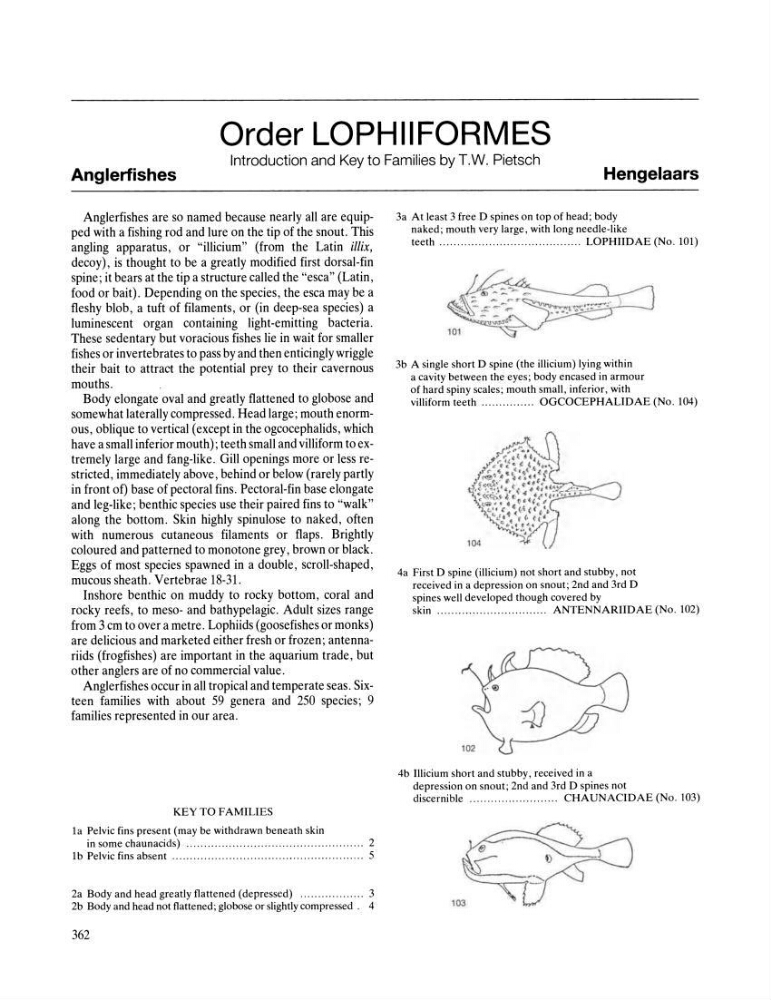
3a At least 3 free D spines on top of head; body
naked; mouth very large , with long needle-like
teeth ........................................ LOPHIIDAE (No. 101)
3b A single short D spine (the illicium) lying within
a cavity between the eyes; body encased in armour
of hard spiny scales; mouth small, inferior, with
villiform teeth ............... OGCOCEPHALIDAE (No. 104)
4a First D spine (illicium) not short and stubby, not
received in a depression on snout; 2nd and 3rd D
spines well developed though covered by
skin ............................... ANTENNARIIDAE (No. 102)
4b Illicium short and stubby, received in a
depression on snout ; 2nd and 3rd D spines not
discernible .......... .. ............. CHAUNACIDAE (No. 103)
Anglerfishes
Introduction and Key to Families by T.W. Pietsch
Hengelaars
Anglerfishes are so named because nearly all are equipped with a fishing rod and lure on the tip of the snout. This
angling apparatus, or "illicium" (from the Latin illix,
decoy), is thought to be a greatly modified first dorsal-fin
spine; it bears at the tip a structure called the "esca" (Latin,
food or bait). Depending on the species, the esca may be a
fleshy blob, a tuft of filaments, or (in deep-sea species) a
luminescent organ containing light-emitting bacteria.
These sedentary but voracious fishes lie in wait for smaller
fishes or invertebrates to pass by and then enticingly wriggle
their bait to attract the potential prey to their cavernous
mouths.
Body elongate oval and greatly flattened to globose and
somewhat laterally compressed. Head large; mouth enormous, oblique to vertical (except in the ogcocephalids, which
have a small inferior mouth); teeth small and villiform to extremely large and fang-like. Gill openings more or less restricted, immediately above, behind or below (rarely partly
in front of) base of pectoral fins. Pectoral-fin base elongate
and leg-like; benthic species use their paired fins to "walk"
along the bottom. Skin highly spinulose to naked, often
with numerous cutaneous filaments or flaps . Brightly
coloured and patterned to monotone grey, brown or black.
Eggs of most species spawned in a double, scroll-shaped,
mucous sheath. Vertebrae 18-31.
Inshore benthic on muddy to rocky bottom, coral and
rocky reefs, to meso- and bathypelagic. Adult sizes range
from 3 cm to over a metre. Lophiids (goosefishes or monks)
are delicious and marketed either fresh or frozen; antennariids (frogfishes) are important in the aquarium trade, but
other anglers are of no commercial value.
Anglerfishes occur in all tropical and temperate seas. Sixteen families with about 59 genera and 250 species; 9
families represented in our area.
KEY TO FAMILIES
la Pelvic fins present (may be withdrawn beneath skin
in some chaunacids) ............ ...................................... 2
Ib Pelvicfins absent ........ .. ............................................ 5
2a Body and head greatly flattened (depressed) .......... ........ 3
2b Body and head not flattened; globose or slightly compressed. 4
362
3a At least 3 free D spines on top of head; body
naked; mouth very large , with long needle-like
teeth ........................................ LOPHIIDAE (No. 101)
3b A single short D spine (the illicium) lying within
a cavity between the eyes; body encased in armour
of hard spiny scales; mouth small, inferior, with
villiform teeth ............... OGCOCEPHALIDAE (No. 104)
4a First D spine (illicium) not short and stubby, not
received in a depression on snout; 2nd and 3rd D
spines well developed though covered by
skin ............................... ANTENNARIIDAE (No. 102)
4b Illicium short and stubby, received in a
depression on snout ; 2nd and 3rd D spines not
discernible .......... .. ............. CHAUNACIDAE (No. 103)