

Genus Lycodonus Goode & Bean, 1883
Four species; 1 in our area.
94.2 Lycodonus vermiformis
Barnard, 1927
Lycodonus vermiformis Barnard, 1927: 873, PI. 35, Fig. 3 (off Cape
Point); Smith, SFSA No. 1027.
D + YzC 117-121; A + Yzc 108-115; P 13-15; GR 10-11; branchiostegal
rays 4; vertebrae 126-129. Head about 10. Gill slit ends ventrally at lower
edge of P base. Small rounded scales cover body and P base. LL absent.
Preserved coloration reported as yellowish brown, abdomen black, throat and gill cavities dark. Attains 27 cm.
Known from 4 specimens taken by bottom trawls off Cape
Point in 841 - 1152 m.
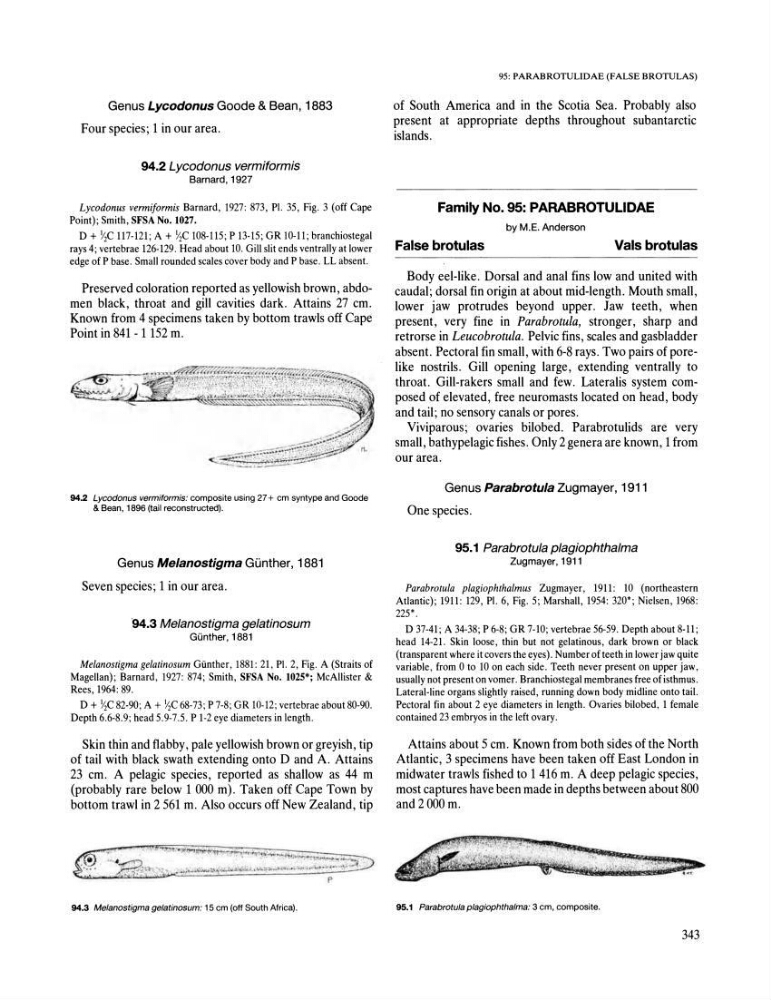
94.2 Lycodonus vermiformis: composite using 27 + cm syntype and Goode
& Bean, 1 896 (tail reconstructed).
Genus Melanostigma Gunther, 1881
Seven species; 1 in our area.
94.3 Melanostigma gelatinosum
Gunther, 1881
Melanostigma gelatinosum Gunther, 1881: 21, PI. 2, Fig. A (Straits of
Magellan); Barnard, 1927: 874; Smith, SFSA No. 1025*; McAllister &
Rees, 1964: 89.
D + Yzc 82-90; A + Yzc 68-73; P 7-8; GR 10-12; vertebrae about 80-90.
Depth 6.6-8.9; head 5.9-7.5. P 1-2 eye diameters in length.
Skin thin and flabby, pale yellowish brown or greyish, tip
of tail with black swath extending onto D and A. Attains
23 cm. A pelagic species, reported as shallow as 44 m
(probably rare below 1 000 m). Taken off Cape Town by
bottom trawl in 2 561 m. Also occurs off New Zealand, tip
94.3 Melanostigma gelatinosum: 15 cm (off South Africa).
95: PARABROTULIDAE (FALSE BROTULAS)
of South America and in the Scotia Sea. Probably also
present at appropriate depths throughout subantarctic
islands.
Family No. 95: PARABROTULIDAE
by M.E. Anderson
False brotulas
Vals brotulas
Body eel-like. Dorsal and anal fins low and united with
caudal; dorsal fin origin at about mid-length. Mouth small,
lower jaw protrudes beyond upper. Jaw teeth, when
present, very fine in Parabrotula, stronger, sharp and
retrorse in Leucobrotula. Pelvic fins, scales and gasbladder
absent. Pectoral fin small, with 6-8 rays. Two pairs of porelike nostrils. Gill opening large, extending ventrally to
throat. Gill-rakers small and few. Lateralis system composed of elevated, free neuromasts located on head, body
and tail; no sensory canals or pores.
Viviparous; ovaries bilobed. Parabrotulids are very
small, bathypelagic fishes. Only 2 genera are known, 1 from
our area.
Genus Parabrotula Zugmayer, 1911
One species.
95.1 Parabrotula plagiophthalma
Zugmayer, 1911
Parabrotula plagiophthalmus Zugmayer, 1911: 10 (northeastern
Atlantic); 1911: 129, PI. 6, Fig. 5; Marshall, 1954: 320*; Nielsen, 1968:
225*.
D 37-41; A 34-38; P 6-8; GR 7-10; vertebrae 56-59. Depth about 8-11;
head 14-21. Skin loose, thin but not gelatinous, dark brown or black
(transparent where it covers the eyes). Number ofteeth in lower jaw quite
variable, from 0 to 10 on each side. Teeth never present on upper jaw,
usually not present on vomer. Branchiostegal membranes free of isthmus.
Lateral-line organs slightly raised, running down body midline onto tail.
Pectoral fin about 2 eye diameters in length. Ovaries bilobed, 1 female
contained 23 embryos in the left ovary.
Attains about 5 cm. Known from both sides of the North
Atlantic, 3 specimens have been taken off East London in
midwater trawls fished to 1416 m. A deep pelagic species,
most captures have been made in depths between about 800
and 2000 m.
95.1 Parabrotula plagiophthalma: 3 cm, composite.
343
Four species; 1 in our area.
94.2 Lycodonus vermiformis
Barnard, 1927
Lycodonus vermiformis Barnard, 1927: 873, PI. 35, Fig. 3 (off Cape
Point); Smith, SFSA No. 1027.
D + YzC 117-121; A + Yzc 108-115; P 13-15; GR 10-11; branchiostegal
rays 4; vertebrae 126-129. Head about 10. Gill slit ends ventrally at lower
edge of P base. Small rounded scales cover body and P base. LL absent.
Preserved coloration reported as yellowish brown, abdomen black, throat and gill cavities dark. Attains 27 cm.
Known from 4 specimens taken by bottom trawls off Cape
Point in 841 - 1152 m.
94.2 Lycodonus vermiformis: composite using 27 + cm syntype and Goode
& Bean, 1 896 (tail reconstructed).
Genus Melanostigma Gunther, 1881
Seven species; 1 in our area.
94.3 Melanostigma gelatinosum
Gunther, 1881
Melanostigma gelatinosum Gunther, 1881: 21, PI. 2, Fig. A (Straits of
Magellan); Barnard, 1927: 874; Smith, SFSA No. 1025*; McAllister &
Rees, 1964: 89.
D + Yzc 82-90; A + Yzc 68-73; P 7-8; GR 10-12; vertebrae about 80-90.
Depth 6.6-8.9; head 5.9-7.5. P 1-2 eye diameters in length.
Skin thin and flabby, pale yellowish brown or greyish, tip
of tail with black swath extending onto D and A. Attains
23 cm. A pelagic species, reported as shallow as 44 m
(probably rare below 1 000 m). Taken off Cape Town by
bottom trawl in 2 561 m. Also occurs off New Zealand, tip
94.3 Melanostigma gelatinosum: 15 cm (off South Africa).
95: PARABROTULIDAE (FALSE BROTULAS)
of South America and in the Scotia Sea. Probably also
present at appropriate depths throughout subantarctic
islands.
Family No. 95: PARABROTULIDAE
by M.E. Anderson
False brotulas
Vals brotulas
Body eel-like. Dorsal and anal fins low and united with
caudal; dorsal fin origin at about mid-length. Mouth small,
lower jaw protrudes beyond upper. Jaw teeth, when
present, very fine in Parabrotula, stronger, sharp and
retrorse in Leucobrotula. Pelvic fins, scales and gasbladder
absent. Pectoral fin small, with 6-8 rays. Two pairs of porelike nostrils. Gill opening large, extending ventrally to
throat. Gill-rakers small and few. Lateralis system composed of elevated, free neuromasts located on head, body
and tail; no sensory canals or pores.
Viviparous; ovaries bilobed. Parabrotulids are very
small, bathypelagic fishes. Only 2 genera are known, 1 from
our area.
Genus Parabrotula Zugmayer, 1911
One species.
95.1 Parabrotula plagiophthalma
Zugmayer, 1911
Parabrotula plagiophthalmus Zugmayer, 1911: 10 (northeastern
Atlantic); 1911: 129, PI. 6, Fig. 5; Marshall, 1954: 320*; Nielsen, 1968:
225*.
D 37-41; A 34-38; P 6-8; GR 7-10; vertebrae 56-59. Depth about 8-11;
head 14-21. Skin loose, thin but not gelatinous, dark brown or black
(transparent where it covers the eyes). Number ofteeth in lower jaw quite
variable, from 0 to 10 on each side. Teeth never present on upper jaw,
usually not present on vomer. Branchiostegal membranes free of isthmus.
Lateral-line organs slightly raised, running down body midline onto tail.
Pectoral fin about 2 eye diameters in length. Ovaries bilobed, 1 female
contained 23 embryos in the left ovary.
Attains about 5 cm. Known from both sides of the North
Atlantic, 3 specimens have been taken off East London in
midwater trawls fished to 1416 m. A deep pelagic species,
most captures have been made in depths between about 800
and 2000 m.
95.1 Parabrotula plagiophthalma: 3 cm, composite.
343