

Order OPHIDIIFORMES
Body more or less elongate; scales small and cycloid or
absent. Dorsal and anal fins single, low, with long bases,
extending to and often joined with the caudal fin; dorsal and
anal fin pterygiophores more numerous than adjacent vertebrae; pelvic fins with 1 or 2 soft-rays or completely absent,
inserted well anterior to pectoral fin base in most species
(below pectoral base in a few species); fin spines absent (except for minute pelvic spines in some species). Two nostrils
on each side of head. Mouth large, the maxilla usually
reaching to or beyond vertical at rear edge of eye; gill openings unrestricted in all but a few species.
The classification of this order is unsettled. Rosen and
Patterson (1969) advocated inclusion in the Gadiformes.
Fraser (1972), McAllister (1968), Marshall and Cohen
(1973) and Cohen and Nielsen (1978) recognise the group as
a separate order. Ophidiiforms are primarily marine and
occupy a variety of habitats, from the intertidal region to
the greatest depths of the sea. Some species are of considerable economic importance, e.g. the kingklip, Genypterus
capensis. Cohen and Nielsen (1978) recognise 87 genera
divided into 4 families.
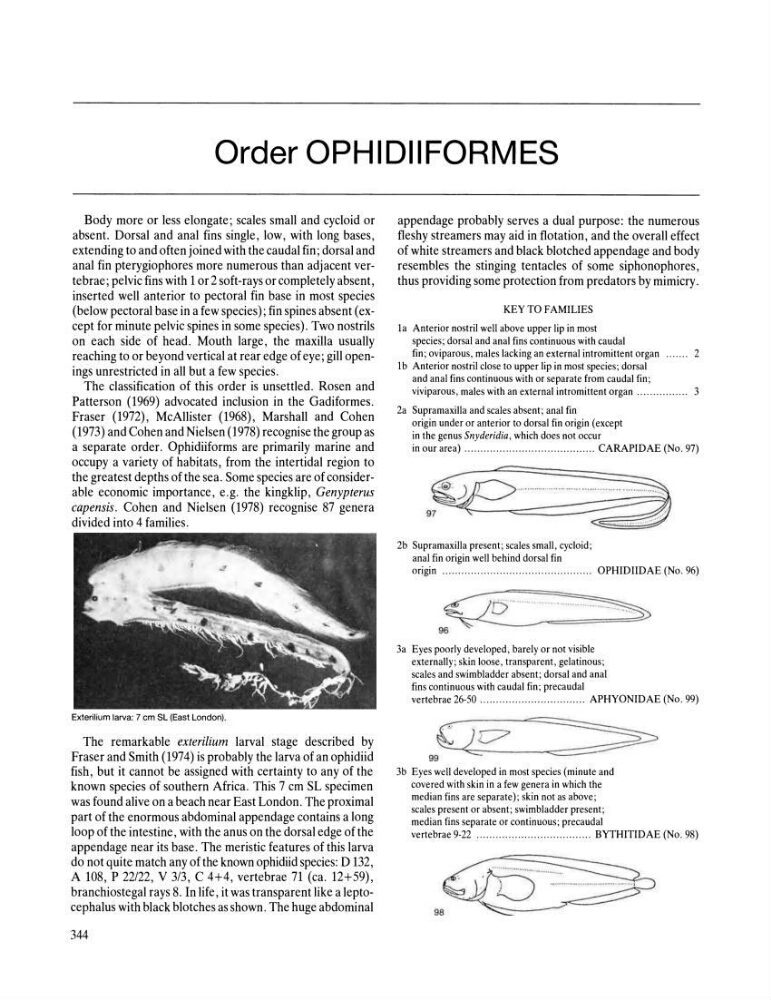
Exterilium larva: 7 em SL (East London).
The remarkable exterilium larval stage described by
Fraser and Smith (1974) is probably the larva of an ophidiid
fish, but it cannot be assigned with certainty to any of the
known species of southern Africa. This 7 cm SL specimen
was found alive on a beach near East London. The proximal
part of the enormous abdominal appendage contains a long
loop of the intestine, with the anus on the dorsal edge of the
appendage near its base. The meristic features of this larva
do not quite match any of the known ophidiid species: D 132,
A 108, P 22/22, V 3/3, C 4+4, vertebrae 71 (ca. 12+59),
branchiostegal rays 8. In life, it was transparent like a leptocephalus with black blotches as shown. The huge abdominal
344
appendage probably serves a dual purpose: the numerous
fleshy streamers may aid in flotation, and the overall effect
of white streamers and black blotched appendage and body
resembles the stinging tentacles of some siphonophores,
thus providing some protection from predators by mimicry.
KEY TO FAMILIES
1 a Anterior nostril well above upper lip in most
species; dorsal and anal fins continuous with caudal
fin; oviparous, males lacking an external intromittent organ ....... 2
1 b Anterior nostril close to upper lip in most species; dorsal
and anal fins continuous with or separate from caudal fin;
viviparous, males with an external intromittent organ ...... ..... ..... 3
2a Supramaxilla and scales absent; anal fin
origin under or anterior to dorsal fin origin (except
in the genus Snyderidia , which does not occur
in our area) ......................................... CARAPIDAE (No. 97)
€ . . . . . . . . . . . . . . . . . . . . . . . ~
~
/
... ~- " .- -.. ....... ...
2b Supramaxilla present; scales small, cycloid;
anal fin origin well behind dorsal fin
origin ...... .......... ............................... OPHIDIIDAE (No. 96)
~H" ~
96
3a Eyes poorly developed, barely or not visible
externally; skin loose, transparent, gelatinous;
scales and swimbladder absent; dorsal and anal
fins continuous with caudal fin; precaudal
vertebrae 26-50 ..... ............................ APHYONIDAE (No. 99)
QC7~
99
3b Eyes well developed in most species (minute and
covered with skin in a few genera in which the
median fins are separate) ; skin not as above;
scales present or absent ; swimbladder present;
median fins separate or continuous; precaudal
vertebrae 9-22 ........................... ......... BYTHITIDAE (No. 98)
Body more or less elongate; scales small and cycloid or
absent. Dorsal and anal fins single, low, with long bases,
extending to and often joined with the caudal fin; dorsal and
anal fin pterygiophores more numerous than adjacent vertebrae; pelvic fins with 1 or 2 soft-rays or completely absent,
inserted well anterior to pectoral fin base in most species
(below pectoral base in a few species); fin spines absent (except for minute pelvic spines in some species). Two nostrils
on each side of head. Mouth large, the maxilla usually
reaching to or beyond vertical at rear edge of eye; gill openings unrestricted in all but a few species.
The classification of this order is unsettled. Rosen and
Patterson (1969) advocated inclusion in the Gadiformes.
Fraser (1972), McAllister (1968), Marshall and Cohen
(1973) and Cohen and Nielsen (1978) recognise the group as
a separate order. Ophidiiforms are primarily marine and
occupy a variety of habitats, from the intertidal region to
the greatest depths of the sea. Some species are of considerable economic importance, e.g. the kingklip, Genypterus
capensis. Cohen and Nielsen (1978) recognise 87 genera
divided into 4 families.
Exterilium larva: 7 em SL (East London).
The remarkable exterilium larval stage described by
Fraser and Smith (1974) is probably the larva of an ophidiid
fish, but it cannot be assigned with certainty to any of the
known species of southern Africa. This 7 cm SL specimen
was found alive on a beach near East London. The proximal
part of the enormous abdominal appendage contains a long
loop of the intestine, with the anus on the dorsal edge of the
appendage near its base. The meristic features of this larva
do not quite match any of the known ophidiid species: D 132,
A 108, P 22/22, V 3/3, C 4+4, vertebrae 71 (ca. 12+59),
branchiostegal rays 8. In life, it was transparent like a leptocephalus with black blotches as shown. The huge abdominal
344
appendage probably serves a dual purpose: the numerous
fleshy streamers may aid in flotation, and the overall effect
of white streamers and black blotched appendage and body
resembles the stinging tentacles of some siphonophores,
thus providing some protection from predators by mimicry.
KEY TO FAMILIES
1 a Anterior nostril well above upper lip in most
species; dorsal and anal fins continuous with caudal
fin; oviparous, males lacking an external intromittent organ ....... 2
1 b Anterior nostril close to upper lip in most species; dorsal
and anal fins continuous with or separate from caudal fin;
viviparous, males with an external intromittent organ ...... ..... ..... 3
2a Supramaxilla and scales absent; anal fin
origin under or anterior to dorsal fin origin (except
in the genus Snyderidia , which does not occur
in our area) ......................................... CARAPIDAE (No. 97)
€ . . . . . . . . . . . . . . . . . . . . . . . ~
~
/
... ~- " .- -.. ....... ...
2b Supramaxilla present; scales small, cycloid;
anal fin origin well behind dorsal fin
origin ...... .......... ............................... OPHIDIIDAE (No. 96)
~H" ~
96
3a Eyes poorly developed, barely or not visible
externally; skin loose, transparent, gelatinous;
scales and swimbladder absent; dorsal and anal
fins continuous with caudal fin; precaudal
vertebrae 26-50 ..... ............................ APHYONIDAE (No. 99)
QC7~
99
3b Eyes well developed in most species (minute and
covered with skin in a few genera in which the
median fins are separate) ; skin not as above;
scales present or absent ; swimbladder present;
median fins separate or continuous; precaudal
vertebrae 9-22 ........................... ......... BYTHITIDAE (No. 98)