

Order ZOARCIFORMES
Body elongate; scales present or absent. Dorsal and anal
fins long, low and continuous with the small, pointed caudal
fin; dorsal and anal fin rays in a 111 relationship with adjacent vertebrae; pelvic fins present or absent. Swimbladder
absent. Vertebrae 56-150.
The relationships and classification of the fishes here assigned to this order are problematical. Gosline (1968,1971)
placed them in the perciform Suborder B1ennioidei; Rosen
and Patterson (1969) included them in the Gadiformes, but
Marshall and Cohen (1973) questioned their gadiform affinities . Two families are here recognised. The Parabrotulidae were first distinguished as a subfamily of the Zoarcidae by Nielsen (1968). M. E. Anderson, in his unpublished Ph.D. dissertation, has adduced evidence to relate
the zoarchids with the Perciformes, whereas the Parabrotulidae are perhaps derived from the ophidiiform
Aphyonidae (Anderson, personal communication).
KEY TO FAMILIES
1 a Single nostril on each side of head; small
or large sensory pores on head .. ............ . ZOARCIDAE (No . 94)
Ib Two nostrils on each side of head ;
no sensory canals or pores on
head ..... .... ....... ......... .. ... ... ... . PARABROTULIDAE (No . 95)
~ ... .. . . ::;;;;;;;v
Family No. 94: ZOARCIDAE
by M.E. Anderson
Eelpouts
Palingpuite
Body eel-like. Dorsal and anal fins long, low, united with
caudal. Mouth moderate, with small, conical teeth in jaws
and usually on vomer and palatine bones. Pelvic fins, when
present, rudimentary (except in 1 species), of 2 or 3 softrays, inserted on throat. Single pair of tubular nostrils. Gill
openings variably a small, pore-like slit to a broad, wide
opening not attached to isthmus. Gill-rakers generally small
and blunt, not numerous. Small or large sensory pores present on head; patterns usually characteristic for each
species. No gasbladder.
342
Generally small, deep-living bottom fishes of polar and
cold-temperate seas; some dwell in intertidal regions, a few
occur in brackish areas, especially in the Arctic. Two genera, Meianostigma and Lycodapus are mesopelagic or
bathypelagic in near-coastal waters and may associate for a
time with the bottom. Of some 225 species in the family,
only 3 have been captured in our area.
KEY TO GENERA
la No V or scales; gill slit a small, pore-like opening
above P; skin thin, transparent, gelatinous ... ........ ... Melanostigma
Ib V and scales present; gill slit large, extending to at least
lower margin of P; skin dark and firm .................................... 2
2a Bony scutes running along bases of D and A;
body depth 22-25 in SL; sensory pores in head
large and prominent ...... ............... ........................ Lycodonus
2b No bony scutes along bases of D and A; body
depth 8-15 in SL; sensory pores in head small,
obscure ..... ... ............. ... .... ............... ... ...... .............. L ycodes
Genus Lycodes Reinhardt, 1835
About 50 species; 1 in our area.
94.1 Lycodes agulhensis
Andriashev, 1959
Lycodes frigidus (non Collette): Barnard , 1927: 872; Smith, SFSA No.
1026*. Lycodes agulhensis Andriashev, 1959: 465, Figs. 1-3 (Agulhas
Bank); Golovan, 1978: 226.
D + \-2C 111; A + \-2C 100; P 22; GR 2+ 11; branchiostegal rays 6; vertebrae 21 +94. Head about 20-23. Gill slit ends ventrally anterior to V
origin. Body with small rounded scales, extending onto P base and D and
A. LL with ventral branch from upper edge of gill slit descending gradually to A base and continuing to tail tip; branch running along midbody
from above A origin nearly to tail tip.
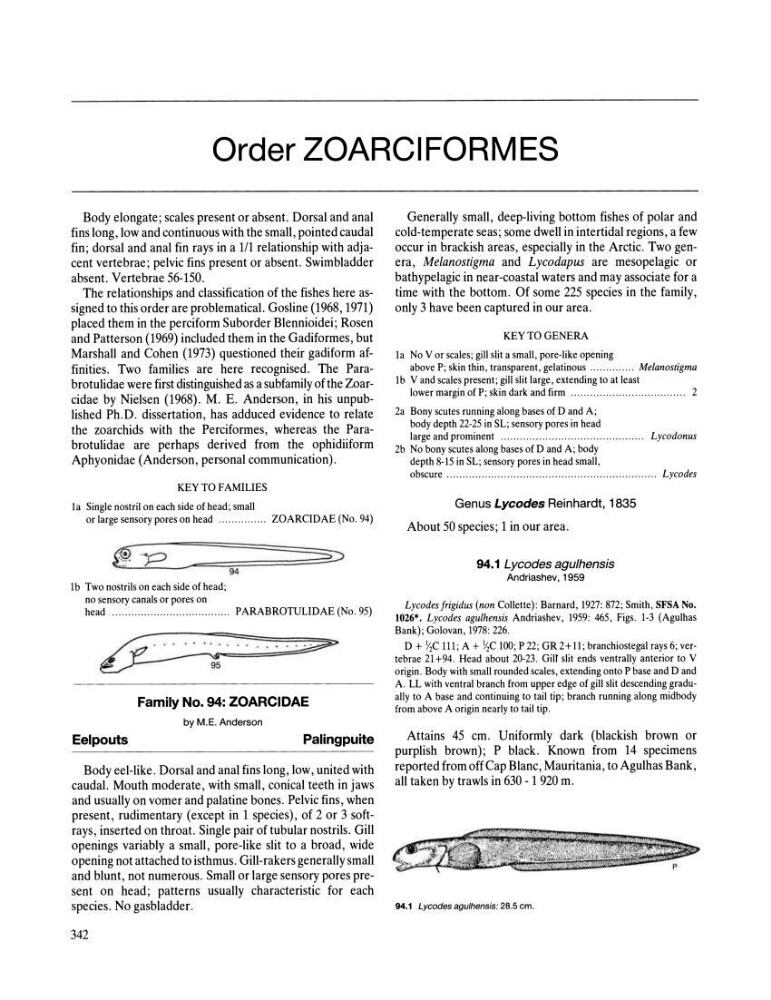
Attains 45 cm. Uniformly dark (blackish brown or
purplish brown); P black. Known from 14 specimens
reported from off Cap Blanc, Mauritania, to Agulhas Bank,
all taken by trawls in 630 - 1 920 m.
94.1 Lycodes agulhensis: 28.5 em.
Body elongate; scales present or absent. Dorsal and anal
fins long, low and continuous with the small, pointed caudal
fin; dorsal and anal fin rays in a 111 relationship with adjacent vertebrae; pelvic fins present or absent. Swimbladder
absent. Vertebrae 56-150.
The relationships and classification of the fishes here assigned to this order are problematical. Gosline (1968,1971)
placed them in the perciform Suborder B1ennioidei; Rosen
and Patterson (1969) included them in the Gadiformes, but
Marshall and Cohen (1973) questioned their gadiform affinities . Two families are here recognised. The Parabrotulidae were first distinguished as a subfamily of the Zoarcidae by Nielsen (1968). M. E. Anderson, in his unpublished Ph.D. dissertation, has adduced evidence to relate
the zoarchids with the Perciformes, whereas the Parabrotulidae are perhaps derived from the ophidiiform
Aphyonidae (Anderson, personal communication).
KEY TO FAMILIES
1 a Single nostril on each side of head; small
or large sensory pores on head .. ............ . ZOARCIDAE (No . 94)
Ib Two nostrils on each side of head ;
no sensory canals or pores on
head ..... .... ....... ......... .. ... ... ... . PARABROTULIDAE (No . 95)
~ ... .. . . ::;;;;;;;v
Family No. 94: ZOARCIDAE
by M.E. Anderson
Eelpouts
Palingpuite
Body eel-like. Dorsal and anal fins long, low, united with
caudal. Mouth moderate, with small, conical teeth in jaws
and usually on vomer and palatine bones. Pelvic fins, when
present, rudimentary (except in 1 species), of 2 or 3 softrays, inserted on throat. Single pair of tubular nostrils. Gill
openings variably a small, pore-like slit to a broad, wide
opening not attached to isthmus. Gill-rakers generally small
and blunt, not numerous. Small or large sensory pores present on head; patterns usually characteristic for each
species. No gasbladder.
342
Generally small, deep-living bottom fishes of polar and
cold-temperate seas; some dwell in intertidal regions, a few
occur in brackish areas, especially in the Arctic. Two genera, Meianostigma and Lycodapus are mesopelagic or
bathypelagic in near-coastal waters and may associate for a
time with the bottom. Of some 225 species in the family,
only 3 have been captured in our area.
KEY TO GENERA
la No V or scales; gill slit a small, pore-like opening
above P; skin thin, transparent, gelatinous ... ........ ... Melanostigma
Ib V and scales present; gill slit large, extending to at least
lower margin of P; skin dark and firm .................................... 2
2a Bony scutes running along bases of D and A;
body depth 22-25 in SL; sensory pores in head
large and prominent ...... ............... ........................ Lycodonus
2b No bony scutes along bases of D and A; body
depth 8-15 in SL; sensory pores in head small,
obscure ..... ... ............. ... .... ............... ... ...... .............. L ycodes
Genus Lycodes Reinhardt, 1835
About 50 species; 1 in our area.
94.1 Lycodes agulhensis
Andriashev, 1959
Lycodes frigidus (non Collette): Barnard , 1927: 872; Smith, SFSA No.
1026*. Lycodes agulhensis Andriashev, 1959: 465, Figs. 1-3 (Agulhas
Bank); Golovan, 1978: 226.
D + \-2C 111; A + \-2C 100; P 22; GR 2+ 11; branchiostegal rays 6; vertebrae 21 +94. Head about 20-23. Gill slit ends ventrally anterior to V
origin. Body with small rounded scales, extending onto P base and D and
A. LL with ventral branch from upper edge of gill slit descending gradually to A base and continuing to tail tip; branch running along midbody
from above A origin nearly to tail tip.
Attains 45 cm. Uniformly dark (blackish brown or
purplish brown); P black. Known from 14 specimens
reported from off Cap Blanc, Mauritania, to Agulhas Bank,
all taken by trawls in 630 - 1 920 m.
94.1 Lycodes agulhensis: 28.5 em.