

92: BREGMACEROTIDAE (CODLETS)
Brownish above, silvery below. Attains 6.7 cm. A circumtropical, oceanic species found in our area from off the
south Cape and Natal coasts to the Mozambique Channel.
92.2 Bregmaceros macclellandii
Thompson, 1840
Bregmaceros macclellandii Thompson, 1840: 184, Fig. (Ganges Delta);
Smith, SFSA No. 251*; Grindley & Penrith, 1965: 283; d'Ancona &
Cavinato, 1965: 66*; Kotthaus, 1969: 45* Hulley, 1972: 228; Belyanina,
1974: 45*.
D 1 +56-65; A 58-69; P 17-24; vertebrae 52-58; LS 70-90; TS 13-15; body
depth 6.5-9.2; D origin opposite A origin.
Brownish above with speckling, silvery below; cheek and
lower head silver. Attains 9.6 cm. Circumtropical, but not
known from eastern Pacific; in our area from the Cape eastwards, frequently thrown up sometimes still alive on
beaches of the southeast Cape coast, especially after stormy
weather.
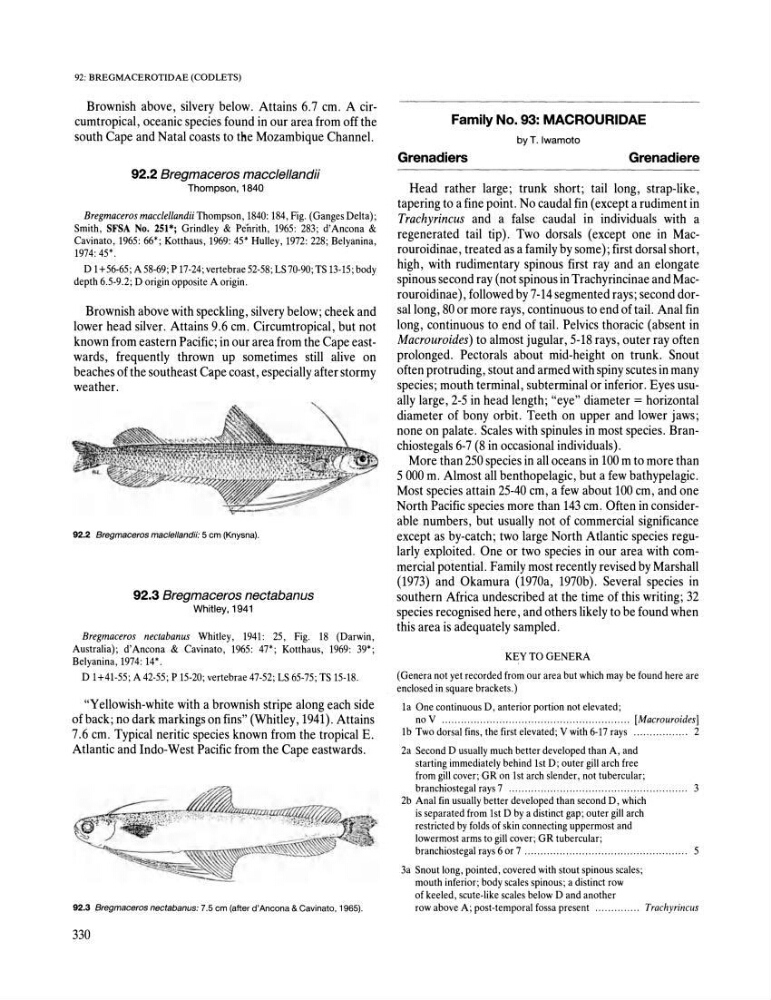
92.2 Bregmaeeros maelel/andii: 5 em (Knysna).
92.3 Bregmaceros nectabanus
Whitley, 1941
Bregmaceros nectabanus Whitley, 1941: 25, Fig. 18 (Darwin,
Australia); d'Ancona & Cavinato, 1965: 47*; Kotthaus, 1969: 39*;
Belyanina, 1974: 14*.
D 1 +41-55; A 42-55; P 15-20; vertebrae 47-52; LS 65-75; TS 15-18.
"Yellowish-white with a brownish stripe along each side
of back; no dark markings on fins" (Whitley, 1941). Attains
7.6 cm. Typical neritic species known from the tropical E.
Atlantic and Indo-West Pacific from the Cape eastwards.
92.3 Bregmaeeros neetabanus: 7.5 em (after d'Aneona & Cavinato, 1965).
330
Family No. 93: MACROURIDAE
by T. Iwamoto
Grenadiers
Grenadiere
Head rather large; trunk short; tail long, strap-like,
tapering to a fine point. No caudal fin (except a rudiment in
Trachyrincus and a false caudal in individuals with a
regenerated tail tip). Two dorsals (except one in Macrouroidinae, treated as a family by some); first dorsal short,
high, with rudimentary spinous first ray and an elongate
spinous second ray (not spinous in Trachyrincinae and Macrouroidinae), followed by 7-14 segmented rays; second dorsal long, 80 or more rays, continuous to end of tail. Anal fin
long, continuous to end of tail. Pelvics thoracic (absent in
Macrouroides) to almost jugular, 5-18 rays, outer ray often
prolonged. Pectorals about mid-height on trunk. Snout
often protruding, stout and armed with spiny scutes in many
species; mouth terminal, subterminal or inferior. Eyes usually large, 2-5 in head length; "eye" diameter = horizontal
diameter of bony orbit. Teeth on upper and lower jaws;
none on palate. Scales with spinules in most species. Branchiostegals 6-7 (8 in occasional individuals).
More than 250 species in all oceans in 100 m to more than
5 000 m. Almost all benthopelagic, but a few bathypelagic.
Most species attain 25-40 cm, a few about 100 cm, and one
North Pacific species more than 143 cm. Often in considerable numbers, but usually not of commercial significance
except as by-catch; two large North Atlantic species regularly exploited. One or two species in our area with commercial potential. Family most recently revised by Marshall
(1973) and Okamura (1970a, 1970b). Several species in
southern Africa undescribed at the time of this writing; 32
species recognised here, and others likely to be found when
this area is adequately sampled.
KEY TO GENERA
(Genera not yet recorded from our area but which may be found here are
enclosed in square brackets.)
1a One continuous D, anterior portion not elevated;
no V ........................................................... [Macrouroides]
1b Two dorsal fins, the first elevated; V with 6-17 rays ................. 2
2a Second D usually much better developed than A, and
starting immediately behind 1st D; outer gill arch free
from gill cover; GR on 1st arch slender, not tubercular;
branchiostegal rays 7 ........................................................ 3
2b Anal fin usually better developed than second D, which
is separated from 1st D by a distinct gap; outer gill arch
restricted by folds of skin connecting uppermost and
lowermost arms to gill cover; GR tubercular;
branchiostegal rays 6 or 7 ................................................... 5
3a Snout long, pointed, covered with stout spinous scales;
mouth inferior; body scales spinous; a distinct row
of keeled, scute-like scales below D and another
row above A; post-temporal fossa present .............. Trachyrincus
Brownish above, silvery below. Attains 6.7 cm. A circumtropical, oceanic species found in our area from off the
south Cape and Natal coasts to the Mozambique Channel.
92.2 Bregmaceros macclellandii
Thompson, 1840
Bregmaceros macclellandii Thompson, 1840: 184, Fig. (Ganges Delta);
Smith, SFSA No. 251*; Grindley & Penrith, 1965: 283; d'Ancona &
Cavinato, 1965: 66*; Kotthaus, 1969: 45* Hulley, 1972: 228; Belyanina,
1974: 45*.
D 1 +56-65; A 58-69; P 17-24; vertebrae 52-58; LS 70-90; TS 13-15; body
depth 6.5-9.2; D origin opposite A origin.
Brownish above with speckling, silvery below; cheek and
lower head silver. Attains 9.6 cm. Circumtropical, but not
known from eastern Pacific; in our area from the Cape eastwards, frequently thrown up sometimes still alive on
beaches of the southeast Cape coast, especially after stormy
weather.
92.2 Bregmaeeros maelel/andii: 5 em (Knysna).
92.3 Bregmaceros nectabanus
Whitley, 1941
Bregmaceros nectabanus Whitley, 1941: 25, Fig. 18 (Darwin,
Australia); d'Ancona & Cavinato, 1965: 47*; Kotthaus, 1969: 39*;
Belyanina, 1974: 14*.
D 1 +41-55; A 42-55; P 15-20; vertebrae 47-52; LS 65-75; TS 15-18.
"Yellowish-white with a brownish stripe along each side
of back; no dark markings on fins" (Whitley, 1941). Attains
7.6 cm. Typical neritic species known from the tropical E.
Atlantic and Indo-West Pacific from the Cape eastwards.
92.3 Bregmaeeros neetabanus: 7.5 em (after d'Aneona & Cavinato, 1965).
330
Family No. 93: MACROURIDAE
by T. Iwamoto
Grenadiers
Grenadiere
Head rather large; trunk short; tail long, strap-like,
tapering to a fine point. No caudal fin (except a rudiment in
Trachyrincus and a false caudal in individuals with a
regenerated tail tip). Two dorsals (except one in Macrouroidinae, treated as a family by some); first dorsal short,
high, with rudimentary spinous first ray and an elongate
spinous second ray (not spinous in Trachyrincinae and Macrouroidinae), followed by 7-14 segmented rays; second dorsal long, 80 or more rays, continuous to end of tail. Anal fin
long, continuous to end of tail. Pelvics thoracic (absent in
Macrouroides) to almost jugular, 5-18 rays, outer ray often
prolonged. Pectorals about mid-height on trunk. Snout
often protruding, stout and armed with spiny scutes in many
species; mouth terminal, subterminal or inferior. Eyes usually large, 2-5 in head length; "eye" diameter = horizontal
diameter of bony orbit. Teeth on upper and lower jaws;
none on palate. Scales with spinules in most species. Branchiostegals 6-7 (8 in occasional individuals).
More than 250 species in all oceans in 100 m to more than
5 000 m. Almost all benthopelagic, but a few bathypelagic.
Most species attain 25-40 cm, a few about 100 cm, and one
North Pacific species more than 143 cm. Often in considerable numbers, but usually not of commercial significance
except as by-catch; two large North Atlantic species regularly exploited. One or two species in our area with commercial potential. Family most recently revised by Marshall
(1973) and Okamura (1970a, 1970b). Several species in
southern Africa undescribed at the time of this writing; 32
species recognised here, and others likely to be found when
this area is adequately sampled.
KEY TO GENERA
(Genera not yet recorded from our area but which may be found here are
enclosed in square brackets.)
1a One continuous D, anterior portion not elevated;
no V ........................................................... [Macrouroides]
1b Two dorsal fins, the first elevated; V with 6-17 rays ................. 2
2a Second D usually much better developed than A, and
starting immediately behind 1st D; outer gill arch free
from gill cover; GR on 1st arch slender, not tubercular;
branchiostegal rays 7 ........................................................ 3
2b Anal fin usually better developed than second D, which
is separated from 1st D by a distinct gap; outer gill arch
restricted by folds of skin connecting uppermost and
lowermost arms to gill cover; GR tubercular;
branchiostegal rays 6 or 7 ................................................... 5
3a Snout long, pointed, covered with stout spinous scales;
mouth inferior; body scales spinous; a distinct row
of keeled, scute-like scales below D and another
row above A; post-temporal fossa present .............. Trachyrincus