

91.1 Melanonus gracilis
Gunther, 1878
Melanonus gracilis Giinther, 1878: 19 (Antarctic, "Challenger" stn.
156); Norman, 1930: 340; Smith, SFSA No. 261*; Hulley, 1972: 228.
Melanosoma acutecaudatum Gilchrist, 1904: 104 (off Cape Peninsula).
D 67-72; A 52-54; P 11-13. Deepest part of body in larger specimens
usually posterior to D origin.
Colour pale to dark brown. Reaches about 20 cm. Circumantarctic, generally south of Subtropical Convergence.
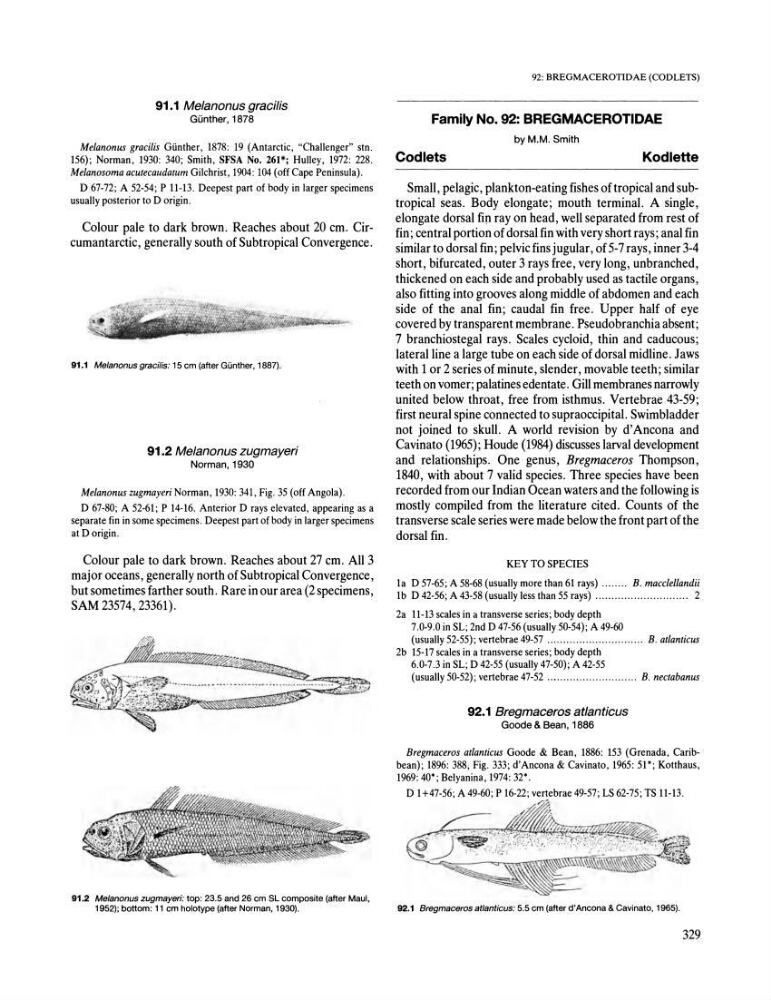
91.1 Me/anonus gracilis: 15 em (after Gunther, 1887).
91.2 Melanonus zugmayeri
Norman, 1930
Melanonus zugmayeri Norman, 1930: 341, Fig. 35 (off Angola).
D 67-80; A 52-61; P 14-16. Anterior D rays elevated, appearing as a
separate fin in some specimens. Deepest part of body in larger specimens
at D origin.
Colour pale to dark brown. Reaches about 27 cm. All 3
major oceans, generally north of Subtropical Convergence,
but sometimes farther south. Rare in our area (2 specimens,
SAM 23574, 23361).
91.2 Melanonus zugmayeri: top: 23.5 and 26 em SL composite (after Maul,
1952); bottom: 11 em holotype (after Norman, 1930).
92: BREGMACEROTIDAE (CODLETS)
Family No. 92: BREGMACEROTIDAE
by M.M. Smith
Codlets
Kodlette
Small, pelagic, plankton-eating fishes of tropical and subtropical seas. Body elongate; mouth terminal. A single,
elongate dorsal fin rayon head, well separated from rest of
fin; central portion of dorsal fin with very short rays; anal fin
similar to dorsal fin; pelvic fins jugular, of 5-7 rays, inner 3-4
short, bifurcated, outer 3 rays free, very long, unbranched,
thickened on each side and probably used as tactile organs,
also fitting into grooves along middle of abdomen and each
side of the anal fin; caudal fin free. Upper half of eye
covered by transparent membrane. Pseudo branchia absent;
7 branchiostegal rays. Scales cycloid, thin and caducous;
lateral line a large tube on each side of dorsal midline. Jaws
with 1 or 2 series of minute, slender, movable teeth; similar
teeth on vomer; palatines edentate. Gill membranes narrowly
united below throat, free from isthmus. Vertebrae 43-59;
first neural spine connected to supraoccipital. Swim bladder
not joined to skull. A world revision by d'Ancona and
Cavinato (1965); Houde (1984) discusses larval development
and relationships. One genus, Bregmaceros Thompson,
1840, with about 7 valid species. Three species have been
recorded from our Indian Ocean waters and the following is
mostly compiled from the literature cited. Counts of the
transverse scale series were made below the front part of the
dorsal fin.
KEY TO SPECIES
la D 57-65; A 58-68 (usually more than 61 rays) ........ B. macclellandii
Ib D 42-56; A 43-58 (usually less than 55 rays) ............................. 2
2a 11-13 scales in a transverse series; body depth
7.0-9.0 in SL; 2nd D 47-56 (usually 50-54); A 49-60
(usually 52-55); vertebrae 49-57 .............................. B. atlanticus
2b 15-17 scales in a transverse series; body depth
6.0-7.3 in SL; D 42-55 (usually 47-50); A 42-55
(usually 50-52); vertebrae 47-52 ............................ B. nectabanus
92.1 Bregmaceros at/anticus
Goode & Bean, 1886
Bregmaceros atlanticus Goode & Bean, 1886: 153 (Grenada, Caribbean); 1896: 388, Fig. 333; d'Ancona & Cavinato, 1965: 51*; Kotthaus,
1969: 40*; Belyanina, 1974: 32*.
D 1 +47-56; A 49-60; P 16-22; vertebrae 49-57; LS 62-75; TS 11-13.
92.1 Bregmaceros at/anticus: 5.5 em (after d' Ancona & Cavinato, 1965).
329
Gunther, 1878
Melanonus gracilis Giinther, 1878: 19 (Antarctic, "Challenger" stn.
156); Norman, 1930: 340; Smith, SFSA No. 261*; Hulley, 1972: 228.
Melanosoma acutecaudatum Gilchrist, 1904: 104 (off Cape Peninsula).
D 67-72; A 52-54; P 11-13. Deepest part of body in larger specimens
usually posterior to D origin.
Colour pale to dark brown. Reaches about 20 cm. Circumantarctic, generally south of Subtropical Convergence.
91.1 Me/anonus gracilis: 15 em (after Gunther, 1887).
91.2 Melanonus zugmayeri
Norman, 1930
Melanonus zugmayeri Norman, 1930: 341, Fig. 35 (off Angola).
D 67-80; A 52-61; P 14-16. Anterior D rays elevated, appearing as a
separate fin in some specimens. Deepest part of body in larger specimens
at D origin.
Colour pale to dark brown. Reaches about 27 cm. All 3
major oceans, generally north of Subtropical Convergence,
but sometimes farther south. Rare in our area (2 specimens,
SAM 23574, 23361).
91.2 Melanonus zugmayeri: top: 23.5 and 26 em SL composite (after Maul,
1952); bottom: 11 em holotype (after Norman, 1930).
92: BREGMACEROTIDAE (CODLETS)
Family No. 92: BREGMACEROTIDAE
by M.M. Smith
Codlets
Kodlette
Small, pelagic, plankton-eating fishes of tropical and subtropical seas. Body elongate; mouth terminal. A single,
elongate dorsal fin rayon head, well separated from rest of
fin; central portion of dorsal fin with very short rays; anal fin
similar to dorsal fin; pelvic fins jugular, of 5-7 rays, inner 3-4
short, bifurcated, outer 3 rays free, very long, unbranched,
thickened on each side and probably used as tactile organs,
also fitting into grooves along middle of abdomen and each
side of the anal fin; caudal fin free. Upper half of eye
covered by transparent membrane. Pseudo branchia absent;
7 branchiostegal rays. Scales cycloid, thin and caducous;
lateral line a large tube on each side of dorsal midline. Jaws
with 1 or 2 series of minute, slender, movable teeth; similar
teeth on vomer; palatines edentate. Gill membranes narrowly
united below throat, free from isthmus. Vertebrae 43-59;
first neural spine connected to supraoccipital. Swim bladder
not joined to skull. A world revision by d'Ancona and
Cavinato (1965); Houde (1984) discusses larval development
and relationships. One genus, Bregmaceros Thompson,
1840, with about 7 valid species. Three species have been
recorded from our Indian Ocean waters and the following is
mostly compiled from the literature cited. Counts of the
transverse scale series were made below the front part of the
dorsal fin.
KEY TO SPECIES
la D 57-65; A 58-68 (usually more than 61 rays) ........ B. macclellandii
Ib D 42-56; A 43-58 (usually less than 55 rays) ............................. 2
2a 11-13 scales in a transverse series; body depth
7.0-9.0 in SL; 2nd D 47-56 (usually 50-54); A 49-60
(usually 52-55); vertebrae 49-57 .............................. B. atlanticus
2b 15-17 scales in a transverse series; body depth
6.0-7.3 in SL; D 42-55 (usually 47-50); A 42-55
(usually 50-52); vertebrae 47-52 ............................ B. nectabanus
92.1 Bregmaceros at/anticus
Goode & Bean, 1886
Bregmaceros atlanticus Goode & Bean, 1886: 153 (Grenada, Caribbean); 1896: 388, Fig. 333; d'Ancona & Cavinato, 1965: 51*; Kotthaus,
1969: 40*; Belyanina, 1974: 32*.
D 1 +47-56; A 49-60; P 16-22; vertebrae 49-57; LS 62-75; TS 11-13.
92.1 Bregmaceros at/anticus: 5.5 em (after d' Ancona & Cavinato, 1965).
329