

3a Gill membranes separate ........................................... Lyconus
3b Gill membranes united ........................................... Lyconodes
Genus Lyconodes Gilchrist, 1922
This problematic genus is based on a single species
described from one specimen, now lost, caught west of the
Cape.
89.1 Lyconodes argenteus
Gilchrist, 1922
Lyconodes argenteus Gilchrist, 1922: 59, PI. 10 Fig. 1 (west of Cape of
Good Hope); Smith, SFSA No. 246*.
D about 110; A more than 94; PIS; V 9. No C. Large teeth in both jaws.
Gill membranes united, free from isthmus.
Darker above, pale below. Attains 45 mm. Probably
pelagic.
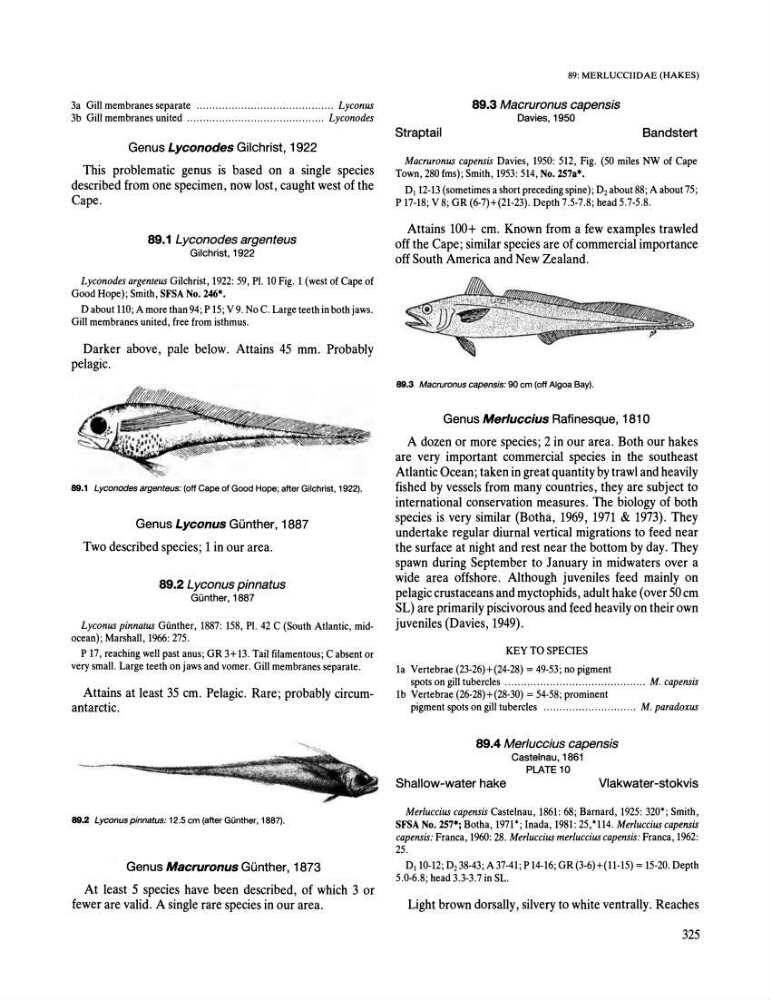
89.1 Lyconodes argenteus: (off Cape of Good Hope; after Gilchrist, 1922).
Genus Lyconus Gunther, 1887
Two described species; 1 in our area.
89.2 Lyconus pinnatus
GOnther, 1887
Lyconus pinnatus Gunther, 1887: 158, PI. 42 C (South Atlantic, midocean); Marshall, 1966: 275.
P 17, reaching well past anus; GR 3+ 13. Tail filamentous; C absent or
very small. Large teeth on jaws and vomer. Gill membranes separate.
Attains at least 35 cm. Pelagic. Rare; probably circumantarctic.
89.2 Lyconus pinnatus: 12.5 em (after Gunther, 1887).
Genus Macruronus Gunther, 1873
At least 5 species have been described, of which 3 or
fewer are valid. A single rare species in our area.
89: MERLUCCIIDAE (HAKES)
Straptail
89.3 Macruronus capensis
Davies, 1950
Bandstert
Macruronus capensis Davies, 1950: 512, Fig. (50 miles NW of Cape
Town, 280 fms); Smith, 1953: 514, No. 257a*.
Dt 12-13 (sometimes a short preceding spine); D2 about 88; A about 75;
P 17-18; V 8; GR (6-7) + (21-23). Depth 7.5-7.8; head 5.7-5.8.
Attains 100+ cm. Known from a few examples trawled
off the Cape; similar species are of commercial importance
off South America and New Zealand.
89.3 Macruronus capensis: 90 em (off Algoa Bay).
Genus Merluccius Rafinesque, 1810
A dozen or more species; 2 in our area. Both our hakes
are very important commercial species in the southeast
Atlantic Ocean; taken in great quantity by trawl and heavily
fished by vessels from many countries, they are subject to
international conservation measures. The biology of both
species is very similar (Botha, 1969, 1971 & 1973). They
undertake regular diurnal vertical migrations to feed near
the surface at night and rest near the bottom by day. They
spawn during September to January in midwaters over a
wide area offshore. Although juveniles feed mainly on
pelagic crustaceans and myctophids, adult hake (over 50 cm
SL) are primarily piscivorous and feed heavily on their own
juveniles (Davies, 1949).
KEY TO SPECIES
la Vertebrae (23-26)+{24-28) = 49-53; no pigment
spots on gill tubercles ............................................ M. capensis
Ib Vertebrae (26-28) + (28-30) = 54-58; prominent
pigment spots on gill tubercles .. ........ ... .. ... .. ..... .... M. paradoxus
89.4 Merluccius capensis
Castelnau, 1861
PLATE 10
Shallow-water hake
Vlakwater-stokvis
Merluccius capensis Castelnau, 1861: 68; Barnard, 1925: 320*; Smith,
SFSA No. 257*; Botha, 1971*; Inada, 1981: 25, *114. Merluccius capensis
capensis: Franca, 1960: 28. Merluccius merluccius capensis: Franca, 1962:
25.
Dt 1O-12; D238-43; A37-41; P 14-16; GR (3-6)+{11-15) = 15-20. Depth
5.0-6.8; head 3.3-3.7 in SL.
Light brown dorsally, silvery to white ventrally. Reaches
325
3b Gill membranes united ........................................... Lyconodes
Genus Lyconodes Gilchrist, 1922
This problematic genus is based on a single species
described from one specimen, now lost, caught west of the
Cape.
89.1 Lyconodes argenteus
Gilchrist, 1922
Lyconodes argenteus Gilchrist, 1922: 59, PI. 10 Fig. 1 (west of Cape of
Good Hope); Smith, SFSA No. 246*.
D about 110; A more than 94; PIS; V 9. No C. Large teeth in both jaws.
Gill membranes united, free from isthmus.
Darker above, pale below. Attains 45 mm. Probably
pelagic.
89.1 Lyconodes argenteus: (off Cape of Good Hope; after Gilchrist, 1922).
Genus Lyconus Gunther, 1887
Two described species; 1 in our area.
89.2 Lyconus pinnatus
GOnther, 1887
Lyconus pinnatus Gunther, 1887: 158, PI. 42 C (South Atlantic, midocean); Marshall, 1966: 275.
P 17, reaching well past anus; GR 3+ 13. Tail filamentous; C absent or
very small. Large teeth on jaws and vomer. Gill membranes separate.
Attains at least 35 cm. Pelagic. Rare; probably circumantarctic.
89.2 Lyconus pinnatus: 12.5 em (after Gunther, 1887).
Genus Macruronus Gunther, 1873
At least 5 species have been described, of which 3 or
fewer are valid. A single rare species in our area.
89: MERLUCCIIDAE (HAKES)
Straptail
89.3 Macruronus capensis
Davies, 1950
Bandstert
Macruronus capensis Davies, 1950: 512, Fig. (50 miles NW of Cape
Town, 280 fms); Smith, 1953: 514, No. 257a*.
Dt 12-13 (sometimes a short preceding spine); D2 about 88; A about 75;
P 17-18; V 8; GR (6-7) + (21-23). Depth 7.5-7.8; head 5.7-5.8.
Attains 100+ cm. Known from a few examples trawled
off the Cape; similar species are of commercial importance
off South America and New Zealand.
89.3 Macruronus capensis: 90 em (off Algoa Bay).
Genus Merluccius Rafinesque, 1810
A dozen or more species; 2 in our area. Both our hakes
are very important commercial species in the southeast
Atlantic Ocean; taken in great quantity by trawl and heavily
fished by vessels from many countries, they are subject to
international conservation measures. The biology of both
species is very similar (Botha, 1969, 1971 & 1973). They
undertake regular diurnal vertical migrations to feed near
the surface at night and rest near the bottom by day. They
spawn during September to January in midwaters over a
wide area offshore. Although juveniles feed mainly on
pelagic crustaceans and myctophids, adult hake (over 50 cm
SL) are primarily piscivorous and feed heavily on their own
juveniles (Davies, 1949).
KEY TO SPECIES
la Vertebrae (23-26)+{24-28) = 49-53; no pigment
spots on gill tubercles ............................................ M. capensis
Ib Vertebrae (26-28) + (28-30) = 54-58; prominent
pigment spots on gill tubercles .. ........ ... .. ... .. ..... .... M. paradoxus
89.4 Merluccius capensis
Castelnau, 1861
PLATE 10
Shallow-water hake
Vlakwater-stokvis
Merluccius capensis Castelnau, 1861: 68; Barnard, 1925: 320*; Smith,
SFSA No. 257*; Botha, 1971*; Inada, 1981: 25, *114. Merluccius capensis
capensis: Franca, 1960: 28. Merluccius merluccius capensis: Franca, 1962:
25.
Dt 1O-12; D238-43; A37-41; P 14-16; GR (3-6)+{11-15) = 15-20. Depth
5.0-6.8; head 3.3-3.7 in SL.
Light brown dorsally, silvery to white ventrally. Reaches
325