

89: MERLUCCIIDAE (HAKES)
140 cm. Caught from about lOoS along west African coast,
over the Agulhas Bank and to Port Elizabeth and East London; possibly to Natal and Valdivia Bank. On the shelf and
slope to depths of 400 m.
89.5 Merluccius paradoxus
Franca, 1960
Deepwater hake
Diepwater-stokvis
Merluccius capensis paradoxus Franca, 1960: 28 (southwest Africa).
Merluccius merluccius paradoxus: Franca, 1962: 25. Merluccius
paradoxus: Botha, 1971*; Inada, 1981: 28,*118.
D11O-12; D2 38-42; A 38-41; P 14-16; GR (4-7)+(13-18) = 18-23. Depth
4.9-6.4; head 3.5-3.8 in SL.
Dark brown dorsally, silvery to white ventrally. Attains
115 cm. Caught from Cape Frio at 18°S (Namibia) to East
London. Generally in deeper water (200 -1 000 m) than M.
capensis, but the depth distributions of the two overlap.
External appearance exactly like M. capensis.
Family No. 90: MORIDAE
by D.M. Cohen
Deepsea cods
Diepsee-kabeljoue
Body tapering to a narrow caudal peduncle. Two or 3
dorsal fins; caudal fin separate from dorsal and anal. No fin
spines. Scales cycloid. No V-shaped ridge on top of head.
First neural spine fused to skull; last vertebra supporting
more than 1 hypural bone. Swimbladder attached to rear of
skull on each side.
Benthopelagic at depths ranging from outer continental
shelf to the abyss. Reaching nearly a metre in length, but
mostly smaller; several species fished commercially in New
Zealand and Australia. About 15 genera and 55-60 species;
5 genera and 9 species in our area.
KEY TO GENERA
la Snout pointed, depressed, projecting slightly in
front of upper jaw; A margin indented ........................ Antimora
Ib Snout rounded; mouth terminal ........................................... 2
2a Three dorsal fins; D2 base shorter than A base ........ Tripterophycis
2b Two dorsal fins; D2 base longer than A base ............................ 3
3a Light organ a small, dark, scaleless patch on
belly .................................................................. Physiculus
3a
3b No light organ on belly ........................................... ............ 4
4a Two long rays in each V; several small basal
rays also present in V of some species ...................... Laemonema
4b V not as above ....................................................... Lepidion
326
Genus Antimora Gunther, 1878
Six nominal species, of which only 2 are valid; 1 in our
area. Recently reviewed by Small (1981).
90.1 Antimora rostrata
Gunther, 1878
Haloporphyrus (Antimora) rostratus Giinther, 1878: 18 (between Cape
of Good Hope and Kerguelen, and east of Rio Plata mouth). Antimora
australis Barnard, 1925: 499 (off Cape Point); Smith, SFSA No. 253.
Antimora rostrata: Iwamoto, 1975: 7* (in part); Small, 1981: 347*.
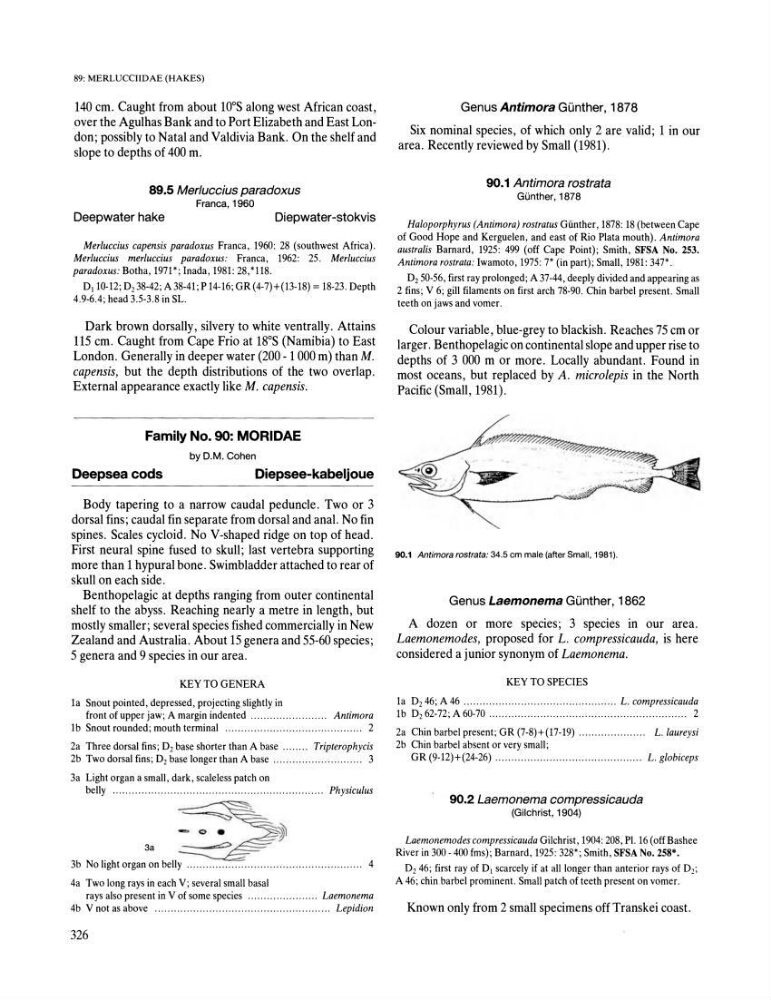
D2 50-56, first ray prolonged; A 37-44, deeply divided and appearing as
2 fins; V 6; gill filaments on first arch 78-90. Chin barbel present. Small
teeth on jaws and vomer.
Colour variable, blue-grey to blackish. Reaches 75 cm or
larger. Benthopelagic on continental slope and upper rise to
depths of 3 000 m or more. Locally abundant. Found in
most oceans, but replaced by A. microiepis in the North
Pacific (Small, 1981).
90.1 Antimora rostrata: 34.5 em male (after Small, 1981).
Genus Laemonema Gunther, 1862
A dozen or more species; 3 species in our area.
Laemonemodes, proposed for L. compressicauda, is here
considered a junior synonym of Laemonema.
KEY TO SPECIES
la D2 46; A 46 ................................................ L. compressicauda
Ib D2 62-72; A 60-70 .................................. .. .......................... 2
2a Chin barbel present; GR (7-8)+(17-19) ..................... L. laureysi
2b Chin barbel absent or very small;
GR (9-12)+(24-26) ............................... .... ........... L. globiceps
90.2 Laemonema compressicauda
(Gilchrist, 1904)
Laemonemodes compressicauda Gilchrist, 1904: 208, PI. 16 (off Bashee
River in 300 - 400 fms); Barnard, 1925: 328*; Smith, SFSA No. 258*.
D2 46; first ray of D1 scarcely if at all longer than anterior rays of D2;
A 46; chin barbel prominent. Small patch of teeth present on vomer.
Known only from 2 small specimens off Transkei coast.
140 cm. Caught from about lOoS along west African coast,
over the Agulhas Bank and to Port Elizabeth and East London; possibly to Natal and Valdivia Bank. On the shelf and
slope to depths of 400 m.
89.5 Merluccius paradoxus
Franca, 1960
Deepwater hake
Diepwater-stokvis
Merluccius capensis paradoxus Franca, 1960: 28 (southwest Africa).
Merluccius merluccius paradoxus: Franca, 1962: 25. Merluccius
paradoxus: Botha, 1971*; Inada, 1981: 28,*118.
D11O-12; D2 38-42; A 38-41; P 14-16; GR (4-7)+(13-18) = 18-23. Depth
4.9-6.4; head 3.5-3.8 in SL.
Dark brown dorsally, silvery to white ventrally. Attains
115 cm. Caught from Cape Frio at 18°S (Namibia) to East
London. Generally in deeper water (200 -1 000 m) than M.
capensis, but the depth distributions of the two overlap.
External appearance exactly like M. capensis.
Family No. 90: MORIDAE
by D.M. Cohen
Deepsea cods
Diepsee-kabeljoue
Body tapering to a narrow caudal peduncle. Two or 3
dorsal fins; caudal fin separate from dorsal and anal. No fin
spines. Scales cycloid. No V-shaped ridge on top of head.
First neural spine fused to skull; last vertebra supporting
more than 1 hypural bone. Swimbladder attached to rear of
skull on each side.
Benthopelagic at depths ranging from outer continental
shelf to the abyss. Reaching nearly a metre in length, but
mostly smaller; several species fished commercially in New
Zealand and Australia. About 15 genera and 55-60 species;
5 genera and 9 species in our area.
KEY TO GENERA
la Snout pointed, depressed, projecting slightly in
front of upper jaw; A margin indented ........................ Antimora
Ib Snout rounded; mouth terminal ........................................... 2
2a Three dorsal fins; D2 base shorter than A base ........ Tripterophycis
2b Two dorsal fins; D2 base longer than A base ............................ 3
3a Light organ a small, dark, scaleless patch on
belly .................................................................. Physiculus
3a
3b No light organ on belly ........................................... ............ 4
4a Two long rays in each V; several small basal
rays also present in V of some species ...................... Laemonema
4b V not as above ....................................................... Lepidion
326
Genus Antimora Gunther, 1878
Six nominal species, of which only 2 are valid; 1 in our
area. Recently reviewed by Small (1981).
90.1 Antimora rostrata
Gunther, 1878
Haloporphyrus (Antimora) rostratus Giinther, 1878: 18 (between Cape
of Good Hope and Kerguelen, and east of Rio Plata mouth). Antimora
australis Barnard, 1925: 499 (off Cape Point); Smith, SFSA No. 253.
Antimora rostrata: Iwamoto, 1975: 7* (in part); Small, 1981: 347*.
D2 50-56, first ray prolonged; A 37-44, deeply divided and appearing as
2 fins; V 6; gill filaments on first arch 78-90. Chin barbel present. Small
teeth on jaws and vomer.
Colour variable, blue-grey to blackish. Reaches 75 cm or
larger. Benthopelagic on continental slope and upper rise to
depths of 3 000 m or more. Locally abundant. Found in
most oceans, but replaced by A. microiepis in the North
Pacific (Small, 1981).
90.1 Antimora rostrata: 34.5 em male (after Small, 1981).
Genus Laemonema Gunther, 1862
A dozen or more species; 3 species in our area.
Laemonemodes, proposed for L. compressicauda, is here
considered a junior synonym of Laemonema.
KEY TO SPECIES
la D2 46; A 46 ................................................ L. compressicauda
Ib D2 62-72; A 60-70 .................................. .. .......................... 2
2a Chin barbel present; GR (7-8)+(17-19) ..................... L. laureysi
2b Chin barbel absent or very small;
GR (9-12)+(24-26) ............................... .... ........... L. globiceps
90.2 Laemonema compressicauda
(Gilchrist, 1904)
Laemonemodes compressicauda Gilchrist, 1904: 208, PI. 16 (off Bashee
River in 300 - 400 fms); Barnard, 1925: 328*; Smith, SFSA No. 258*.
D2 46; first ray of D1 scarcely if at all longer than anterior rays of D2;
A 46; chin barbel prominent. Small patch of teeth present on vomer.
Known only from 2 small specimens off Transkei coast.