

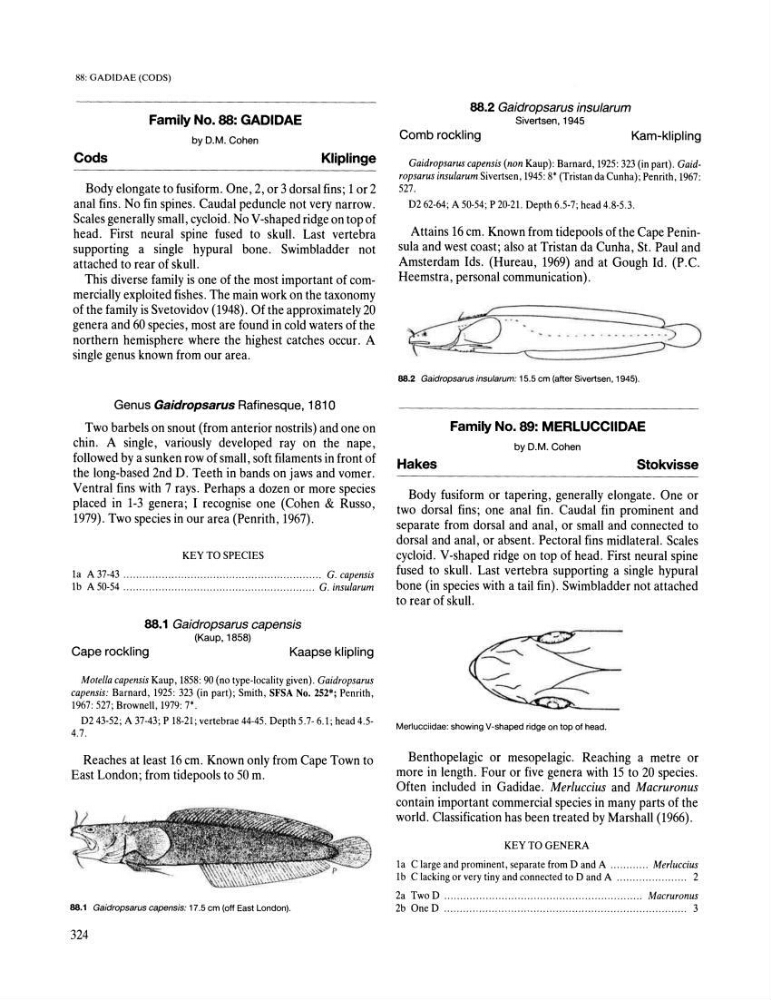
88: GADIDAE (COOS)
Cods
Family No. 88: GADIDAE
by D.M. Cohen
Kliplinge
Body elongate to fusiform. One, 2, or 3 dorsal fins; 1 or 2
anal fins. No fin spines. Caudal peduncle not very narrow.
Scales generally small, cycloid. No V-shaped ridge on top of
head. First neural spine fused to skull. Last vertebra
supporting a single hypural bone. Swimbladder not
attached to rear of skull.
This diverse family is one of the most important of commercially exploited fishes. The main work on the taxonomy
of the family is Svetovidov (1948). Of the approximately 20
genera and 60 species, most are found in cold waters of the
northern hemisphere where the highest catches occur. A
single genus known from our area.
Genus Gaidropsarus Rafinesque, 1810
Two barbels on snout (from anterior nostrils) and one on
chin. A single, variously developed rayon the nape,
followed by a sunken row of small, soft filaments in front of
the long-based 2nd D. Teeth in bands on jaws and vomer.
Ventral fins with 7 rays. Perhaps a dozen or more species
placed in 1-3 genera; I recognise one (Cohen & Russo,
1979). Two species in our area (Penrith, 1967).
KEY TO SPECIES
la A 37-43 .. ...... ... ... .... .... .... ........ ........ .... ...... .......... G. capensis
Ib A 50-54 ...... ... ..... ...... .. ....................... .... ........... G. insularum
88.1 Gaidropsarus capensis
(Kaup, 1858)
Cape rockling
Kaapse klipling
Motella capensis Kaup, 1858: 90 (no type-locality given). Gaidropsarus
capensis: Barnard, 1925: 323 (in part); Smith, SFSA No. 252*; Penrith,
1967: 527; Brownell, 1979: 7*.
0243-52; A 37-43; P 18-21; vertebrae 44-45. Depth 5.7- 6.1; head 4.54.7.
Reaches at least 16 cm. Known only from Cape Town to
East London; from tidepools to 50 m.
88.1 Gaidropsarus capensis: 17.5 em (off East London).
324
88.2 Gaidropsarus insularum
Sivertsen, 1945
Comb rockling
Kam-klipling
Gaidropsarus capensis (non Kaup): Barnard, 1925: 323 (in part) . Gaidropsarus insularum Sivertsen, 1945: 8* (Tristan da Cunha); Penrith, 1967:
527.
0262-64; A 50-54; P 20-21. Depth 6.5-7; head 4.8-5.3.
Attains 16 cm. Known from tidepools ofthe Cape Peninsula and west coast; also at Tristan da Cunha, St. Paul and
Amsterdam Ids. (Hureau, 1969) and at Gough Id. (P.e.
Heemstra, personal communication).
88.2 Gaidropsarus insularum: 15.5 em (after Sivertsen, 1945).
Hakes
Family No. 89: MERLUCCIIDAE
by D.M. Cohen
Stokvisse
Body fusiform or tapering, generally elongate. One or
two dorsal fins; one anal fin. Caudal fin prominent and
separate from dorsal and anal, or small and connected to
dorsal and anal, or absent. Pectoral fins midlateral. Scales
cycloid. V-shaped ridge on top of head. First neural spine
fused to skull. Last vertebra supporting a single hypural
bone (in species with a tail fin). Swimbladder not attached
to rear of skull.
Merlueeiidae: showing V-shaped ridge on top of head.
Benthopelagic or mesopelagic. Reaching a metre or
more in length. Four or five genera with 15 to 20 species.
Often included in Gadidae. Merluccius and Macruronus
contain important commercial species in many parts of the
world. Classification has been treated by Marshall (1966).
KEY TO GENERA
la C large and prominent, separate from D and A ............ Merluccius
Ib C lacking or very tiny and connected to D and A ...................... 2
2a Two 0 ........................... ............... .................... Macruronus
2b One 0 .............. .. ... ... ... ................................................... 3
Cods
Family No. 88: GADIDAE
by D.M. Cohen
Kliplinge
Body elongate to fusiform. One, 2, or 3 dorsal fins; 1 or 2
anal fins. No fin spines. Caudal peduncle not very narrow.
Scales generally small, cycloid. No V-shaped ridge on top of
head. First neural spine fused to skull. Last vertebra
supporting a single hypural bone. Swimbladder not
attached to rear of skull.
This diverse family is one of the most important of commercially exploited fishes. The main work on the taxonomy
of the family is Svetovidov (1948). Of the approximately 20
genera and 60 species, most are found in cold waters of the
northern hemisphere where the highest catches occur. A
single genus known from our area.
Genus Gaidropsarus Rafinesque, 1810
Two barbels on snout (from anterior nostrils) and one on
chin. A single, variously developed rayon the nape,
followed by a sunken row of small, soft filaments in front of
the long-based 2nd D. Teeth in bands on jaws and vomer.
Ventral fins with 7 rays. Perhaps a dozen or more species
placed in 1-3 genera; I recognise one (Cohen & Russo,
1979). Two species in our area (Penrith, 1967).
KEY TO SPECIES
la A 37-43 .. ...... ... ... .... .... .... ........ ........ .... ...... .......... G. capensis
Ib A 50-54 ...... ... ..... ...... .. ....................... .... ........... G. insularum
88.1 Gaidropsarus capensis
(Kaup, 1858)
Cape rockling
Kaapse klipling
Motella capensis Kaup, 1858: 90 (no type-locality given). Gaidropsarus
capensis: Barnard, 1925: 323 (in part); Smith, SFSA No. 252*; Penrith,
1967: 527; Brownell, 1979: 7*.
0243-52; A 37-43; P 18-21; vertebrae 44-45. Depth 5.7- 6.1; head 4.54.7.
Reaches at least 16 cm. Known only from Cape Town to
East London; from tidepools to 50 m.
88.1 Gaidropsarus capensis: 17.5 em (off East London).
324
88.2 Gaidropsarus insularum
Sivertsen, 1945
Comb rockling
Kam-klipling
Gaidropsarus capensis (non Kaup): Barnard, 1925: 323 (in part) . Gaidropsarus insularum Sivertsen, 1945: 8* (Tristan da Cunha); Penrith, 1967:
527.
0262-64; A 50-54; P 20-21. Depth 6.5-7; head 4.8-5.3.
Attains 16 cm. Known from tidepools ofthe Cape Peninsula and west coast; also at Tristan da Cunha, St. Paul and
Amsterdam Ids. (Hureau, 1969) and at Gough Id. (P.e.
Heemstra, personal communication).
88.2 Gaidropsarus insularum: 15.5 em (after Sivertsen, 1945).
Hakes
Family No. 89: MERLUCCIIDAE
by D.M. Cohen
Stokvisse
Body fusiform or tapering, generally elongate. One or
two dorsal fins; one anal fin. Caudal fin prominent and
separate from dorsal and anal, or small and connected to
dorsal and anal, or absent. Pectoral fins midlateral. Scales
cycloid. V-shaped ridge on top of head. First neural spine
fused to skull. Last vertebra supporting a single hypural
bone (in species with a tail fin). Swimbladder not attached
to rear of skull.
Merlueeiidae: showing V-shaped ridge on top of head.
Benthopelagic or mesopelagic. Reaching a metre or
more in length. Four or five genera with 15 to 20 species.
Often included in Gadidae. Merluccius and Macruronus
contain important commercial species in many parts of the
world. Classification has been treated by Marshall (1966).
KEY TO GENERA
la C large and prominent, separate from D and A ............ Merluccius
Ib C lacking or very tiny and connected to D and A ...................... 2
2a Two 0 ........................... ............... .................... Macruronus
2b One 0 .............. .. ... ... ... ................................................... 3