

Order GADIFORMES
Pelvic fins jugular to thoracic (absent in Macrouroides,
which is not yet reported from our area); fin spines absent
(except for macrourids, in which the first 2 dorsal fin rays
are usually spinous); pectoral fins lateral; caudal fin reduced or absent in some species; dorsal and anal fin bases
elongate, extending along most of the back and ventral part
of the tail; dorsal and anal fin rays (and pterygiophores)
more numerous than adjace.nt vertebrae; no adipose fin.
Scales cycloid, but covered with spinules in most macrourids. Gills 4, with a slit behind the 4th gill. Swimbladder
euphysoclistous, generally well developed (but reduced in a
few genera). Two nostrils on each side of the head.
Gadiforms are primarily marine benthopelagic or
bathypelagic fishes of worldwide distribution. The families
Gadidae and Merlucciidae include species of great
economic importance (e.g. cod, haddock, pollock, ling,
hake, etc.). Eight families, of which 6 are represented in our
area.
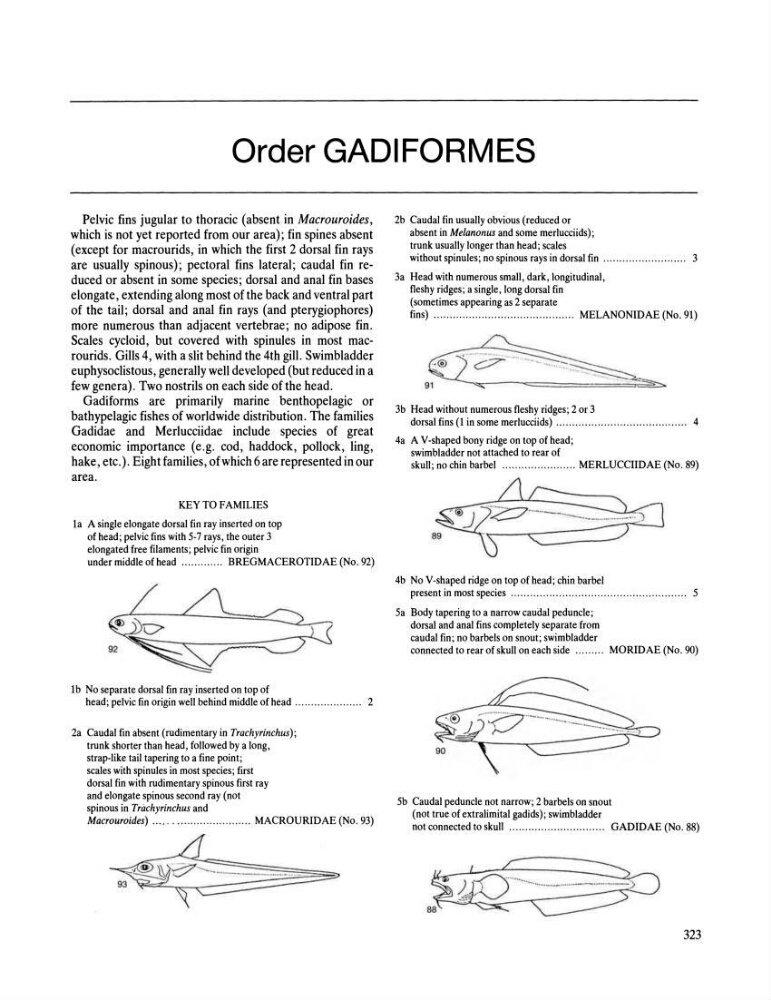
KEY TO FAMILIES
la A single elongate dorsal fin ray inserted on top
of head; pelvic fins with 5-7 rays, the outer 3
elongated free filaments; pelvic fin origin
under middle of head ............. BREGMACEROTIDAE (No. 92)
Ib No separate dorsal fin ray inserted on top of
head; pelvic fin origin well behind middle of head..................... 2
2a Caudal fin absent (rudimentary in Trachyrinchus);
trunk shorter than head, followed by a long,
strap-like tail tapering to a fine point;
scales with spinules in most species; first
dorsal fin with rudimentary spinous first ray
and elongate spinous second ray (not
spinous in Trilchyrinchus and
Macrouroides) ...................... ....... MACROURIDAE (No. 93)
2b Caudal fin usually obvious (reduced or
absent in Melanonus and some merlucciids);
trunk usually longer than head; scales
without spinules; no spinous rays in dorsal fin ................ ... ....... 3
3a Head with numerous small, dark, longitudinal,
fleshy ridges; a single, long dorsal fin
(sometimes appearing as 2 separate
fins) ............................................ MELANONIDAE (No. 91)
3b Head without numerous fleshy ridges; 2 or 3
dorsal fins (1 in some merlucciids) .... .... ............ .......... ..... ... ... 4
4a A V-shaped bony ridge on top of head;
swimbladder not attached to rear of
skull; no chin barbel ....................... MERLUCCIIDAE (No. 89)
4b No V-shaped ridge on top of head; chin barbel
present in most species ....................................................... 5
5a Body tapering to a narrow caudal peduncle;
dorsal and anal fins completely separate from
caudal fin; no barbels on snout; swimbladder
connected to rear of skull on each side ......... MORIDAE (No. 90)
5b Caudal peduncle not narrow; 2 barbels on snout
(not true of extralimital gadids); swimbladder
not connected to skull ..... ......... .......... ...... GADIDAE (No. 88)
323
Pelvic fins jugular to thoracic (absent in Macrouroides,
which is not yet reported from our area); fin spines absent
(except for macrourids, in which the first 2 dorsal fin rays
are usually spinous); pectoral fins lateral; caudal fin reduced or absent in some species; dorsal and anal fin bases
elongate, extending along most of the back and ventral part
of the tail; dorsal and anal fin rays (and pterygiophores)
more numerous than adjace.nt vertebrae; no adipose fin.
Scales cycloid, but covered with spinules in most macrourids. Gills 4, with a slit behind the 4th gill. Swimbladder
euphysoclistous, generally well developed (but reduced in a
few genera). Two nostrils on each side of the head.
Gadiforms are primarily marine benthopelagic or
bathypelagic fishes of worldwide distribution. The families
Gadidae and Merlucciidae include species of great
economic importance (e.g. cod, haddock, pollock, ling,
hake, etc.). Eight families, of which 6 are represented in our
area.
KEY TO FAMILIES
la A single elongate dorsal fin ray inserted on top
of head; pelvic fins with 5-7 rays, the outer 3
elongated free filaments; pelvic fin origin
under middle of head ............. BREGMACEROTIDAE (No. 92)
Ib No separate dorsal fin ray inserted on top of
head; pelvic fin origin well behind middle of head..................... 2
2a Caudal fin absent (rudimentary in Trachyrinchus);
trunk shorter than head, followed by a long,
strap-like tail tapering to a fine point;
scales with spinules in most species; first
dorsal fin with rudimentary spinous first ray
and elongate spinous second ray (not
spinous in Trilchyrinchus and
Macrouroides) ...................... ....... MACROURIDAE (No. 93)
2b Caudal fin usually obvious (reduced or
absent in Melanonus and some merlucciids);
trunk usually longer than head; scales
without spinules; no spinous rays in dorsal fin ................ ... ....... 3
3a Head with numerous small, dark, longitudinal,
fleshy ridges; a single, long dorsal fin
(sometimes appearing as 2 separate
fins) ............................................ MELANONIDAE (No. 91)
3b Head without numerous fleshy ridges; 2 or 3
dorsal fins (1 in some merlucciids) .... .... ............ .......... ..... ... ... 4
4a A V-shaped bony ridge on top of head;
swimbladder not attached to rear of
skull; no chin barbel ....................... MERLUCCIIDAE (No. 89)
4b No V-shaped ridge on top of head; chin barbel
present in most species ....................................................... 5
5a Body tapering to a narrow caudal peduncle;
dorsal and anal fins completely separate from
caudal fin; no barbels on snout; swimbladder
connected to rear of skull on each side ......... MORIDAE (No. 90)
5b Caudal peduncle not narrow; 2 barbels on snout
(not true of extralimital gadids); swimbladder
not connected to skull ..... ......... .......... ...... GADIDAE (No. 88)
323