

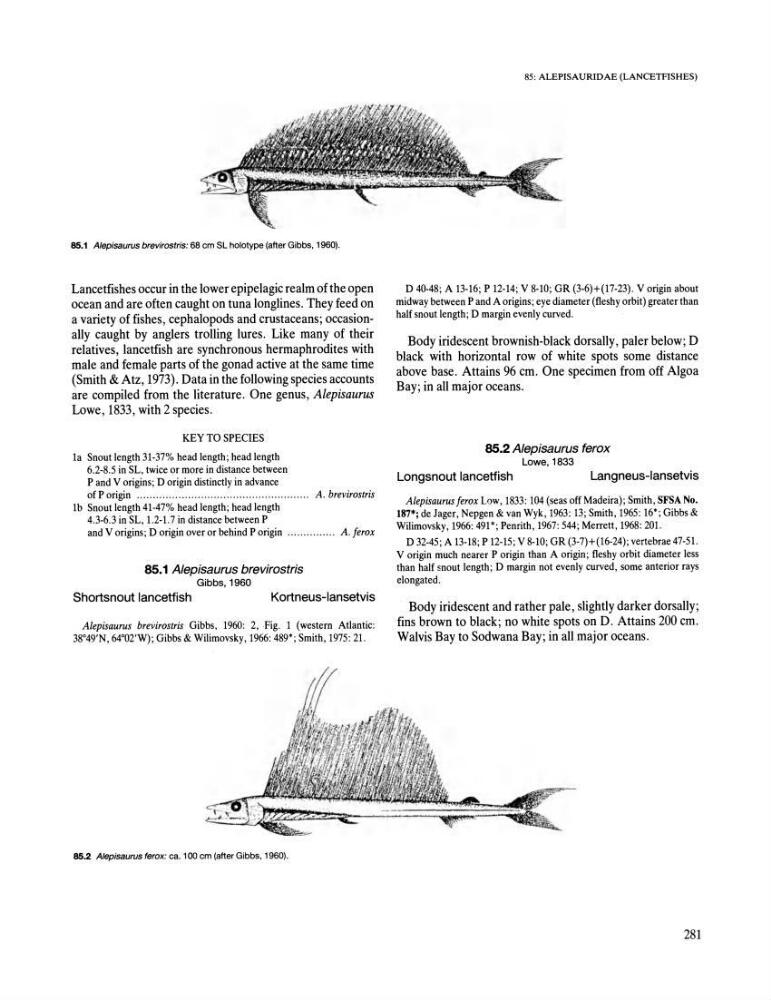
85.1 Alepisaurus brevirostris: 68 em SL holotype (after Gibbs, 1960).
Lancetfishes occur in the lower epipelagic realm of the open
ocean and are often caught on tuna longlines. They feed on
a variety of fishes, cephalopods and crustaceans; occasionally caught by anglers trolling lures. Like many of their
relatives, lancetfish are synchronous hermaphrodites with
male and female parts of the gonad active at the same time
(Smith & Atz, 1973). Data in the following species accounts
are compiled from the literature. One genus, Alepisaurus
Lowe, 1833, with 2 species.
KEY TO SPECIES
la Snout length 31·37% head length; head length
6.2-8.5 in SL, twice or more in distance between
P and V origins; D origin distinctly in advance
of P origin ........... .... .... ... ............. ...... ......... .. .. A. brevirostris
Ib Snout length 41-47% head length ; head length
4.3-6.3 in SL, 1.2-1.7 in distance between P
and V origins; D origin over or behind P origin .......... ..... A. ferox
85.1 Alepisaurus brevirostris
Gibbs, 1960
Shortsnout lancetfish
Kortneus-Iansetvis
Alepisaurus brevirostris Gibbs, 1960: 2, Fig. 1 (western Atlantic:
38°49'N, 64°02'W) ; Gibbs & Wilimovsky, 1966: 489*; Smith, 1975: 21.
85.2 Alepisaurus ferox: ea. 100 em (after Gibbs, 1960).
85: ALEPISAURIDAE (LANCETFISHES)
D 40-48; A 13-16; P 12-14; V 8-10; GR (3-6)+(17-23). V origin about
midway between P and A origins; eye diameter (fleshy orbit) greater than
half snout length; D margin evenly curved.
Body iridescent brownish-black dorsally, paler below; D
black with horizontal row of white spots some distance
above base. Attains 96 cm. One specimen from off Algoa
Bay; in all major oceans.
85.2 Alepisaurus ferox
Lowe, 1833
Longsnout lancetfish
Langneus-Iansetvis
Alepisaurus ferox Low, 1833: 104 (seas off Madeira); Smith, SFSA No.
187*; de Jager, Nepgen & van Wyk, 1963: 13; Smith, 1965: 16*; Gibbs &
Wilimovsky, 1966: 491*; Penrith, 1967: 544; Merrett, 1968: 201.
D 32-45; A 13-18; P 12-15; V 8-10; GR (3-7)+(16-24); vertebrae 47-51.
V origin much nearer P origin than A origin ; fleshy orbit diameter less
than half snout length; D margin not evenly curved, some anterior rays
elongated.
Body iridescent and rather pale, slightly darker dorsally;
fins brown to black; no white spots on D. Attains 200 cm.
Walvis Bay to Sodwana Bay; in all major oceans.
281
Lancetfishes occur in the lower epipelagic realm of the open
ocean and are often caught on tuna longlines. They feed on
a variety of fishes, cephalopods and crustaceans; occasionally caught by anglers trolling lures. Like many of their
relatives, lancetfish are synchronous hermaphrodites with
male and female parts of the gonad active at the same time
(Smith & Atz, 1973). Data in the following species accounts
are compiled from the literature. One genus, Alepisaurus
Lowe, 1833, with 2 species.
KEY TO SPECIES
la Snout length 31·37% head length; head length
6.2-8.5 in SL, twice or more in distance between
P and V origins; D origin distinctly in advance
of P origin ........... .... .... ... ............. ...... ......... .. .. A. brevirostris
Ib Snout length 41-47% head length ; head length
4.3-6.3 in SL, 1.2-1.7 in distance between P
and V origins; D origin over or behind P origin .......... ..... A. ferox
85.1 Alepisaurus brevirostris
Gibbs, 1960
Shortsnout lancetfish
Kortneus-Iansetvis
Alepisaurus brevirostris Gibbs, 1960: 2, Fig. 1 (western Atlantic:
38°49'N, 64°02'W) ; Gibbs & Wilimovsky, 1966: 489*; Smith, 1975: 21.
85.2 Alepisaurus ferox: ea. 100 em (after Gibbs, 1960).
85: ALEPISAURIDAE (LANCETFISHES)
D 40-48; A 13-16; P 12-14; V 8-10; GR (3-6)+(17-23). V origin about
midway between P and A origins; eye diameter (fleshy orbit) greater than
half snout length; D margin evenly curved.
Body iridescent brownish-black dorsally, paler below; D
black with horizontal row of white spots some distance
above base. Attains 96 cm. One specimen from off Algoa
Bay; in all major oceans.
85.2 Alepisaurus ferox
Lowe, 1833
Longsnout lancetfish
Langneus-Iansetvis
Alepisaurus ferox Low, 1833: 104 (seas off Madeira); Smith, SFSA No.
187*; de Jager, Nepgen & van Wyk, 1963: 13; Smith, 1965: 16*; Gibbs &
Wilimovsky, 1966: 491*; Penrith, 1967: 544; Merrett, 1968: 201.
D 32-45; A 13-18; P 12-15; V 8-10; GR (3-7)+(16-24); vertebrae 47-51.
V origin much nearer P origin than A origin ; fleshy orbit diameter less
than half snout length; D margin not evenly curved, some anterior rays
elongated.
Body iridescent and rather pale, slightly darker dorsally;
fins brown to black; no white spots on D. Attains 200 cm.
Walvis Bay to Sodwana Bay; in all major oceans.
281