

Order MYCTOPHIFORMES
by P.A. Hulley
Lanternvisse
Lanternfishes
Small to moderate-sized fishes, head and body compressed; maxillary toothless and excluded from gape by premaxillary; adipose fin present; body photophores present
or absent; upper pharyngeal dentition reduced; hinge-joint
between fourth tooth-plate and toothed surface of third
pharyngobranchial, and between tooth-plate of second
epibranchial and toothed surface of second pharyngobranchial; cartilaginous fourth pharyngobranchial reduced; separate internal division of retractor arcuum branchialium muscle, which inserts on third pharyngobranchial; second
preural neural spine in caudal skeleton reduced to low crest,
with first epural growing forward and downward over the
crest.
Two families now recognised (Rosen, 1973): Myctophidae and Neoscopelidae . Paxton (1972) has given osteological characters that will distinguish myctophids from
neoscopelids.
KEY TO FAMILIES
la Photophores absent on ventral part of body .. .. ... . ........... .. ....... 2
Ib Photophores present on ventral part of body ...... ........... ... ....... 3
Family No. 86: MYCTOPHIDAE
by PA Hulley
Lanternfishes
Lantemvisse
Head and body compressed. Eyes large and lateral
(dorsolateral in Protomyctophum (Hierops)). Mouth terminal (subterminal in Centrobranchus, Gonichthys, Loweina) , extending beyond vertical through middle of eye;
upper edge of jaw formed by premaxillary only. Teeth
small. Rudimentary spine at base of dorsal, anal, uppermost pectoral and outermost ventral fin ray. Adipose fin
present. Anal fin origin under or close behind base of dorsal
fin. Scales cycloid or ctenoid. Photophores (light organs)
present (absent in Taaningichthys paurolychnus) , arranged
in distinct groups on head and trunk. Smaller "secondary"
photophores on head, trunk and fins in some species.
Luminous organs of various shapes and sizes on head or
caudal peduncle, and at base of adipose fin in some species.
High-oceanic mesopelagic/bathypelagic or pseudoceanic
pelagiclepibenthic from Arctic to Antarctic waters.
282
2a Caudal peduncle with well-developed supracaudal
and infracaudal glands bordered by heavy
pigment .......... .... ... .................. ..... MYCTOPHIDAE (in part)
2b Caudal peduncle without supracaudal and
infracaudal glands ... ..................... NEOSCOPELIDAE (in part)
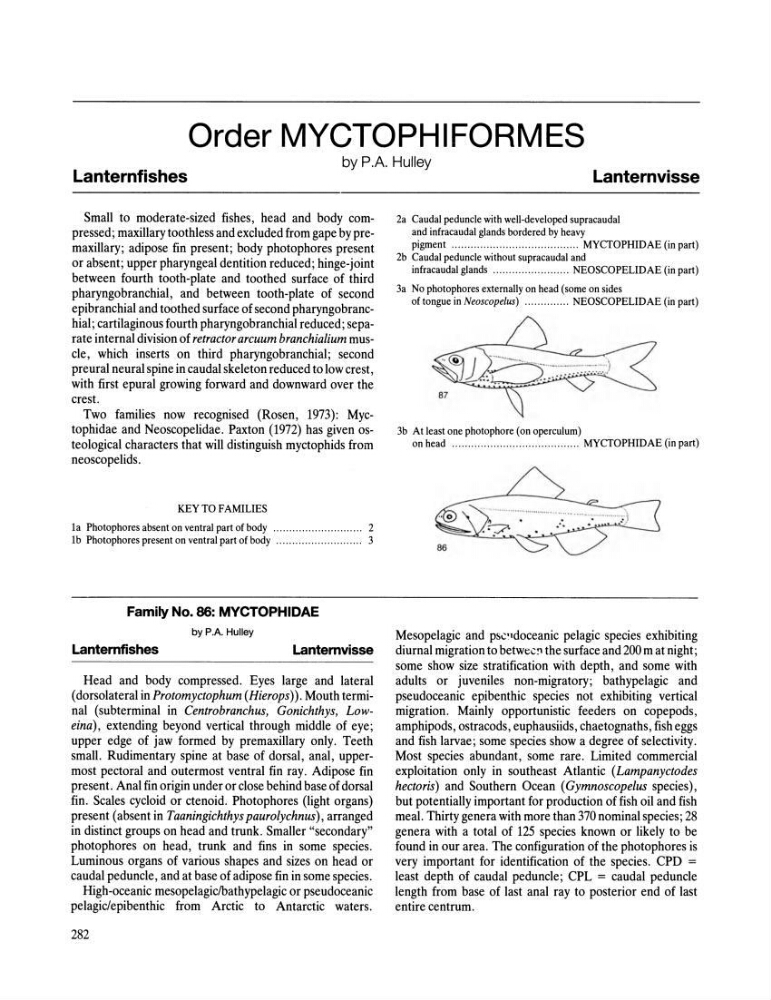
3a No photophores externally on head (some on sides
of tongue in Neoscopelus) ............ .. NEOSCOPELIDAE (in part)
3b At least one photophore (on operculum)
on head .............. ........ .................. MYCTOPHIDAE (in part)
Mesopelagic and pS~~ldoceanic pelagic species exhibiting
diurnal migration to betwec!l the surface and 200 m at night;
some show size stratification with depth, and some with
adults or juveniles non-migratory; bathypelagic and
pseudoceanic epibenthic species not exhibiting vertical
migration. Mainly opportunistic feeders on copepods,
amphipods, ostracods, euphausiids, chaetognaths, fish eggs
and fish larvae; some species show a degree of selectivity.
Most species abundant, some rare. Limited commercial
exploitation only in southeast Atlantic (Lampanyctodes
hectoris) and Southern Ocean (Gymnoscopelus species),
but potentially important for production of fish oil and fish
meal. Thirty genera with more than 370 nominal species; 28
genera with a total of 125 species known or likely to be
found in our area. The configuration of the photophores is
very important for identification of the species. CPD =
least depth of caudal peduncle; CPL = caudal peduncle
length from base of last anal ray to posterior end of last
entire centrum.
by P.A. Hulley
Lanternvisse
Lanternfishes
Small to moderate-sized fishes, head and body compressed; maxillary toothless and excluded from gape by premaxillary; adipose fin present; body photophores present
or absent; upper pharyngeal dentition reduced; hinge-joint
between fourth tooth-plate and toothed surface of third
pharyngobranchial, and between tooth-plate of second
epibranchial and toothed surface of second pharyngobranchial; cartilaginous fourth pharyngobranchial reduced; separate internal division of retractor arcuum branchialium muscle, which inserts on third pharyngobranchial; second
preural neural spine in caudal skeleton reduced to low crest,
with first epural growing forward and downward over the
crest.
Two families now recognised (Rosen, 1973): Myctophidae and Neoscopelidae . Paxton (1972) has given osteological characters that will distinguish myctophids from
neoscopelids.
KEY TO FAMILIES
la Photophores absent on ventral part of body .. .. ... . ........... .. ....... 2
Ib Photophores present on ventral part of body ...... ........... ... ....... 3
Family No. 86: MYCTOPHIDAE
by PA Hulley
Lanternfishes
Lantemvisse
Head and body compressed. Eyes large and lateral
(dorsolateral in Protomyctophum (Hierops)). Mouth terminal (subterminal in Centrobranchus, Gonichthys, Loweina) , extending beyond vertical through middle of eye;
upper edge of jaw formed by premaxillary only. Teeth
small. Rudimentary spine at base of dorsal, anal, uppermost pectoral and outermost ventral fin ray. Adipose fin
present. Anal fin origin under or close behind base of dorsal
fin. Scales cycloid or ctenoid. Photophores (light organs)
present (absent in Taaningichthys paurolychnus) , arranged
in distinct groups on head and trunk. Smaller "secondary"
photophores on head, trunk and fins in some species.
Luminous organs of various shapes and sizes on head or
caudal peduncle, and at base of adipose fin in some species.
High-oceanic mesopelagic/bathypelagic or pseudoceanic
pelagiclepibenthic from Arctic to Antarctic waters.
282
2a Caudal peduncle with well-developed supracaudal
and infracaudal glands bordered by heavy
pigment .......... .... ... .................. ..... MYCTOPHIDAE (in part)
2b Caudal peduncle without supracaudal and
infracaudal glands ... ..................... NEOSCOPELIDAE (in part)
3a No photophores externally on head (some on sides
of tongue in Neoscopelus) ............ .. NEOSCOPELIDAE (in part)
3b At least one photophore (on operculum)
on head .............. ........ .................. MYCTOPHIDAE (in part)
Mesopelagic and pS~~ldoceanic pelagic species exhibiting
diurnal migration to betwec!l the surface and 200 m at night;
some show size stratification with depth, and some with
adults or juveniles non-migratory; bathypelagic and
pseudoceanic epibenthic species not exhibiting vertical
migration. Mainly opportunistic feeders on copepods,
amphipods, ostracods, euphausiids, chaetognaths, fish eggs
and fish larvae; some species show a degree of selectivity.
Most species abundant, some rare. Limited commercial
exploitation only in southeast Atlantic (Lampanyctodes
hectoris) and Southern Ocean (Gymnoscopelus species),
but potentially important for production of fish oil and fish
meal. Thirty genera with more than 370 nominal species; 28
genera with a total of 125 species known or likely to be
found in our area. The configuration of the photophores is
very important for identification of the species. CPD =
least depth of caudal peduncle; CPL = caudal peduncle
length from base of last anal ray to posterior end of last
entire centrum.