

83: EVERMANNELLIDAE (SABRETOOTHED FISHES)
83.2 Evermannella ba/bo
(Risso, 1820)
Scopelus balbo Risso, 1820: 268 (Mediterranean Sea). Evermanella
balbo: Johnson, 1982: 127*.
D 12-13; A 33-37; P 12. Body depth at A origin 14-18% SL; head length
21-25% SL.
Colour in alcohol: varies from light to dark brown, with
numerous variably-sized melanophores on body and head;
melanophores on body in 7 to 13 irregular rows. Attains
150 mm SL. Oceanic; most adults taken in depths exceeding
400 m, but some from 100 - 300 m. Numerous South
Atlantic records just to the west of our boundary, and 4
specimens from off southern Natal. Occurs in cooler, more
productive regions of North and South Atlantic, and
Mediterranean Sea; presumed to be circumglobal in
Transition Region of southern oceans.
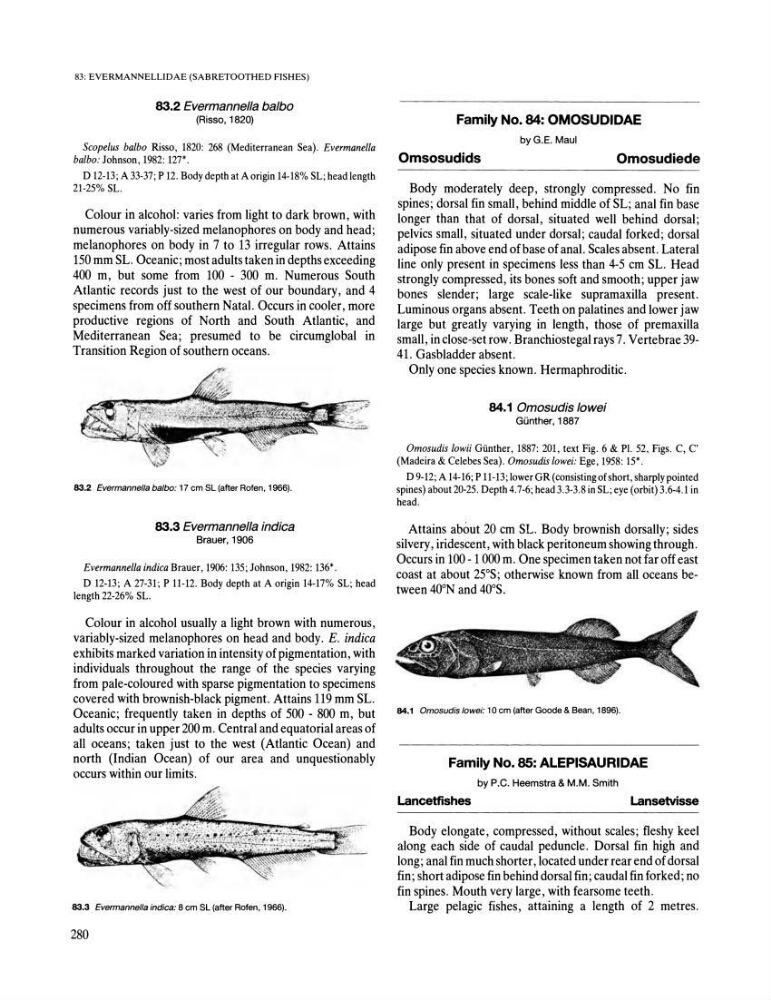
83.2 Evermannella balbo: 17 em SL (after Roten, 1966).
83.3 Evermannella indica
Brauer, 1906
Evermannella indica Brauer, 1906: 135; Johnson, 1982: 136*.
D 12-13; A 27-31; P 11-12. Body depth at A origin 14-17% SL; head
length 22-26% SL.
Colour in alcohol usually a light brown with numerous,
variably-sized melanophores on head and body. E. indica
exhibits marked variation in intensity of pigmentation, with
individuals throughout the range of the species varying
from pale-coloured with sparse pigmentation to specimens
covered with brownish-black pigment. Attains 119 mm SL.
Oceanic; frequently taken in depths of 500 - 800 m, but
adults occur in upper 200 m. Central and equatorial areas of
all oceans; taken just to the west (Atlantic Ocean) and
north (Indian Ocean) of our area and unquestionably
occurs within our limits.
83.3 Evermannella indica: 8 em SL (after Roten, 1966).
280
Family No. 84: OMOSUDIDAE
byG.E. Maul
Omsosudids
Omosudiede
Body moderately deep, strongly compressed. No fin
spines; dorsal fin small, behind middle of SL; anal fin base
longer than that of dorsal, situated well behind dorsal;
pelvics small, situated under dorsal; caudal forked; dorsal
adipose fin above end of base of anal. Scales absent. Lateral
line only present in specimens less than 4-5 cm SL. Head
strongly compressed, its bones soft and smooth; upper jaw
bones slender; large scale-like supramaxilla present.
Luminous organs absent. Teeth on palatines and lower jaw
large but greatly varying in length, those of premaxilla
small, in close-set row. Branchiostegal rays 7. Vertebrae 3941. Gasbladder absent.
Only one species known. Hermaphroditic.
84.1 Omosudis lowei
Gunther, 1887
Omosudis lowii Giinther, 1887: 201, text Fig. 6 & PI. 52, Figs. C, C'
(Madeira & Celebes Sea). Omosudis lowei: Ege, 1958: 15*.
D 9-12; A 14-16; P 11-13; lower GR (consisting of short, sharply pointed
spines) about 20-25. Depth 4.7-6; head 3.3-3.8 in SL; eye (orbit) 3.6-4.1 in
head.
Attains about 20 cm SL. Body brownish dorsally; sides
silvery, iridescent, with black peritoneum showing through.
Occurs in 100 - 1000 m. One specimen taken not far off east
coast at about 25°S; otherwise known from all oceans between 400N and 40 o S.
84.1 Omosudis lowei: 10 em (after Goode & Bean, 1896).
Family No. 85: ALEPISAURIDAE
by P.C. Heemstra & M.M. Smith
Lancetfishes
Lansetvisse
Body elongate, compressed, without scales; fleshy keel
along each side of caudal peduncle. Dorsal fin high and
long; anal fin much shorter, located under rear end of dorsal
fin; short adipose fin behind dorsal fin; caudal fin forked; no
fin spines. Mouth very large, with fearsome teeth.
Large pelagic fishes, attaining a length of 2 metres.
83.2 Evermannella ba/bo
(Risso, 1820)
Scopelus balbo Risso, 1820: 268 (Mediterranean Sea). Evermanella
balbo: Johnson, 1982: 127*.
D 12-13; A 33-37; P 12. Body depth at A origin 14-18% SL; head length
21-25% SL.
Colour in alcohol: varies from light to dark brown, with
numerous variably-sized melanophores on body and head;
melanophores on body in 7 to 13 irregular rows. Attains
150 mm SL. Oceanic; most adults taken in depths exceeding
400 m, but some from 100 - 300 m. Numerous South
Atlantic records just to the west of our boundary, and 4
specimens from off southern Natal. Occurs in cooler, more
productive regions of North and South Atlantic, and
Mediterranean Sea; presumed to be circumglobal in
Transition Region of southern oceans.
83.2 Evermannella balbo: 17 em SL (after Roten, 1966).
83.3 Evermannella indica
Brauer, 1906
Evermannella indica Brauer, 1906: 135; Johnson, 1982: 136*.
D 12-13; A 27-31; P 11-12. Body depth at A origin 14-17% SL; head
length 22-26% SL.
Colour in alcohol usually a light brown with numerous,
variably-sized melanophores on head and body. E. indica
exhibits marked variation in intensity of pigmentation, with
individuals throughout the range of the species varying
from pale-coloured with sparse pigmentation to specimens
covered with brownish-black pigment. Attains 119 mm SL.
Oceanic; frequently taken in depths of 500 - 800 m, but
adults occur in upper 200 m. Central and equatorial areas of
all oceans; taken just to the west (Atlantic Ocean) and
north (Indian Ocean) of our area and unquestionably
occurs within our limits.
83.3 Evermannella indica: 8 em SL (after Roten, 1966).
280
Family No. 84: OMOSUDIDAE
byG.E. Maul
Omsosudids
Omosudiede
Body moderately deep, strongly compressed. No fin
spines; dorsal fin small, behind middle of SL; anal fin base
longer than that of dorsal, situated well behind dorsal;
pelvics small, situated under dorsal; caudal forked; dorsal
adipose fin above end of base of anal. Scales absent. Lateral
line only present in specimens less than 4-5 cm SL. Head
strongly compressed, its bones soft and smooth; upper jaw
bones slender; large scale-like supramaxilla present.
Luminous organs absent. Teeth on palatines and lower jaw
large but greatly varying in length, those of premaxilla
small, in close-set row. Branchiostegal rays 7. Vertebrae 3941. Gasbladder absent.
Only one species known. Hermaphroditic.
84.1 Omosudis lowei
Gunther, 1887
Omosudis lowii Giinther, 1887: 201, text Fig. 6 & PI. 52, Figs. C, C'
(Madeira & Celebes Sea). Omosudis lowei: Ege, 1958: 15*.
D 9-12; A 14-16; P 11-13; lower GR (consisting of short, sharply pointed
spines) about 20-25. Depth 4.7-6; head 3.3-3.8 in SL; eye (orbit) 3.6-4.1 in
head.
Attains about 20 cm SL. Body brownish dorsally; sides
silvery, iridescent, with black peritoneum showing through.
Occurs in 100 - 1000 m. One specimen taken not far off east
coast at about 25°S; otherwise known from all oceans between 400N and 40 o S.
84.1 Omosudis lowei: 10 em (after Goode & Bean, 1896).
Family No. 85: ALEPISAURIDAE
by P.C. Heemstra & M.M. Smith
Lancetfishes
Lansetvisse
Body elongate, compressed, without scales; fleshy keel
along each side of caudal peduncle. Dorsal fin high and
long; anal fin much shorter, located under rear end of dorsal
fin; short adipose fin behind dorsal fin; caudal fin forked; no
fin spines. Mouth very large, with fearsome teeth.
Large pelagic fishes, attaining a length of 2 metres.