

limited evidence suggests that species of Coccorella may
specialise on oceanic squid. Evermannellids occur in all
oceans approximately between 400N and 40 0 S; they are of
no commercial importance. Three genera and 7 species, 3
species in our area. Odontostomops normalops (Parr, 1928)
and Coccorella atrata (Alcock, 1893) have not yet been
recorded from the area, but are included in the key.
Recently revised by Johnson (1982).
KEY TO SPECIES
1a Eyes "normal" not tubular, directed laterad;
aperture in adipose eyelid much smaller than
lens of eye; (anteriormost palatine fang and
at least some dentary fangs barbed; no fossa
at dentary symphysis; pyloric caecum
lacking) ......................................... Odontostomops normalops
(Tropical/subtropical in all 3 major oceans; taken to the west
(Atlantic Ocean) and north (Indian Ocean) of our area).
Odontostomops normalops: 10 em SL (after Roten, 1966).
1b Eyes semitubular or tubular, directed dorsolaterad or dorsad; aperture in adipose eyelid
slightly to markedly greater than lens of eye ............................ 2
2a Eyes semitubular, directed dorsolaterad; aperture
in adipose eyelid only slightly greater than lens of eye;
jaw teeth unbarbed; anteriormost palatine tooth an
enormous, unbarbed, sabre-like fang, 7.1-10% SL; no
fossa at dentary symphysis; pyloric caecum extending
into head, visible on floor of mouth as a distinct black
tube beneath basibranchial series .......................................... 3
- "~rf
"
. II I
. ,-.: r". - I
~/
Coccorella atlantica: 4 em SL (after Roten, 1966).
2b Eyes tubular, directed dorsad and slightly anteriad;
aperture in adipose eyelid much larger than lens of eye;
anteriormost palatine fang 4.6-7.3% SL; at least some
dentary teeth distinctly barbed; a vertically elongate
fossa centred on dentary symphysis; no pyloric caecum .............. 4
~
tiiEA'
Evermannella indica: 8 em SL (after Roten, 1966).
3a Vertebrae 48-50; bony interorbital width
3.2-4.7% SL; typically 6 pores, 3+3, in frontal
canal commissure (a series of latero-sensory
pores behind interorbital region of frontals,
forming a transverse connection between
infraorbital series of each side ....................... Coccorella atlantica
83: EVERMANNELLIDAE (SABRETOOTHED FISHES)
3b Vertebrae 45-47; bony interorbital width 4.7-6.1 %
SL; typically 4 pores, 2+ 2, in frontal canal
commissure ............................................................ C. atrata
(Tropical Indo-Pacific; has been taken at W16'S, 41°48'E).
Coccorella atrata: dorsal view ot head; arrow indicates the series ot 4 trontal
canal pores.
4a A rays 33-37; vertebrae 52-54 ......................... Evermanella balbo
4b A rays 27-31; vertebrae 48-52 ..................................... E. indica
Genus Coccorella Roule, 1929
Two species, 1 known to occur off southern Africa.
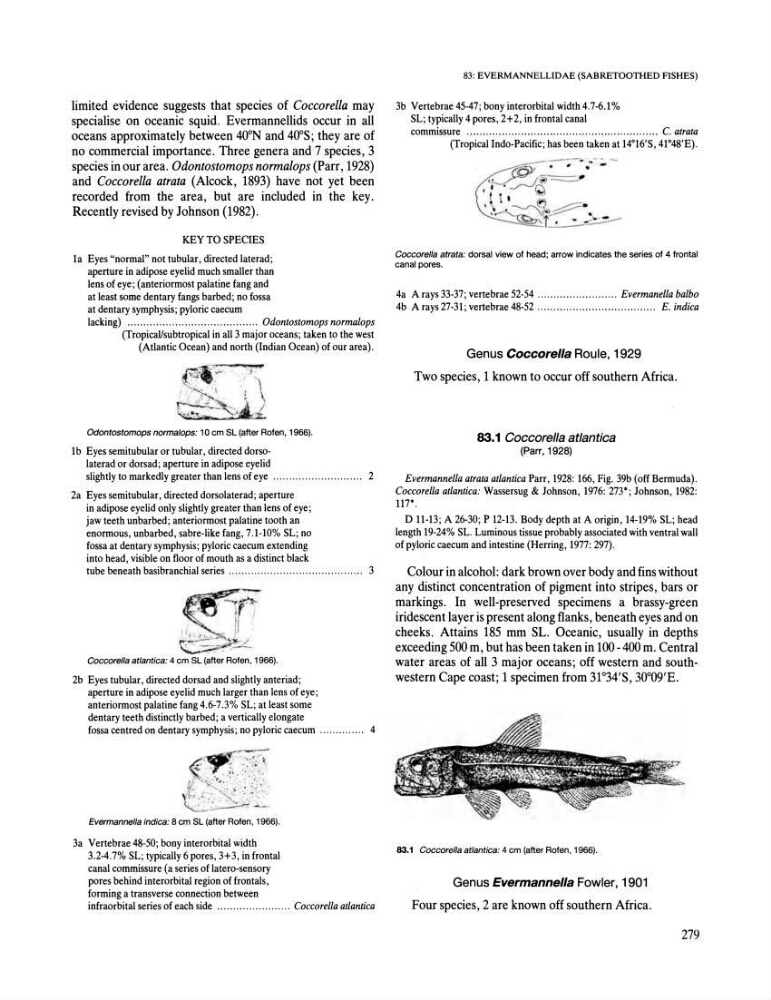
83.1 Coccorella atlantica
(Parr, 1928)
Evermannella atrata atlantica Parr, 1928: 166, Fig. 39b (off Bermuda).
Coccorella atlantica: Wassersug & Johnson, 1976: 273*; Johnson, 1982:
117*.
D 11-13; A 26-30; P 12-13. Body depth at A origin, 14-19% SL; head
length 19-24% SL. Luminous tissue probably associated with ventral wall
of pyloric caecum and intestine (Herring, 1977: 297).
Colour in alcohol: dark brown over body and fins without
any distinct concentration of pigment into stripes, bars or
markings. In well-preserved specimens a brassy-green
iridescent layer is present along flanks, beneath eyes and on
cheeks. Attains 185 mm SL. Oceanic, usually in depths
exceeding 500 m, but has been taken in 100 - 400 m. Central
water areas of all 3 major oceans; off western and southwestern Cape coast; 1 specimen from 31°34'S, 30 0 09'E.
83.1 Coccorella atlantica: 4 em (after Roten, 1966).
Genus Evermannella Fowler, 1901
Four species, 2 are known off southern Africa.
279
specialise on oceanic squid. Evermannellids occur in all
oceans approximately between 400N and 40 0 S; they are of
no commercial importance. Three genera and 7 species, 3
species in our area. Odontostomops normalops (Parr, 1928)
and Coccorella atrata (Alcock, 1893) have not yet been
recorded from the area, but are included in the key.
Recently revised by Johnson (1982).
KEY TO SPECIES
1a Eyes "normal" not tubular, directed laterad;
aperture in adipose eyelid much smaller than
lens of eye; (anteriormost palatine fang and
at least some dentary fangs barbed; no fossa
at dentary symphysis; pyloric caecum
lacking) ......................................... Odontostomops normalops
(Tropical/subtropical in all 3 major oceans; taken to the west
(Atlantic Ocean) and north (Indian Ocean) of our area).
Odontostomops normalops: 10 em SL (after Roten, 1966).
1b Eyes semitubular or tubular, directed dorsolaterad or dorsad; aperture in adipose eyelid
slightly to markedly greater than lens of eye ............................ 2
2a Eyes semitubular, directed dorsolaterad; aperture
in adipose eyelid only slightly greater than lens of eye;
jaw teeth unbarbed; anteriormost palatine tooth an
enormous, unbarbed, sabre-like fang, 7.1-10% SL; no
fossa at dentary symphysis; pyloric caecum extending
into head, visible on floor of mouth as a distinct black
tube beneath basibranchial series .......................................... 3
- "~rf
"
. II I
. ,-.: r". - I
~/
Coccorella atlantica: 4 em SL (after Roten, 1966).
2b Eyes tubular, directed dorsad and slightly anteriad;
aperture in adipose eyelid much larger than lens of eye;
anteriormost palatine fang 4.6-7.3% SL; at least some
dentary teeth distinctly barbed; a vertically elongate
fossa centred on dentary symphysis; no pyloric caecum .............. 4
~
tiiEA'
Evermannella indica: 8 em SL (after Roten, 1966).
3a Vertebrae 48-50; bony interorbital width
3.2-4.7% SL; typically 6 pores, 3+3, in frontal
canal commissure (a series of latero-sensory
pores behind interorbital region of frontals,
forming a transverse connection between
infraorbital series of each side ....................... Coccorella atlantica
83: EVERMANNELLIDAE (SABRETOOTHED FISHES)
3b Vertebrae 45-47; bony interorbital width 4.7-6.1 %
SL; typically 4 pores, 2+ 2, in frontal canal
commissure ............................................................ C. atrata
(Tropical Indo-Pacific; has been taken at W16'S, 41°48'E).
Coccorella atrata: dorsal view ot head; arrow indicates the series ot 4 trontal
canal pores.
4a A rays 33-37; vertebrae 52-54 ......................... Evermanella balbo
4b A rays 27-31; vertebrae 48-52 ..................................... E. indica
Genus Coccorella Roule, 1929
Two species, 1 known to occur off southern Africa.
83.1 Coccorella atlantica
(Parr, 1928)
Evermannella atrata atlantica Parr, 1928: 166, Fig. 39b (off Bermuda).
Coccorella atlantica: Wassersug & Johnson, 1976: 273*; Johnson, 1982:
117*.
D 11-13; A 26-30; P 12-13. Body depth at A origin, 14-19% SL; head
length 19-24% SL. Luminous tissue probably associated with ventral wall
of pyloric caecum and intestine (Herring, 1977: 297).
Colour in alcohol: dark brown over body and fins without
any distinct concentration of pigment into stripes, bars or
markings. In well-preserved specimens a brassy-green
iridescent layer is present along flanks, beneath eyes and on
cheeks. Attains 185 mm SL. Oceanic, usually in depths
exceeding 500 m, but has been taken in 100 - 400 m. Central
water areas of all 3 major oceans; off western and southwestern Cape coast; 1 specimen from 31°34'S, 30 0 09'E.
83.1 Coccorella atlantica: 4 em (after Roten, 1966).
Genus Evermannella Fowler, 1901
Four species, 2 are known off southern Africa.
279