

81: PARALEPIDIDAE (BARRACUDINAS)
Juveniles pale, transparent when fresh; a row of small
stellate melanophores at each side of dorsal midline; 16-17
peritoneal pigment sections. Known only from juveniles up
to 15 cm; probably attains 25+ cm. Epipelagic to
mesopelagic in tropical waters of Indian and Pacific oceans;
off South Africa only in Agulhas Current.
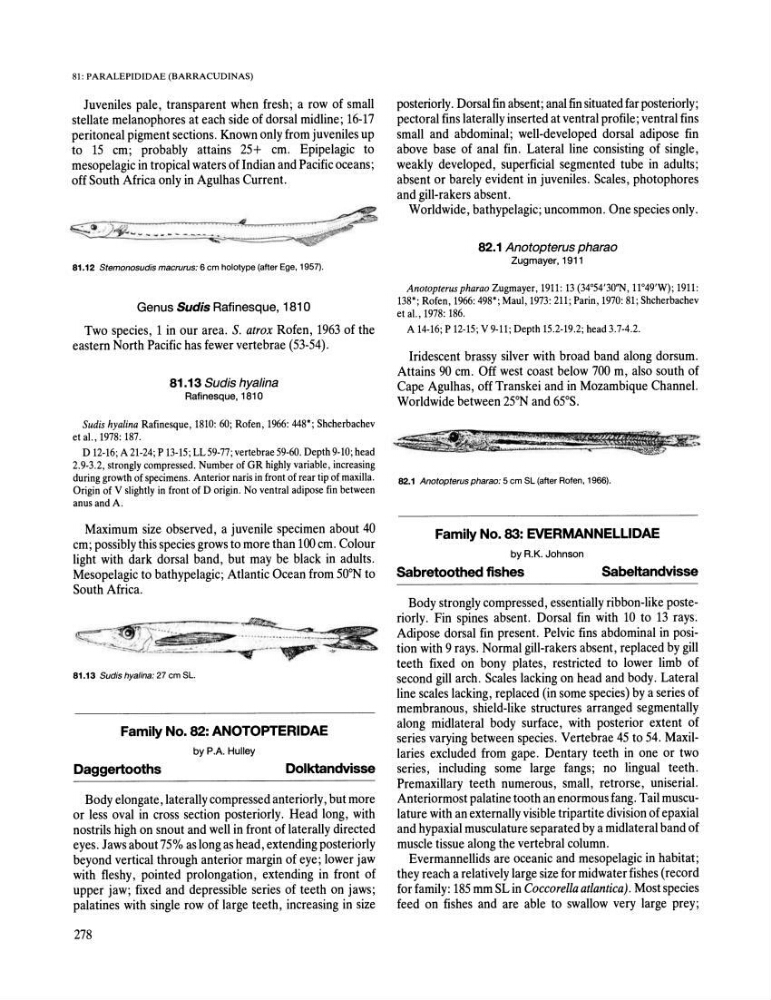
81.12 Stemonosudis macrurus: 6 em holotype (after Ege, 1957).
Genus Sudis Rafinesque, 1810
Two species, 1 in our area. S. atrox Rofen, 1963 of the
eastern North Pacific has fewer vertebrae (53-54).
81.13 Sudis hyalina
Rafinesque, 1810
Sudis hyalina Rafinesque, 1810: 60; Rofen, 1966: 448*; Shcherbachev
et aI. , 1978: 187.
D 12-16; A 21-24; P 13-15; LL59-77; vertebrae 59-60. Depth 9-10; head
2.9-3.2, strongly compressed. Number of GR highly variable, increasing
during growth of specimens. Anterior naris in front of rear tip of maxilla.
Origin of V slightly in front of D origin. No ventral adipose fin between
anus andA.
Maximum size observed, a juvenile specimen about 40
cm; possibly this species grows to more than 100 cm. Colour
light with dark dorsal band, but may be black in adults.
Mesopelagic to bathypelagic; Atlantic Ocean from 50 0 N to
South Africa.
81.13 Sudis hyalina: 27 em SL.
Family No. 82: ANOTOPTERIDAE
by P.A. Hulley
Daggertooths
Dolktandvisse
Body elongate, laterally compressed anteriorly, but more
or less oval in cross section posteriorly. Head long, with
nostrils high on snout and well in front of laterally directed
eyes. Jaws about 75% as long as head, extending posteriorly
beyond vertical through anterior margin of eye; lower jaw
with fleshy, pointed prolongation, extending in front of
upper jaw; fixed and depressible series of teeth on jaws;
palatines with single row of large teeth, increasing in size
278
posteriorly. Dorsal fin absent; anal fin situated far posteriorly;
pectoral fins laterally inserted at ventral profile; ventral fins
small and abdominal; well-developed dorsal adipose fin
above base of anal fin. Lateral line consisting of single,
weakly developed, superficial segmented tube in adults;
absent or barely evident in juveniles. Scales, photophores
and gill-rakers absent.
Worldwide, bathypelagic; uncommon. One species only.
82.1 Anotopterus pharao
Zugmayer, 1911
Anotopterus pharao Zugmayer, 1911: 13 (34°54'30"N, 11°49'W); 1911:
138*; Rofen, 1966: 498*; Maul,1973: 211; Parin, 1970: 81; Shcherbachev
et aI., 1978: 186.
A 14-16; P 12-15; V 9-11; Depth 15.2-19.2; head 3.7-4.2.
Iridescent brassy silver with broad band along dorsum.
Attains 90 cm. Off west coast below 700 m, also south of
Cape Agulhas, off Transkei and in Mozambique Channel.
Worldwide between 25°N and 65°S.
82.1 Anotopterus pharao: 5 em SL (after Roten, 1966).
Family No. 83: EVERMANNELLIDAE
by R.K. Johnson
Sabretoothed fishes
Sabeltandvisse
Body strongly compressed, essentially ribbon-like posteriorly. Fin spines absent. Dorsal fin with 10 to 13 rays.
Adipose dorsal fin present. Pelvic fins abdominal in position with 9 rays. Normal gill-rakers absent, replaced by gill
teeth fixed on bony plates, restricted to lower limb of
second gill arch. Scales lacking on head and body. Lateral
line scales lacking, replaced (in some species) by a series of
membranous, shield-like structures arranged segmentally
along midlateral body surface, with posterior extent of
series varying between species. Vertebrae 45 to 54. Maxillaries excluded from gape. Dentary teeth in one or two
series, including some large fangs; no lingual teeth.
Premaxillary teeth numerous, small, retrorse, uniserial.
Anteriormost palatine tooth an enormous fang. Tail musculature with an externally visible tripartite division of epaxial
and hypaxial musculature separated by a midlateral band of
muscle tissue along the vertebral column.
Evermannellids are oceanic and mesopelagic in habitat;
they reach a relatively large size for midwater fishes (record
for family: 185 mm SL in Coccorella atlantica). Most species
feed on fishes and are able to swallow very large prey;
Juveniles pale, transparent when fresh; a row of small
stellate melanophores at each side of dorsal midline; 16-17
peritoneal pigment sections. Known only from juveniles up
to 15 cm; probably attains 25+ cm. Epipelagic to
mesopelagic in tropical waters of Indian and Pacific oceans;
off South Africa only in Agulhas Current.
81.12 Stemonosudis macrurus: 6 em holotype (after Ege, 1957).
Genus Sudis Rafinesque, 1810
Two species, 1 in our area. S. atrox Rofen, 1963 of the
eastern North Pacific has fewer vertebrae (53-54).
81.13 Sudis hyalina
Rafinesque, 1810
Sudis hyalina Rafinesque, 1810: 60; Rofen, 1966: 448*; Shcherbachev
et aI. , 1978: 187.
D 12-16; A 21-24; P 13-15; LL59-77; vertebrae 59-60. Depth 9-10; head
2.9-3.2, strongly compressed. Number of GR highly variable, increasing
during growth of specimens. Anterior naris in front of rear tip of maxilla.
Origin of V slightly in front of D origin. No ventral adipose fin between
anus andA.
Maximum size observed, a juvenile specimen about 40
cm; possibly this species grows to more than 100 cm. Colour
light with dark dorsal band, but may be black in adults.
Mesopelagic to bathypelagic; Atlantic Ocean from 50 0 N to
South Africa.
81.13 Sudis hyalina: 27 em SL.
Family No. 82: ANOTOPTERIDAE
by P.A. Hulley
Daggertooths
Dolktandvisse
Body elongate, laterally compressed anteriorly, but more
or less oval in cross section posteriorly. Head long, with
nostrils high on snout and well in front of laterally directed
eyes. Jaws about 75% as long as head, extending posteriorly
beyond vertical through anterior margin of eye; lower jaw
with fleshy, pointed prolongation, extending in front of
upper jaw; fixed and depressible series of teeth on jaws;
palatines with single row of large teeth, increasing in size
278
posteriorly. Dorsal fin absent; anal fin situated far posteriorly;
pectoral fins laterally inserted at ventral profile; ventral fins
small and abdominal; well-developed dorsal adipose fin
above base of anal fin. Lateral line consisting of single,
weakly developed, superficial segmented tube in adults;
absent or barely evident in juveniles. Scales, photophores
and gill-rakers absent.
Worldwide, bathypelagic; uncommon. One species only.
82.1 Anotopterus pharao
Zugmayer, 1911
Anotopterus pharao Zugmayer, 1911: 13 (34°54'30"N, 11°49'W); 1911:
138*; Rofen, 1966: 498*; Maul,1973: 211; Parin, 1970: 81; Shcherbachev
et aI., 1978: 186.
A 14-16; P 12-15; V 9-11; Depth 15.2-19.2; head 3.7-4.2.
Iridescent brassy silver with broad band along dorsum.
Attains 90 cm. Off west coast below 700 m, also south of
Cape Agulhas, off Transkei and in Mozambique Channel.
Worldwide between 25°N and 65°S.
82.1 Anotopterus pharao: 5 em SL (after Roten, 1966).
Family No. 83: EVERMANNELLIDAE
by R.K. Johnson
Sabretoothed fishes
Sabeltandvisse
Body strongly compressed, essentially ribbon-like posteriorly. Fin spines absent. Dorsal fin with 10 to 13 rays.
Adipose dorsal fin present. Pelvic fins abdominal in position with 9 rays. Normal gill-rakers absent, replaced by gill
teeth fixed on bony plates, restricted to lower limb of
second gill arch. Scales lacking on head and body. Lateral
line scales lacking, replaced (in some species) by a series of
membranous, shield-like structures arranged segmentally
along midlateral body surface, with posterior extent of
series varying between species. Vertebrae 45 to 54. Maxillaries excluded from gape. Dentary teeth in one or two
series, including some large fangs; no lingual teeth.
Premaxillary teeth numerous, small, retrorse, uniserial.
Anteriormost palatine tooth an enormous fang. Tail musculature with an externally visible tripartite division of epaxial
and hypaxial musculature separated by a midlateral band of
muscle tissue along the vertebral column.
Evermannellids are oceanic and mesopelagic in habitat;
they reach a relatively large size for midwater fishes (record
for family: 185 mm SL in Coccorella atlantica). Most species
feed on fishes and are able to swallow very large prey;