

80: GIGANTURIDAE (TELESCOPEFISHES)
Ib P 36-42; A 11-14; C peduncle depth < 11.5% SL
(larvae), < 5% SL Quveniles and adults) ............... Rosaura indica
80.1 Gigantura chuni
Brauer, 1901
Gigantura chuni Brauer, 1901: 128 (Gulf of Guinea). Gigantura vorax
Regan,I925: 54, Figs. 1-4; PI. 7, Fig. 2 (central North Atlantic); Walters,
1964: 574* (western North Atlantic).
D 16-19; A 8-10; P 30-33; V 5 (in larvae), lacking in adults; vertebrae
29-30 (Walters, 1964: 574). Body heavy and compressed; C peduncle
depth 8-12% SL in adults.
Colour black to greyish brown in alcohol. A burnished
iridescent silvery coloration has been described for fresh
material in good condition. Attains at least 16 cm SL.
Mainly tropical in all 3 major oceans. Nearest capture to our
area at 16°12'S, 42°04'E, thus it presumably occurs within
the northern Indian Ocean sector of our area.
~; ;"~'"
80.1 Gigantura chuni: 15.5 em SL (after Walters. 1964).
80.2 Rosaura indica
(Brauer, 1901)
Gigantura chuni indica Brauer, 1901: 129 (Indian Ocean). Gigantura
indica: Brauer, 1906: 311*. Gigantura gracilis Regan, 1925: 54, PI. 7, Fig.
1 (western North Atlantic, Caribbean Sea, Gulf of Mexico). Rosaura
rotunda Tucker, 1954: 167, Figs. 1-8 (western equatorial Atlantic); Berry
& Perkins 1965: 654*. Bathyleptus lisae Walters, 1961: 316, Fig. 1 (central
North Pacific). Bathyleptus gracilis: Walters, 1964: 572*. Bathyleptus
indicus: Walters, 1964: 572.
D 16-19; A 11-14; P 36-42; V 5 (in larvae); vertebrae 30-31 (Walters,
1961: 316). Trunk pencil-shaped; C peduncle depth ca. 2.5-4.5 % SL in
adults.
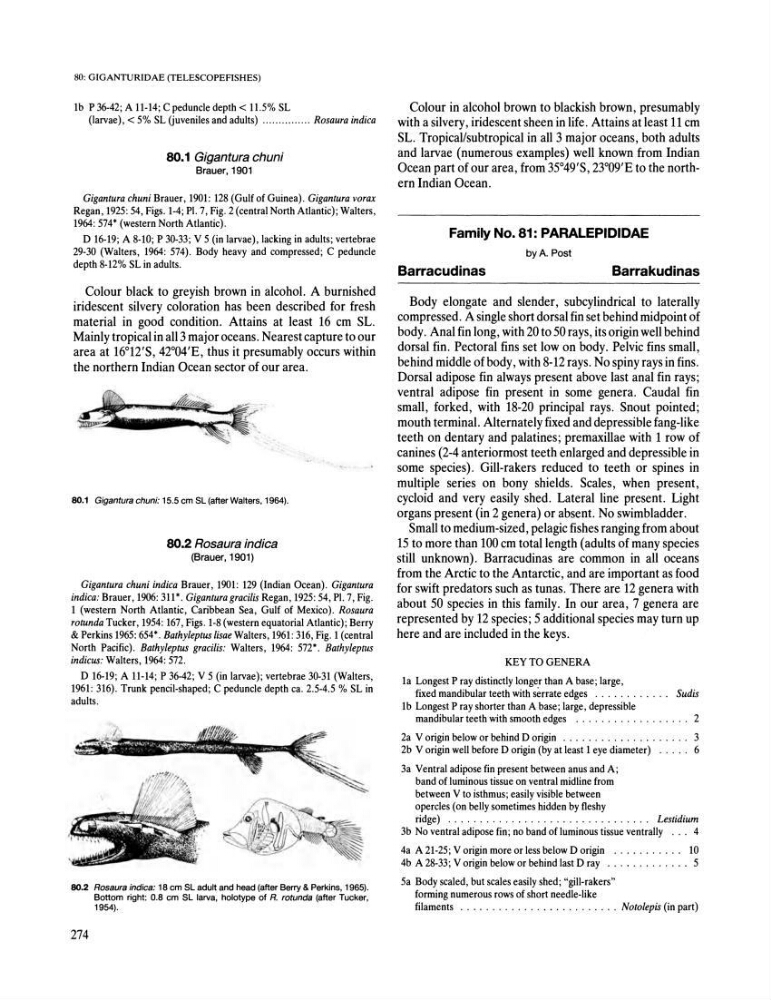
80.2 Rosaura indica: 18 em SL adult and head (after Berry & Perkins, 1965).
274
Bottom right: 0.8 em SL larva, holotype of R. rotunda (after Tucker,
1954).
Colour in alcohol brown to blackish brown, presumably
with a silvery, iridescent sheen in life. Attains at least 11 cm
SL. Tropical/subtropical in all 3 major oceans, both adults
and larvae (numerous examples) well known from Indian
Ocean part of our area, from 35°49'S, 23°09'E to the northern Indian Ocean.
Family No. 81: PARALEPIDIDAE
by A. Post
Barracudinas
Barrakudinas
Body elongate and slender, sub cylindrical to laterally
compressed. A single short dorsal fin set behind midpoint of
body. Anal fin long, with 20 to 50 rays, its origin well behind
dorsal fin. Pectoral fins set low on body. Pelvic fins small,
behind middle of body, with 8-12 rays. No spiny rays in fins.
Dorsal adipose fin always present above last anal fin rays;
ventral adipose fin present in some genera. Caudal fin
small, forked, with 18-20 principal rays. Snout pointed;
mouth terminal. Alternately fixed and depressible fang-like
teeth on dentary and palatines; premaxillae with 1 row of
canines (2-4 anteriormost teeth enlarged and depressible in
some species). Gill-rakers reduced to teeth or spines in
multiple series on bony shields. Scales, when present,
cycloid and very easily shed. Lateral line present. Light
organs present (in 2 genera) or absent. No swim bladder.
Small to medium-sized, pelagic fishes ranging from about
15 to more than 100 cm total length (adults of many species
still unknown). Barracudinas are common in all oceans
from the Arctic to the Antarctic, and are important as food
for swift predators such as tunas. There are 12 genera with
about 50 species in this family. In our area, 7 genera are
represented by 12 species; 5 additional species may turn up
here and are included in the keys.
KEY TO GENERA
la Longest P ray distinctly longer than A base; large,
fixed mandibular teeth with serrate edges ............ Sudis
Ib Longest P ray shorter than A base; large, depressible
mandibular teeth with smooth edges .................. 2
2a V origin below or behind D origin . . . . . . . . . . . . . . . . . . . . 3
2b V origin well before D origin (by at least 1 eye diameter)
6
3a Ventral adipose fin present between anus and A;
band of luminous tissue on ventral midline from
between V to isthmus; easily visible between
opercIes (on belly sometimes hidden by fleshy
ridge) ................................ Lestidium
3b No ventral adipose fin; no band of luminous tissue ventrally ... 4
4a A 21-25; V origin more or less below D origin ........... 10
4b A 28-33; V origin below or behind last Dray ............. 5
5a Body scaled, but scales easily shed; "gill-rakers"
forming numerous rows of short needle-like
filaments ......................... Notolepis (in part)
Ib P 36-42; A 11-14; C peduncle depth < 11.5% SL
(larvae), < 5% SL Quveniles and adults) ............... Rosaura indica
80.1 Gigantura chuni
Brauer, 1901
Gigantura chuni Brauer, 1901: 128 (Gulf of Guinea). Gigantura vorax
Regan,I925: 54, Figs. 1-4; PI. 7, Fig. 2 (central North Atlantic); Walters,
1964: 574* (western North Atlantic).
D 16-19; A 8-10; P 30-33; V 5 (in larvae), lacking in adults; vertebrae
29-30 (Walters, 1964: 574). Body heavy and compressed; C peduncle
depth 8-12% SL in adults.
Colour black to greyish brown in alcohol. A burnished
iridescent silvery coloration has been described for fresh
material in good condition. Attains at least 16 cm SL.
Mainly tropical in all 3 major oceans. Nearest capture to our
area at 16°12'S, 42°04'E, thus it presumably occurs within
the northern Indian Ocean sector of our area.
~; ;"~'"
80.1 Gigantura chuni: 15.5 em SL (after Walters. 1964).
80.2 Rosaura indica
(Brauer, 1901)
Gigantura chuni indica Brauer, 1901: 129 (Indian Ocean). Gigantura
indica: Brauer, 1906: 311*. Gigantura gracilis Regan, 1925: 54, PI. 7, Fig.
1 (western North Atlantic, Caribbean Sea, Gulf of Mexico). Rosaura
rotunda Tucker, 1954: 167, Figs. 1-8 (western equatorial Atlantic); Berry
& Perkins 1965: 654*. Bathyleptus lisae Walters, 1961: 316, Fig. 1 (central
North Pacific). Bathyleptus gracilis: Walters, 1964: 572*. Bathyleptus
indicus: Walters, 1964: 572.
D 16-19; A 11-14; P 36-42; V 5 (in larvae); vertebrae 30-31 (Walters,
1961: 316). Trunk pencil-shaped; C peduncle depth ca. 2.5-4.5 % SL in
adults.
80.2 Rosaura indica: 18 em SL adult and head (after Berry & Perkins, 1965).
274
Bottom right: 0.8 em SL larva, holotype of R. rotunda (after Tucker,
1954).
Colour in alcohol brown to blackish brown, presumably
with a silvery, iridescent sheen in life. Attains at least 11 cm
SL. Tropical/subtropical in all 3 major oceans, both adults
and larvae (numerous examples) well known from Indian
Ocean part of our area, from 35°49'S, 23°09'E to the northern Indian Ocean.
Family No. 81: PARALEPIDIDAE
by A. Post
Barracudinas
Barrakudinas
Body elongate and slender, sub cylindrical to laterally
compressed. A single short dorsal fin set behind midpoint of
body. Anal fin long, with 20 to 50 rays, its origin well behind
dorsal fin. Pectoral fins set low on body. Pelvic fins small,
behind middle of body, with 8-12 rays. No spiny rays in fins.
Dorsal adipose fin always present above last anal fin rays;
ventral adipose fin present in some genera. Caudal fin
small, forked, with 18-20 principal rays. Snout pointed;
mouth terminal. Alternately fixed and depressible fang-like
teeth on dentary and palatines; premaxillae with 1 row of
canines (2-4 anteriormost teeth enlarged and depressible in
some species). Gill-rakers reduced to teeth or spines in
multiple series on bony shields. Scales, when present,
cycloid and very easily shed. Lateral line present. Light
organs present (in 2 genera) or absent. No swim bladder.
Small to medium-sized, pelagic fishes ranging from about
15 to more than 100 cm total length (adults of many species
still unknown). Barracudinas are common in all oceans
from the Arctic to the Antarctic, and are important as food
for swift predators such as tunas. There are 12 genera with
about 50 species in this family. In our area, 7 genera are
represented by 12 species; 5 additional species may turn up
here and are included in the keys.
KEY TO GENERA
la Longest P ray distinctly longer than A base; large,
fixed mandibular teeth with serrate edges ............ Sudis
Ib Longest P ray shorter than A base; large, depressible
mandibular teeth with smooth edges .................. 2
2a V origin below or behind D origin . . . . . . . . . . . . . . . . . . . . 3
2b V origin well before D origin (by at least 1 eye diameter)
6
3a Ventral adipose fin present between anus and A;
band of luminous tissue on ventral midline from
between V to isthmus; easily visible between
opercIes (on belly sometimes hidden by fleshy
ridge) ................................ Lestidium
3b No ventral adipose fin; no band of luminous tissue ventrally ... 4
4a A 21-25; V origin more or less below D origin ........... 10
4b A 28-33; V origin below or behind last Dray ............. 5
5a Body scaled, but scales easily shed; "gill-rakers"
forming numerous rows of short needle-like
filaments ......................... Notolepis (in part)