

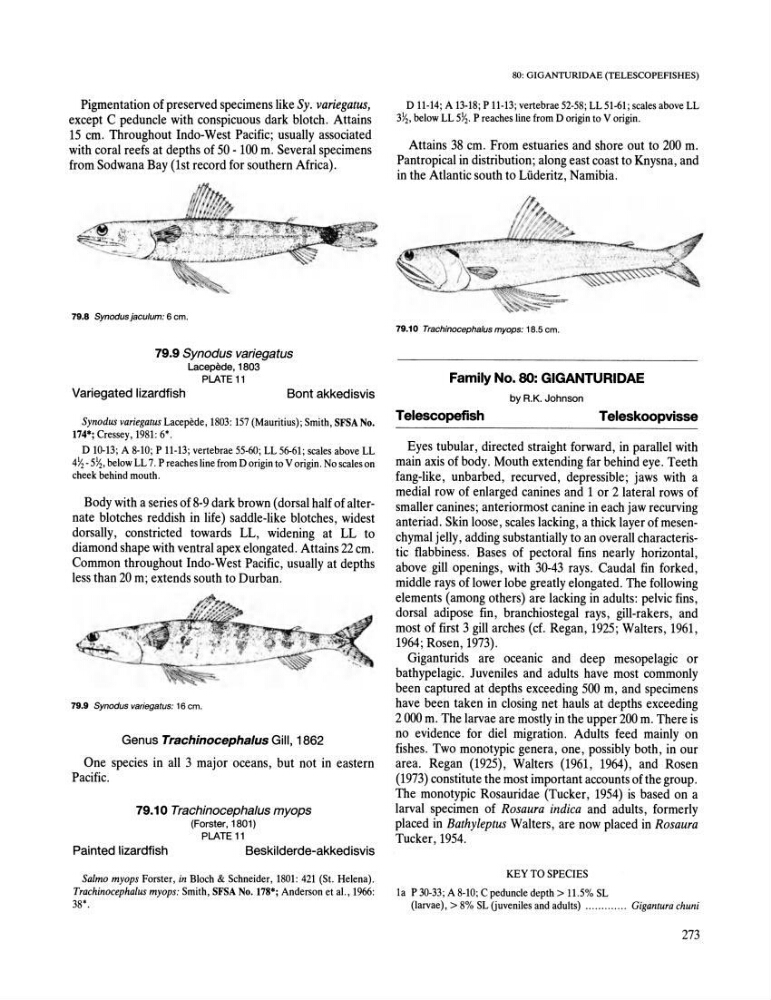
Pigmentation of preserved specimens like Sy. variegatus,
except C peduncle with conspicuous dark blotch. Attains
15 cm. Throughout Indo-West Pacific; usually associated
with coral reefs at depths of 50 - 100 m. Several specimens
from Sodwana Bay (1st record for southern Africa) .
79.8 Synodus jaculum: 6 em.
79.9 Synodus variegatus
Lacepede, 1803
PLATE 11
Variegated lizardfish
Bont akkedisvis
Synodus variegatus Lacepede, 1803: 157 (Mauritius); Smith, SFSA No.
174*; Cressey, 1981: 6* .
D 10-13; A 8-10; P 11-13; vertebrae 55-60; LL 56-61; scales above LL
41z -51z, below LL 7. P reacheslinefrom D origin to V origin . No scales on
cheek behind mouth.
Body with a series of 8-9 dark brown (dorsal half of alternate blotches reddish in life) saddle-like blotches, widest
dorsally, constricted towards LL, widening at LL to
diamond shape with ventral apex elongated. Attains 22 cm.
Common throughout Indo-West Pacific, usually at depths
less than 20 m; extends south to Durban.
79.9 Synodus variegatus: 16 em .
Genus Trachinocephalus Gill, 1862
One species in all 3 major oceans, but not in eastern
Pacific.
79.10 Trachinocephalus myops
(Forster, 1801)
PLATE 11
Painted lizardfish
Beskilderde-akkedisvis
Salmo myops Forster, in Bloch & Schneider, 1801: 421 (St. Helena).
Trachinocephalus myops: Smith, SFSA No. 178*; Anderson et aI., 1966:
38*.
80: GIGANTURIDAE (TELESCOPEFISHES)
D 11-14; A 13-18; P 11-13; vertebrae 52-58; LL 51-61; scales above LL
31z, below LL 51z. P reaches line from D origin to V origin.
Attains 38 cm. From estuaries and shore out to 200 m.
Pantropical in distribution; along east coast to Knysna, and
in the Atlantic south to Liideritz, Namibia.
79.10 Trachinocephalus myops: 18.5 em.
Family No. 80: GIGANTURIDAE
by R.K. Johnson
Telescopefish
Teleskoopvisse
Eyes tubular, directed straight forward, in parallel with
main axis of body. Mouth extending far behind eye. Teeth
fang-like, unbarbed, recurved, depressible; jaws with a
medial row of enlarged canines and 1 or 2 lateral rows of
smaller canines; anteriormost canine in each jaw recurving
anteriad. Skin loose, scales lacking, a thick layer of mesenchymal jelly, adding substantially to an overall characteristic flabbiness. Bases of pectoral fins nearly horizontal,
above gill openings, with 30-43 rays. Caudal fin forked,
middle rays of lower lobe greatly elongated. The following
elements (among others) are lacking in adults: pelvic fins,
dorsal adipose fin, branchiostegal rays, gill-rakers, and
most of first 3 gill arches (cf. Regan, 1925; Walters, 1961,
1964; Rosen, 1973).
Giganturids are oceanic and deep mesopelagic or
bathypelagic. Juveniles and adults have most commonly
been captured at depths exceeding 500 m, and specimens
have been taken in closing net hauls at depths exceeding
2000 m. The larvae are mostly in the upper 200 m. There is
no evidence for diel migration. Adults feed mainly on
fishes . Two mono typic genera, one, possibly both, in our
area. Regan (1925), Walters (1961, 1964), and Rosen
(1973) constitute the most important accounts of the group.
The monotypic Rosauridae (Tucker, 1954) is based on a
larval specimen of Rosaura indica and adults, formerly
placed in Bathyleptus Walters, are now placed in Rosaura
Tucker, 1954.
KEY TO SPECIES
1a P 30-33; A 8-10; C peduncle depth> 11.5% SL
(larvae), > 8% SL (juveniles and adults) ............. Gigantura chuni
273
except C peduncle with conspicuous dark blotch. Attains
15 cm. Throughout Indo-West Pacific; usually associated
with coral reefs at depths of 50 - 100 m. Several specimens
from Sodwana Bay (1st record for southern Africa) .
79.8 Synodus jaculum: 6 em.
79.9 Synodus variegatus
Lacepede, 1803
PLATE 11
Variegated lizardfish
Bont akkedisvis
Synodus variegatus Lacepede, 1803: 157 (Mauritius); Smith, SFSA No.
174*; Cressey, 1981: 6* .
D 10-13; A 8-10; P 11-13; vertebrae 55-60; LL 56-61; scales above LL
41z -51z, below LL 7. P reacheslinefrom D origin to V origin . No scales on
cheek behind mouth.
Body with a series of 8-9 dark brown (dorsal half of alternate blotches reddish in life) saddle-like blotches, widest
dorsally, constricted towards LL, widening at LL to
diamond shape with ventral apex elongated. Attains 22 cm.
Common throughout Indo-West Pacific, usually at depths
less than 20 m; extends south to Durban.
79.9 Synodus variegatus: 16 em .
Genus Trachinocephalus Gill, 1862
One species in all 3 major oceans, but not in eastern
Pacific.
79.10 Trachinocephalus myops
(Forster, 1801)
PLATE 11
Painted lizardfish
Beskilderde-akkedisvis
Salmo myops Forster, in Bloch & Schneider, 1801: 421 (St. Helena).
Trachinocephalus myops: Smith, SFSA No. 178*; Anderson et aI., 1966:
38*.
80: GIGANTURIDAE (TELESCOPEFISHES)
D 11-14; A 13-18; P 11-13; vertebrae 52-58; LL 51-61; scales above LL
31z, below LL 51z. P reaches line from D origin to V origin.
Attains 38 cm. From estuaries and shore out to 200 m.
Pantropical in distribution; along east coast to Knysna, and
in the Atlantic south to Liideritz, Namibia.
79.10 Trachinocephalus myops: 18.5 em.
Family No. 80: GIGANTURIDAE
by R.K. Johnson
Telescopefish
Teleskoopvisse
Eyes tubular, directed straight forward, in parallel with
main axis of body. Mouth extending far behind eye. Teeth
fang-like, unbarbed, recurved, depressible; jaws with a
medial row of enlarged canines and 1 or 2 lateral rows of
smaller canines; anteriormost canine in each jaw recurving
anteriad. Skin loose, scales lacking, a thick layer of mesenchymal jelly, adding substantially to an overall characteristic flabbiness. Bases of pectoral fins nearly horizontal,
above gill openings, with 30-43 rays. Caudal fin forked,
middle rays of lower lobe greatly elongated. The following
elements (among others) are lacking in adults: pelvic fins,
dorsal adipose fin, branchiostegal rays, gill-rakers, and
most of first 3 gill arches (cf. Regan, 1925; Walters, 1961,
1964; Rosen, 1973).
Giganturids are oceanic and deep mesopelagic or
bathypelagic. Juveniles and adults have most commonly
been captured at depths exceeding 500 m, and specimens
have been taken in closing net hauls at depths exceeding
2000 m. The larvae are mostly in the upper 200 m. There is
no evidence for diel migration. Adults feed mainly on
fishes . Two mono typic genera, one, possibly both, in our
area. Regan (1925), Walters (1961, 1964), and Rosen
(1973) constitute the most important accounts of the group.
The monotypic Rosauridae (Tucker, 1954) is based on a
larval specimen of Rosaura indica and adults, formerly
placed in Bathyleptus Walters, are now placed in Rosaura
Tucker, 1954.
KEY TO SPECIES
1a P 30-33; A 8-10; C peduncle depth> 11.5% SL
(larvae), > 8% SL (juveniles and adults) ............. Gigantura chuni
273