

Order AULOPIFORMES
Pelvic fins with 8-12 rays, under or in front of dorsal fin;
caudal fin forked; no fin spines; pectoral fin base midlateral
or near ventral edge of body (above gill openings in giganturids); dorsal adipose fin usually present; soft-rayed dorsal
fin (absent in Anotopteridae) well in front of anal fin.
Swimbladder absent. Mouth large; teeth on jaws usually
well developed (lost in adult notosudids); maxillae
excluded from the gape (not toothed). The unique anatomical feature that characterises aulopiform fishes is the configuration of the dorsal elements of the second and third gill
arches (Rosen, 1973).
The Aulopiformes comprise about 15 families of predatory marine fishes, most of which have become adapted to a
deep-sea habitat.
KEY TO FAMILIES
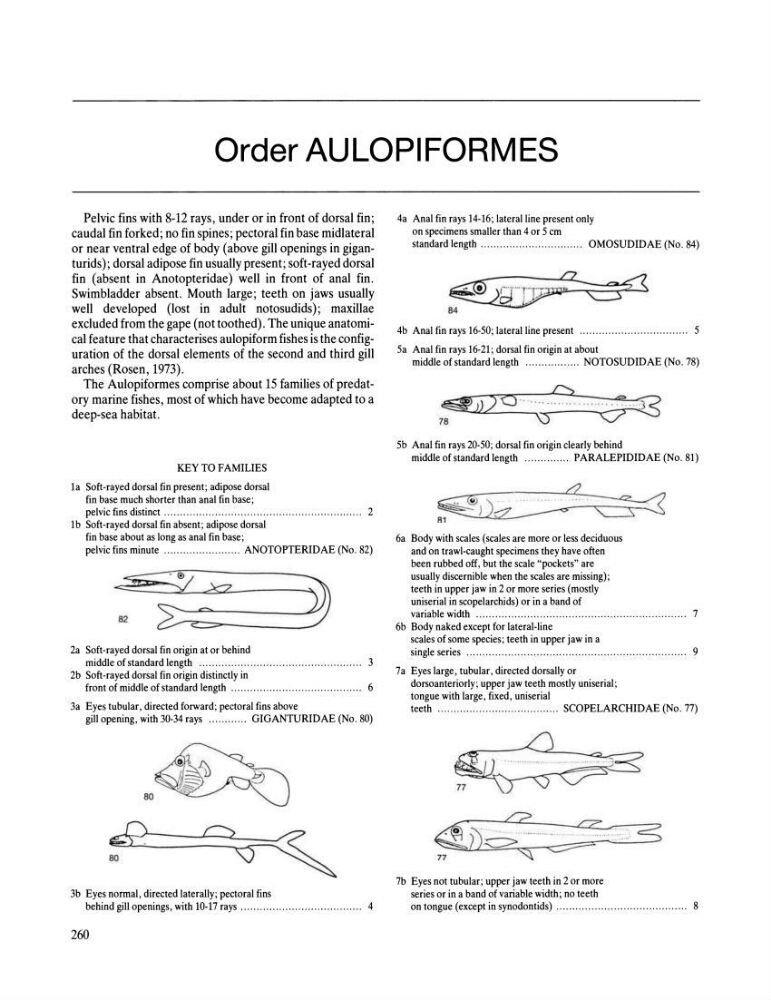
la Soft-rayed dorsal fin present; adipose dorsal
fin base much shorter than anal fin base;
pelvic fins distinct.............................................................. 2
Ib Soft-rayed dorsal fin absent; adipose dorsal
fin base about as long as anal fin base;
pelvic fins minute ........................ ANOTOPTERIDAE (No. 82)
2a Soft-rayed dorsal fin origin at or behind
middle of standard length . .. .. .. ... .. .. ...... .. .. ... .. .. ... .. ..... .. ... .. ... 3
2b Soft-rayed dorsal fin origin distinctly in
front of middle of standard length ......................................... 6
3a Eyes tubular, directed forward; pectoral fins above
gill opening, with 30-34 rays ............ GIGANTURIDAE (No. 80)
80
3b Eyes normal, directed laterally; pectoral fins
behind gill openings, with 10-17 rays...................................... 4
260
4a Anal fin rays 14-16; lateral line present only
on specimens smaller than 4 or 5 cm
standard length..................... ..... ...... OMOSUDIDAE (No. 84)
~~
84
4b Anal fin rays 16-50; lateral line present .................................. 5
5a Anal fin rays 16-21; dorsal fin origin at about
middle of standard length ................. NOTOSUDIDAE (No. 78)
_ _ .,.,....., _ _ 0
7~))O ..... ~ .. .. .... .. .. ~
5b Anal fin rays 20-50; dorsal fin origin clearly behind
middle of standard length .... .. .. .. .... P ARALEPID ID AE (No. 81)
~) d~" ~
81
6a Body with scales (scales are more or less deciduous
and on trawl-caught specimens they have often
been rubbed off, but the scale "pockets" are
usually discernible when the scales are missing);
teeth in upper jaw in 2 or more series (mostly
uniserial in scopelarchids) or in a band of
variable width ........................................ .. ... ..... .. .. ... .. ... .... 7
6b Body naked except for lateral-line
scales of some species; teeth in upper jaw in a
single series ..................................................................... 9
7a Eyes large, tubular, directed dorsally or
dorsoanteriorly; upper jaw teeth mostly uniserial;
tongue with large, fixed, uniserial
teeth ...................................... SCOPELARCHIDAE (No. 77)
7b Eyes not tubular; upper jaw teeth in 2 or more
series or in a band of variable width; no teeth
on tongue (except in synodontids) ......................................... 8
Pelvic fins with 8-12 rays, under or in front of dorsal fin;
caudal fin forked; no fin spines; pectoral fin base midlateral
or near ventral edge of body (above gill openings in giganturids); dorsal adipose fin usually present; soft-rayed dorsal
fin (absent in Anotopteridae) well in front of anal fin.
Swimbladder absent. Mouth large; teeth on jaws usually
well developed (lost in adult notosudids); maxillae
excluded from the gape (not toothed). The unique anatomical feature that characterises aulopiform fishes is the configuration of the dorsal elements of the second and third gill
arches (Rosen, 1973).
The Aulopiformes comprise about 15 families of predatory marine fishes, most of which have become adapted to a
deep-sea habitat.
KEY TO FAMILIES
la Soft-rayed dorsal fin present; adipose dorsal
fin base much shorter than anal fin base;
pelvic fins distinct.............................................................. 2
Ib Soft-rayed dorsal fin absent; adipose dorsal
fin base about as long as anal fin base;
pelvic fins minute ........................ ANOTOPTERIDAE (No. 82)
2a Soft-rayed dorsal fin origin at or behind
middle of standard length . .. .. .. ... .. .. ...... .. .. ... .. .. ... .. ..... .. ... .. ... 3
2b Soft-rayed dorsal fin origin distinctly in
front of middle of standard length ......................................... 6
3a Eyes tubular, directed forward; pectoral fins above
gill opening, with 30-34 rays ............ GIGANTURIDAE (No. 80)
80
3b Eyes normal, directed laterally; pectoral fins
behind gill openings, with 10-17 rays...................................... 4
260
4a Anal fin rays 14-16; lateral line present only
on specimens smaller than 4 or 5 cm
standard length..................... ..... ...... OMOSUDIDAE (No. 84)
~~
84
4b Anal fin rays 16-50; lateral line present .................................. 5
5a Anal fin rays 16-21; dorsal fin origin at about
middle of standard length ................. NOTOSUDIDAE (No. 78)
_ _ .,.,....., _ _ 0
7~))O ..... ~ .. .. .... .. .. ~
5b Anal fin rays 20-50; dorsal fin origin clearly behind
middle of standard length .... .. .. .. .... P ARALEPID ID AE (No. 81)
~) d~" ~
81
6a Body with scales (scales are more or less deciduous
and on trawl-caught specimens they have often
been rubbed off, but the scale "pockets" are
usually discernible when the scales are missing);
teeth in upper jaw in 2 or more series (mostly
uniserial in scopelarchids) or in a band of
variable width ........................................ .. ... ..... .. .. ... .. ... .... 7
6b Body naked except for lateral-line
scales of some species; teeth in upper jaw in a
single series ..................................................................... 9
7a Eyes large, tubular, directed dorsally or
dorsoanteriorly; upper jaw teeth mostly uniserial;
tongue with large, fixed, uniserial
teeth ...................................... SCOPELARCHIDAE (No. 77)
7b Eyes not tubular; upper jaw teeth in 2 or more
series or in a band of variable width; no teeth
on tongue (except in synodontids) ......................................... 8