

Seldom exceeds 45 mm SL. Indo-Pacific species taken in
500 - 1 000 m; not reported in our area, but common in Indian Ocean north of 15°S; reported to 30 0 S in Indian Ocean
east of 50 0 E longitude.
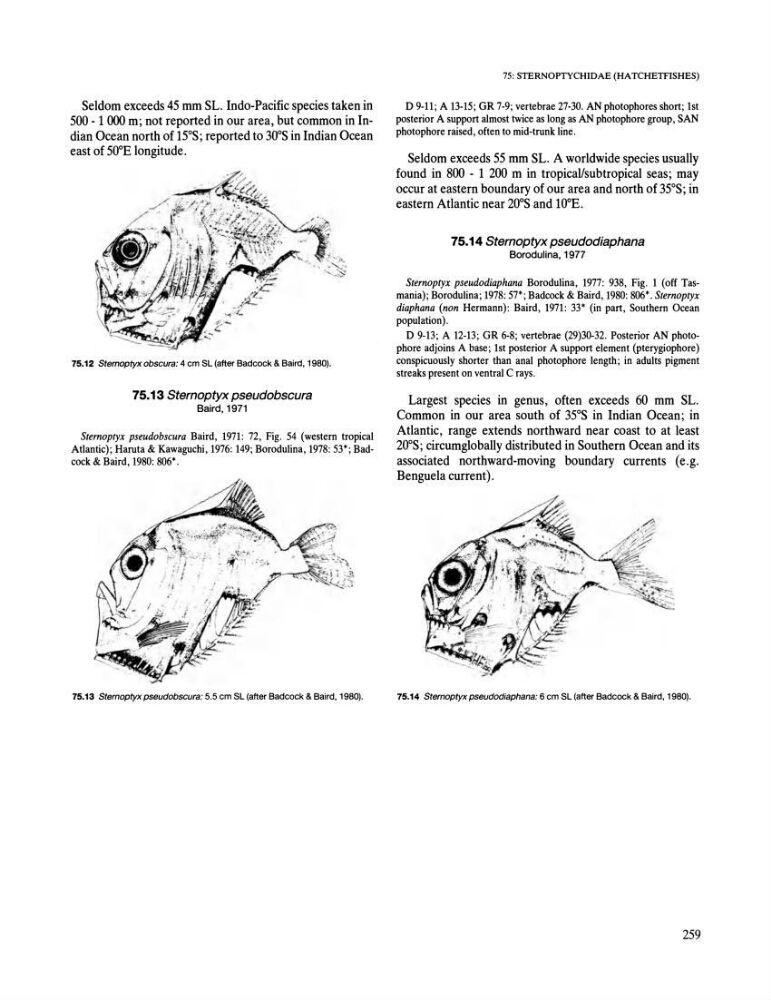
75.12 Stemoptyxobscura: 4 em SL (after Badeoek & Baird, 1980).
75.13 Sternoptyx pseudobscura
Baird,1971
Sternoptyx pseudobscura Baird, 1971: 72, Fig. 54 (western tropical
Atlantic); Haruta & Kawaguchi, 1976: 149; Borodulina, 1978: 53*; Badcock & Baird, 1980: 806*.
75.13 Stemoptyx pseudobscura: 5.5 em SL (after Badeoek & Baird, 1980).
75: STERNOPTYCHIDAE (HA TCHETFISHES)
D 9-11; A 13-15; GR 7-9; vertebrae 27-30. AN photophores short; 1st
posterior A support almost twice as long as AN photophore group, SAN
photophore raised, often to mid-trunk line.
Seldom exceeds 55 mm SL. A worldwide species usually
found in 800 - 1 200 m in tropical/subtropical seas; may
occur at eastern boundary of our area and north of 35°S; in
eastern Atlantic near 20 0 S and WOE.
75.14 Sternoptyx pseudodiaphana
Borodulina, 1977
Sternoptyx pseudodiaphana Borodulina, 1977: 938, Fig. 1 (off Tasmania); Borodulina; 1978: 57*; Badcock & Baird, 1980: 806*. Sternoptyx
diaphana (non Hermann): Baird, 1971: 33* (in part, Southern Ocean
population) .
D 9-13; A 12-13; GR 6-8; vertebrae (29)30-32. Posterior AN photophore adjoins A base; 1st posterior A support element (pterygiophore)
conspicuously shorter than anal photophore length; in adults pigment
streaks present on ventral Crays.
Largest species in genus, often exceeds 60 mm SL.
Common in our area south of 35°S in Indian Ocean; in
Atlantic, range extends northward near coast to at least
20 o S; circumglobally distributed in Southern Ocean and its
associated northward-moving boundary currents (e. g.
Benguela current).
75.14 Stemoptyx pseudodiaphana: 6 em SL (after Badeoek & Baird, 1980).
259
500 - 1 000 m; not reported in our area, but common in Indian Ocean north of 15°S; reported to 30 0 S in Indian Ocean
east of 50 0 E longitude.
75.12 Stemoptyxobscura: 4 em SL (after Badeoek & Baird, 1980).
75.13 Sternoptyx pseudobscura
Baird,1971
Sternoptyx pseudobscura Baird, 1971: 72, Fig. 54 (western tropical
Atlantic); Haruta & Kawaguchi, 1976: 149; Borodulina, 1978: 53*; Badcock & Baird, 1980: 806*.
75.13 Stemoptyx pseudobscura: 5.5 em SL (after Badeoek & Baird, 1980).
75: STERNOPTYCHIDAE (HA TCHETFISHES)
D 9-11; A 13-15; GR 7-9; vertebrae 27-30. AN photophores short; 1st
posterior A support almost twice as long as AN photophore group, SAN
photophore raised, often to mid-trunk line.
Seldom exceeds 55 mm SL. A worldwide species usually
found in 800 - 1 200 m in tropical/subtropical seas; may
occur at eastern boundary of our area and north of 35°S; in
eastern Atlantic near 20 0 S and WOE.
75.14 Sternoptyx pseudodiaphana
Borodulina, 1977
Sternoptyx pseudodiaphana Borodulina, 1977: 938, Fig. 1 (off Tasmania); Borodulina; 1978: 57*; Badcock & Baird, 1980: 806*. Sternoptyx
diaphana (non Hermann): Baird, 1971: 33* (in part, Southern Ocean
population) .
D 9-13; A 12-13; GR 6-8; vertebrae (29)30-32. Posterior AN photophore adjoins A base; 1st posterior A support element (pterygiophore)
conspicuously shorter than anal photophore length; in adults pigment
streaks present on ventral Crays.
Largest species in genus, often exceeds 60 mm SL.
Common in our area south of 35°S in Indian Ocean; in
Atlantic, range extends northward near coast to at least
20 o S; circumglobally distributed in Southern Ocean and its
associated northward-moving boundary currents (e. g.
Benguela current).
75.14 Stemoptyx pseudodiaphana: 6 em SL (after Badeoek & Baird, 1980).
259