

75: STERNOPTYCHIDAE (HA TCHETFISHES)
Dark dorsal pigment bar posterior to head does not reach
midline. Largest specimen less than 50 mm SL. Known
from a few specimens off Madagascar; several specimens
reported from tropical Pacific.
75.10 Po/yipnus pol/i
Schultz, 1961
Polyipnus polli Schultz, 1961 : 535, Fig. 13 (off Congo); Baird, 1971 :
98*; Karrer , 1975: 68. Polyipnus laternatus (non Garman): Norman, 1930:
303*; Poll, 1953: 64* . Polyipnus spinosus (non Gunther): Smith, SFSA
No. 159*.
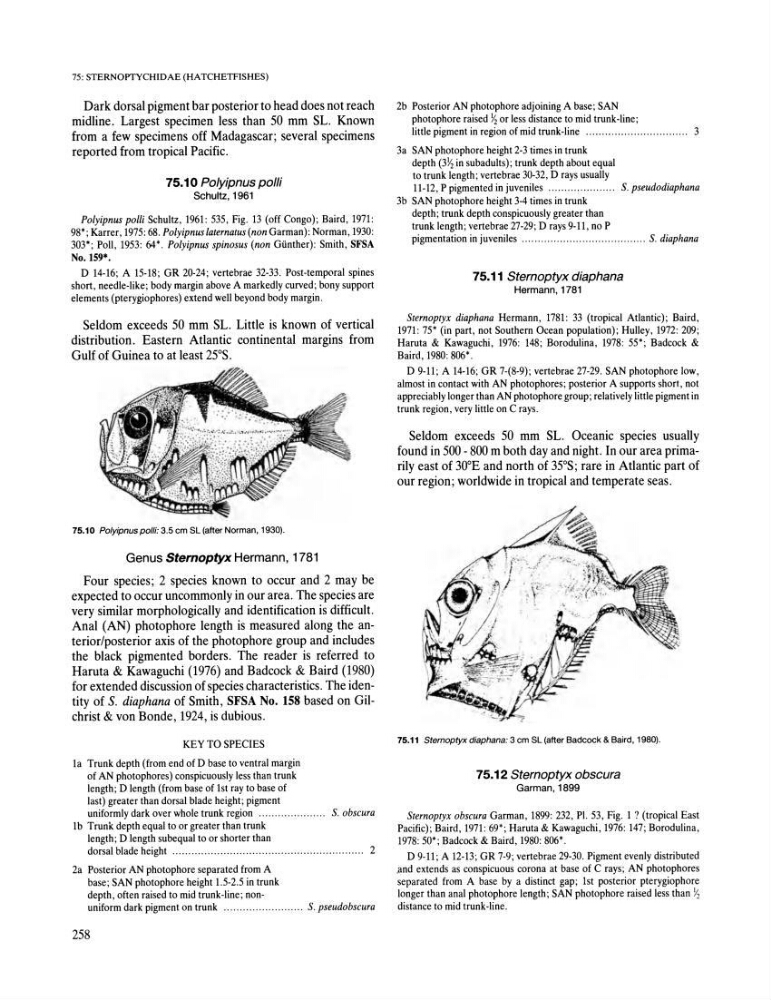
D 14-16; A 15-18; GR 20-24; vertebrae 32-33 . Post-temporal spines
short, needle-like; body margin above A markedly curved; bony support
elements (pterygiophores) extend well beyond body margin.
Seldom exceeds 50 mm SL. Little is known of vertical
distribution. Eastern Atlantic continental margins from
Gulf of Guinea to at least 2SOS.
75.10 Po/yipnus pOIli: 3 .5 em SL (after Norman. 1930).
Genus Sternoptyx Hermann, 1781
Four species; 2 species known to occur and 2 may be
expected to occur uncommonly in our area. The species are
very similar morphologically and identification is difficult.
Anal (AN) photophore length is measured along the anterior/posterior axis of the photophore group and includes
the black pigmented borders. The reader is referred to
Haruta & Kawaguchi (1976) and Badcock & Baird (1980)
for extended discussion of species characteristics. The identity of S. diaphana of Smith, SFSA No. 158 based on Gilchrist & von Bonde, 1924, is dubious.
KEY TO SPECIES
la Trunk depth (from end of D base to ventral margin
of AN photophores) conspicuously less than trunk
length ; D length (from base of 1st ray to base of
last) greater than dorsal blade height; pigment
uniformly dark over whole trunk region ............. ...... .. S. obscura
Ib Trunk depth equal to or greater than trunk
length; D length subequal to or shorter than
dorsal blade height ... ..... .... .. .... ... .... .. .... ... ... .. ... ...... .... ....... . 2
2a Posterior AN photophore separated from A
base; SAN photophore height 1.5-2.5 in trunk
depth , often raised to mid trunk-line ; nonuniform dark pigment on trunk .. .. ... ..... .... ...... ... S. pseudobscura
258
2b Posterior AN photophore adjoining A base; SAN
photophore raised Yz or less distance to mid trunk-line;
little pigment in region of mid trunk-line ........ .... .......... ... .... ... 3
3a SAN photophore height 2-3 times in trunk
depth (3Yz in subadults); trunk depth about equal
to trunk length ; vertebrae 30-32, D rays usually
11-12, P pigmented in juveniles .. ................... S. pseudodiaphana
3b SAN photophore height 3-4 times in trunk
depth; trunk depth conspicuously greater than
trunk length; vertebrae 27-29; Drays 9-11, no P
pigmentation in juveniles ..... .... ..... ... ..... ........... ...... S. diaphana
75.11 Sternoptyx diaphana
Hermann, 1781
Sternoptyx diaphana Hermann, 1781 : 33 (tropical Atlantic); Baird,
1971 : 75* (in part, not Southern Ocean population); Hulley , 1972: 209;
Haruta & Kawaguchi , 1976: 148; Borodulina, 1978: 55*; Badcock &
Baird, 1980: 806 * .
D 9-11 ; A 14-16; GR 7-(8-9); vertebrae 27-29. SAN photophore low,
almost in contact with AN photophores; posterior A supports short, not
appreciably longer than AN photophore group; relatively little pigment in
trunk region, very little on Crays.
Seldom exceeds 50 mm SL. Oceanic species usually
found in 500 - 800 m both day and night. In our area primarily east of 30 0 E and north of 35°S; rare in Atlantic part of
our region; worldwide in tropical and temperate seas.
75.11 Sternoptyx diaphana: 3 em SL (after Badcoek & Baird, 1980).
75.12 Sternoptyx obscura
Garman, 1899
Sternoptyx obscura Garman, 1899: 232, PI. 53 , Fig. 1 ? (tropical East
Pacific); Baird, 1971: 69*; Haruta & Kawaguchi , 1976: 147 ; Borodulina ,
1978: 50*; Badcock & Baird, 1980: 806* .
D 9-11; A 12-13; GR 7-9; vertebrae 29-30. Pigment evenly distributed
,and extends as conspicuous corona at base of C rays; AN photophores
separated from A base by a distinct gap; 1st posterior pterygiophore
longer than anal photophore length; SAN photophore raised less than ).]
distance to mid trunk-line .
Dark dorsal pigment bar posterior to head does not reach
midline. Largest specimen less than 50 mm SL. Known
from a few specimens off Madagascar; several specimens
reported from tropical Pacific.
75.10 Po/yipnus pol/i
Schultz, 1961
Polyipnus polli Schultz, 1961 : 535, Fig. 13 (off Congo); Baird, 1971 :
98*; Karrer , 1975: 68. Polyipnus laternatus (non Garman): Norman, 1930:
303*; Poll, 1953: 64* . Polyipnus spinosus (non Gunther): Smith, SFSA
No. 159*.
D 14-16; A 15-18; GR 20-24; vertebrae 32-33 . Post-temporal spines
short, needle-like; body margin above A markedly curved; bony support
elements (pterygiophores) extend well beyond body margin.
Seldom exceeds 50 mm SL. Little is known of vertical
distribution. Eastern Atlantic continental margins from
Gulf of Guinea to at least 2SOS.
75.10 Po/yipnus pOIli: 3 .5 em SL (after Norman. 1930).
Genus Sternoptyx Hermann, 1781
Four species; 2 species known to occur and 2 may be
expected to occur uncommonly in our area. The species are
very similar morphologically and identification is difficult.
Anal (AN) photophore length is measured along the anterior/posterior axis of the photophore group and includes
the black pigmented borders. The reader is referred to
Haruta & Kawaguchi (1976) and Badcock & Baird (1980)
for extended discussion of species characteristics. The identity of S. diaphana of Smith, SFSA No. 158 based on Gilchrist & von Bonde, 1924, is dubious.
KEY TO SPECIES
la Trunk depth (from end of D base to ventral margin
of AN photophores) conspicuously less than trunk
length ; D length (from base of 1st ray to base of
last) greater than dorsal blade height; pigment
uniformly dark over whole trunk region ............. ...... .. S. obscura
Ib Trunk depth equal to or greater than trunk
length; D length subequal to or shorter than
dorsal blade height ... ..... .... .. .... ... .... .. .... ... ... .. ... ...... .... ....... . 2
2a Posterior AN photophore separated from A
base; SAN photophore height 1.5-2.5 in trunk
depth , often raised to mid trunk-line ; nonuniform dark pigment on trunk .. .. ... ..... .... ...... ... S. pseudobscura
258
2b Posterior AN photophore adjoining A base; SAN
photophore raised Yz or less distance to mid trunk-line;
little pigment in region of mid trunk-line ........ .... .......... ... .... ... 3
3a SAN photophore height 2-3 times in trunk
depth (3Yz in subadults); trunk depth about equal
to trunk length ; vertebrae 30-32, D rays usually
11-12, P pigmented in juveniles .. ................... S. pseudodiaphana
3b SAN photophore height 3-4 times in trunk
depth; trunk depth conspicuously greater than
trunk length; vertebrae 27-29; Drays 9-11, no P
pigmentation in juveniles ..... .... ..... ... ..... ........... ...... S. diaphana
75.11 Sternoptyx diaphana
Hermann, 1781
Sternoptyx diaphana Hermann, 1781 : 33 (tropical Atlantic); Baird,
1971 : 75* (in part, not Southern Ocean population); Hulley , 1972: 209;
Haruta & Kawaguchi , 1976: 148; Borodulina, 1978: 55*; Badcock &
Baird, 1980: 806 * .
D 9-11 ; A 14-16; GR 7-(8-9); vertebrae 27-29. SAN photophore low,
almost in contact with AN photophores; posterior A supports short, not
appreciably longer than AN photophore group; relatively little pigment in
trunk region, very little on Crays.
Seldom exceeds 50 mm SL. Oceanic species usually
found in 500 - 800 m both day and night. In our area primarily east of 30 0 E and north of 35°S; rare in Atlantic part of
our region; worldwide in tropical and temperate seas.
75.11 Sternoptyx diaphana: 3 em SL (after Badcoek & Baird, 1980).
75.12 Sternoptyx obscura
Garman, 1899
Sternoptyx obscura Garman, 1899: 232, PI. 53 , Fig. 1 ? (tropical East
Pacific); Baird, 1971: 69*; Haruta & Kawaguchi , 1976: 147 ; Borodulina ,
1978: 50*; Badcock & Baird, 1980: 806* .
D 9-11; A 12-13; GR 7-9; vertebrae 29-30. Pigment evenly distributed
,and extends as conspicuous corona at base of C rays; AN photophores
separated from A base by a distinct gap; 1st posterior pterygiophore
longer than anal photophore length; SAN photophore raised less than ).]
distance to mid trunk-line .