

coloration at night. Single, characteristic, subabdominal
spine with prominent serrations. Rarely exceeds 38 mm.
Generally found in 250 - 650 m; little apparent vertical
migration. Common in our area to 35°S on either side of
Cape of Good Hope; broad worldwide distribution.
75.7 Argyrope/ecus s/adeni
Regan, 1908
Argyropelecus sladeni Regan, 1908: 218 (Chagos Archipelago, Indian
Ocean); Baird, 1971: 65*; Hecht & Hecht, 1978: 202*; Borodulina, 1978:
45*. Argyropelecus olfersi (non Cuvier): Barnard, 1925: 153; Smith, SFSA
No. 161.
D 9; A 12; GR 17-21; vertebrae 35-37. Body depth posterior to D 2 in
SL; dorsal blade low, not pronounced; no large canine teeth; postabdominal spines small, nearly symmetrical.
Seldom exceeds 60 mm. Small vertical migration indicated: 100 - 350 m at night, 350 - 600 m by day. Probably
limited in our area to west of 20oE. Worldwide; reported to
12°S in Indian Ocean.
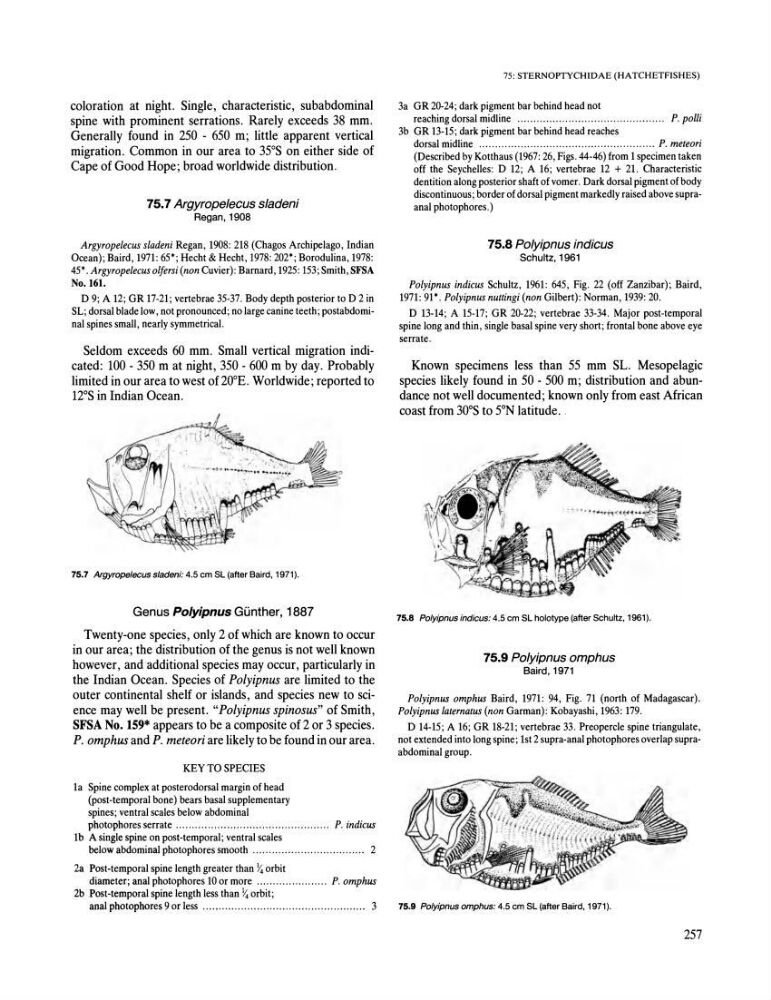
75.7 Argyropelecus sladeni: 4.5 em SL (after Baird, 1971).
Genus Po/yipnus Gunther, 1887
Twenty-one species, only 2 of which are known to occur
in our area; the distribution of the genus is not well known
however, and additional species may occur, particularly in
the Indian Ocean. Species of Poiyipnus are limited to the
outer continental shelf or islands, and species new to science may well be present. "Poiyipnus spinosus" of Smith,
SFSA No. 159* appears to be a composite of 2 or 3 species.
P. omphus and P. meteori are likely to be found in our area.
KEY TO SPECIES
1a Spine complex at posterodorsal margin of head
(post-temporal bone) bears basal supplementary
spines; ventral scales below abdominal
photophores serrate ................................................ P. indicus
Ib A single spine on post-temporal; ventral scales
below abdominal photophores smooth ............................ ....... 2
2a Post-temporal spine length greater than ~ orbit
diameter; anal photophores 10 or more ...................... P. omphus
2b Post-temporal spine length less than ~ orbit;
anal photophores 9 or less ................................................... 3
75: STERNOPTYCHIDAE (HATCHETFISHES)
3a GR 20-24; dark pigment bar behind head not
reaching dorsal midline .............................................. P. polli
3b GR 13-15; dark pigment bar behind head reaches
dorsal midline ....................................................... P. meteori
(Described by Kotthaus (1967: 26, Figs. 44-46) from 1 specimen taken
off the Seychelles: D 12; A 16; vertebrae 12 + 21. Characteristic
dentition along posterior shaft of vomer. Dark dorsal pigment of body
discontinuous; border of dorsal pigment markedly raised above supraanal photophores.)
75.8 Po/yipnus indicus
Schultz, 1961
Polyipnus indicus Schultz, 1961: 645, Fig. 22 (off Zanzibar); Baird,
1971: 91 *. Polyipnus nuttingi (non Gilbert): Norman, 1939: 20.
D 13-14; A 15-17; GR 20-22; vertebrae 33-34. Major post-temporal
spine long and thin, single basal spine very short; frontal bone above eye
serrate.
Known specimens less than 55 mm SL. Mesopelagic
species likely found in 50 - 500 m; distribution and abundance not well documented; known only from east African
coast from 30 0 S to 5°N latitude ..
75.8 Polyipnus indicus: 4.5 em SL holotype (after Schultz, 1961).
75.9 Po/yipnus omphus
Baird,1971
Polyipnus omphus Baird, 1971: 94, Fig. 71 (north of Madagascar).
Polyipnus laternatus (non Garman): Kobayashi, 1963: 179.
D 14-15; A 16; GR 18-21; vertebrae 33. PreopercIe spine triangulate,
not extended into long spine; 1st 2 supra-anal photophores overlap supraabdominal group.
75.9 Polyipnus omphus: 4.5 em SL (after Baird, 1971).
257
spine with prominent serrations. Rarely exceeds 38 mm.
Generally found in 250 - 650 m; little apparent vertical
migration. Common in our area to 35°S on either side of
Cape of Good Hope; broad worldwide distribution.
75.7 Argyrope/ecus s/adeni
Regan, 1908
Argyropelecus sladeni Regan, 1908: 218 (Chagos Archipelago, Indian
Ocean); Baird, 1971: 65*; Hecht & Hecht, 1978: 202*; Borodulina, 1978:
45*. Argyropelecus olfersi (non Cuvier): Barnard, 1925: 153; Smith, SFSA
No. 161.
D 9; A 12; GR 17-21; vertebrae 35-37. Body depth posterior to D 2 in
SL; dorsal blade low, not pronounced; no large canine teeth; postabdominal spines small, nearly symmetrical.
Seldom exceeds 60 mm. Small vertical migration indicated: 100 - 350 m at night, 350 - 600 m by day. Probably
limited in our area to west of 20oE. Worldwide; reported to
12°S in Indian Ocean.
75.7 Argyropelecus sladeni: 4.5 em SL (after Baird, 1971).
Genus Po/yipnus Gunther, 1887
Twenty-one species, only 2 of which are known to occur
in our area; the distribution of the genus is not well known
however, and additional species may occur, particularly in
the Indian Ocean. Species of Poiyipnus are limited to the
outer continental shelf or islands, and species new to science may well be present. "Poiyipnus spinosus" of Smith,
SFSA No. 159* appears to be a composite of 2 or 3 species.
P. omphus and P. meteori are likely to be found in our area.
KEY TO SPECIES
1a Spine complex at posterodorsal margin of head
(post-temporal bone) bears basal supplementary
spines; ventral scales below abdominal
photophores serrate ................................................ P. indicus
Ib A single spine on post-temporal; ventral scales
below abdominal photophores smooth ............................ ....... 2
2a Post-temporal spine length greater than ~ orbit
diameter; anal photophores 10 or more ...................... P. omphus
2b Post-temporal spine length less than ~ orbit;
anal photophores 9 or less ................................................... 3
75: STERNOPTYCHIDAE (HATCHETFISHES)
3a GR 20-24; dark pigment bar behind head not
reaching dorsal midline .............................................. P. polli
3b GR 13-15; dark pigment bar behind head reaches
dorsal midline ....................................................... P. meteori
(Described by Kotthaus (1967: 26, Figs. 44-46) from 1 specimen taken
off the Seychelles: D 12; A 16; vertebrae 12 + 21. Characteristic
dentition along posterior shaft of vomer. Dark dorsal pigment of body
discontinuous; border of dorsal pigment markedly raised above supraanal photophores.)
75.8 Po/yipnus indicus
Schultz, 1961
Polyipnus indicus Schultz, 1961: 645, Fig. 22 (off Zanzibar); Baird,
1971: 91 *. Polyipnus nuttingi (non Gilbert): Norman, 1939: 20.
D 13-14; A 15-17; GR 20-22; vertebrae 33-34. Major post-temporal
spine long and thin, single basal spine very short; frontal bone above eye
serrate.
Known specimens less than 55 mm SL. Mesopelagic
species likely found in 50 - 500 m; distribution and abundance not well documented; known only from east African
coast from 30 0 S to 5°N latitude ..
75.8 Polyipnus indicus: 4.5 em SL holotype (after Schultz, 1961).
75.9 Po/yipnus omphus
Baird,1971
Polyipnus omphus Baird, 1971: 94, Fig. 71 (north of Madagascar).
Polyipnus laternatus (non Garman): Kobayashi, 1963: 179.
D 14-15; A 16; GR 18-21; vertebrae 33. PreopercIe spine triangulate,
not extended into long spine; 1st 2 supra-anal photophores overlap supraabdominal group.
75.9 Polyipnus omphus: 4.5 em SL (after Baird, 1971).
257