

75: STERNOPTYCHIDAE (HATCHETFISHES)
75.3 Argyropelecus aculeatus
Valenciennes, 1849
Argyrope/ecus acu/eatus Valenciennes, in Cuv. & Val., 1849: 406
(Azores); Grindley & Penrith, 1965: 282; Baird, 1971: 48*; Hulley, 1972:
208; Borodulina, 1978: 40* . Argyrope/ecus amabilis Ogilby, 1888: 1313
(Lord Howe Id .); Grindley & Penrith, 1965: 282. Argyrope/ecus caninus
Garman, 1899: 235 (Indian Ocean).
D 9; A 12; GR 15-17; vertebrae 34-36. Body depth at posterior of dorsal
blade less than 1.4 in SL. Small serrate spines ventral to caudal photophores.
Exceeds 70 mm. In 200 - 500 m by day, diurnal vertical
migration to about 150 m at night. Common in our area,
particularly east of 20oE; worldwide in tropical and temperate seas.
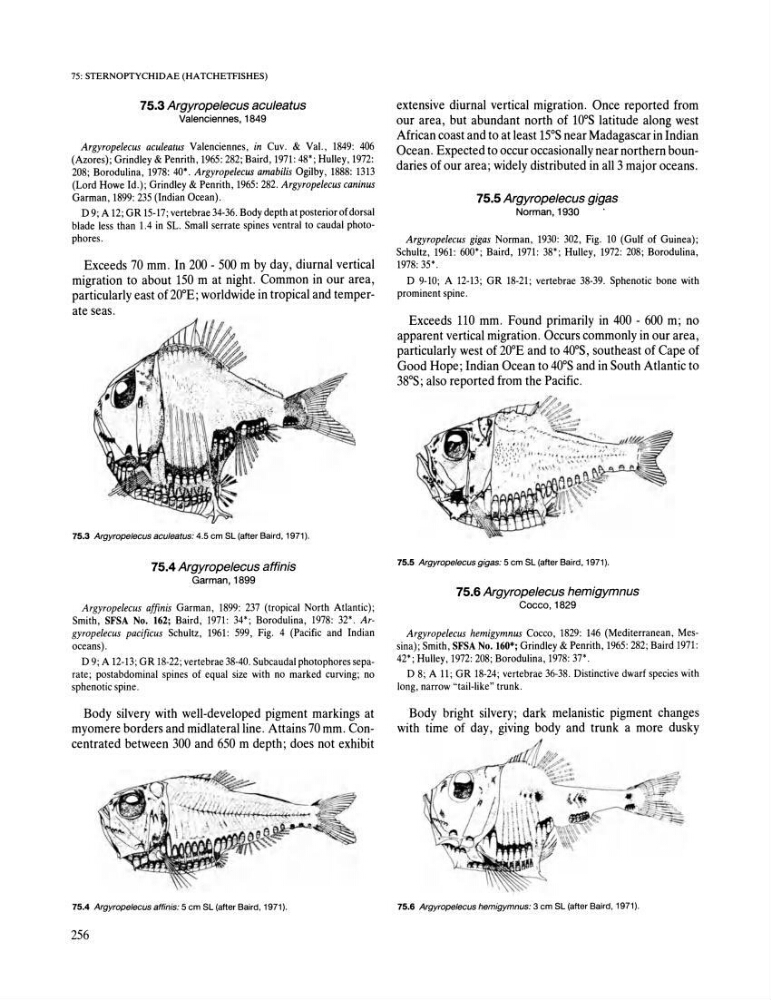
75.3 Argyropelecus aculeatus: 4.5 em SL (after Baird, 1971).
75.4 Argyropelecus affinis
Garman, 1899
Argyrope/ecus affinis Garman, 1899: 237 (tropical North Atlantic);
Smith, SFSA No. 162; Baird, 1971 : 34*; Borodulina, 1978: 32* Argyrope/ecus pacificus Schultz, 1961: 599, Fig. 4 (Pacific and Indian
oceans) .
D 9; A 12-13; GR 18-22; vertebrae 38-40. Subcaudal photophores separate; postabdominal spines of equal size with no marked curving; no
sphenotic spine.
Body silvery with well-developed pigment markings at
myomere borders and midlateralline. Attains 70 mm. Concentrated between 300 and 650 m depth; does not exhibit
75.4 Argyropelecus affinis: 5 em SL (after Baird, 1971).
256
extensive diurnal vertical migration. Once reported from
our area, but abundant north of lOoS latitude along west
African coast and to at least 15°S near Madagascar in Indian
Ocean. Expected to occur occasionally near northern boundaries of our area; widely distributed in all 3 major oceans.
75.5 Argyropelecus gigas
Norman, 1930
Argyrope/ecus gigas Norman, 1930: 302, Fig. 10 (Gulf of Guinea);
Schultz, 1961: 600*; Baird, 1971: 38* ; Hulley, 1972: 208; Borodulina,
1978: 35* .
D 9-10; A 12-13; GR 18-21; vertebrae 38-39. Sphenotic bone with
prominent spine.
Exceeds 110 mm . Found primarily in 400 - 600 m; no
apparent vertical migration. Occurs commonly in our area,
particularly west of 200E and to 40 o S, southeast of Cape of
Good Hope; Indian Ocean to 40 0 S and in South Atlantic to
38°S; also reported from the Pacific.
75.5 Argyropelecus gigas: 5 em SL (after Baird, 1971).
75.6 Argyropelecus hemigymnus
Cocco, 1829
Argyrope/ecus hemigymnus Cocco , 1829: 146 (Mediterranean , Messina); Smith, SFSA No. 160*; Grindley & Penrith, 1965: 282; Baird 1971:
42* ; Hulley, 1972: 208; Borodulina, 1978: 37*.
D 8; A 11; GR 18-24; vertebrae 36-38 . Distinctive dwarf species with
long, narrow "tail-like" trunk .
Body bright silvery; dark melanistic pigment changes
with time of day, giving body and trunk a more dusky
75.6 Argyropelecus hemigymnus: 3 em SL (after Baird, 1971).
75.3 Argyropelecus aculeatus
Valenciennes, 1849
Argyrope/ecus acu/eatus Valenciennes, in Cuv. & Val., 1849: 406
(Azores); Grindley & Penrith, 1965: 282; Baird, 1971: 48*; Hulley, 1972:
208; Borodulina, 1978: 40* . Argyrope/ecus amabilis Ogilby, 1888: 1313
(Lord Howe Id .); Grindley & Penrith, 1965: 282. Argyrope/ecus caninus
Garman, 1899: 235 (Indian Ocean).
D 9; A 12; GR 15-17; vertebrae 34-36. Body depth at posterior of dorsal
blade less than 1.4 in SL. Small serrate spines ventral to caudal photophores.
Exceeds 70 mm. In 200 - 500 m by day, diurnal vertical
migration to about 150 m at night. Common in our area,
particularly east of 20oE; worldwide in tropical and temperate seas.
75.3 Argyropelecus aculeatus: 4.5 em SL (after Baird, 1971).
75.4 Argyropelecus affinis
Garman, 1899
Argyrope/ecus affinis Garman, 1899: 237 (tropical North Atlantic);
Smith, SFSA No. 162; Baird, 1971 : 34*; Borodulina, 1978: 32* Argyrope/ecus pacificus Schultz, 1961: 599, Fig. 4 (Pacific and Indian
oceans) .
D 9; A 12-13; GR 18-22; vertebrae 38-40. Subcaudal photophores separate; postabdominal spines of equal size with no marked curving; no
sphenotic spine.
Body silvery with well-developed pigment markings at
myomere borders and midlateralline. Attains 70 mm. Concentrated between 300 and 650 m depth; does not exhibit
75.4 Argyropelecus affinis: 5 em SL (after Baird, 1971).
256
extensive diurnal vertical migration. Once reported from
our area, but abundant north of lOoS latitude along west
African coast and to at least 15°S near Madagascar in Indian
Ocean. Expected to occur occasionally near northern boundaries of our area; widely distributed in all 3 major oceans.
75.5 Argyropelecus gigas
Norman, 1930
Argyrope/ecus gigas Norman, 1930: 302, Fig. 10 (Gulf of Guinea);
Schultz, 1961: 600*; Baird, 1971: 38* ; Hulley, 1972: 208; Borodulina,
1978: 35* .
D 9-10; A 12-13; GR 18-21; vertebrae 38-39. Sphenotic bone with
prominent spine.
Exceeds 110 mm . Found primarily in 400 - 600 m; no
apparent vertical migration. Occurs commonly in our area,
particularly west of 200E and to 40 o S, southeast of Cape of
Good Hope; Indian Ocean to 40 0 S and in South Atlantic to
38°S; also reported from the Pacific.
75.5 Argyropelecus gigas: 5 em SL (after Baird, 1971).
75.6 Argyropelecus hemigymnus
Cocco, 1829
Argyrope/ecus hemigymnus Cocco , 1829: 146 (Mediterranean , Messina); Smith, SFSA No. 160*; Grindley & Penrith, 1965: 282; Baird 1971:
42* ; Hulley, 1972: 208; Borodulina, 1978: 37*.
D 8; A 11; GR 18-24; vertebrae 36-38 . Distinctive dwarf species with
long, narrow "tail-like" trunk .
Body bright silvery; dark melanistic pigment changes
with time of day, giving body and trunk a more dusky
75.6 Argyropelecus hemigymnus: 3 em SL (after Baird, 1971).