

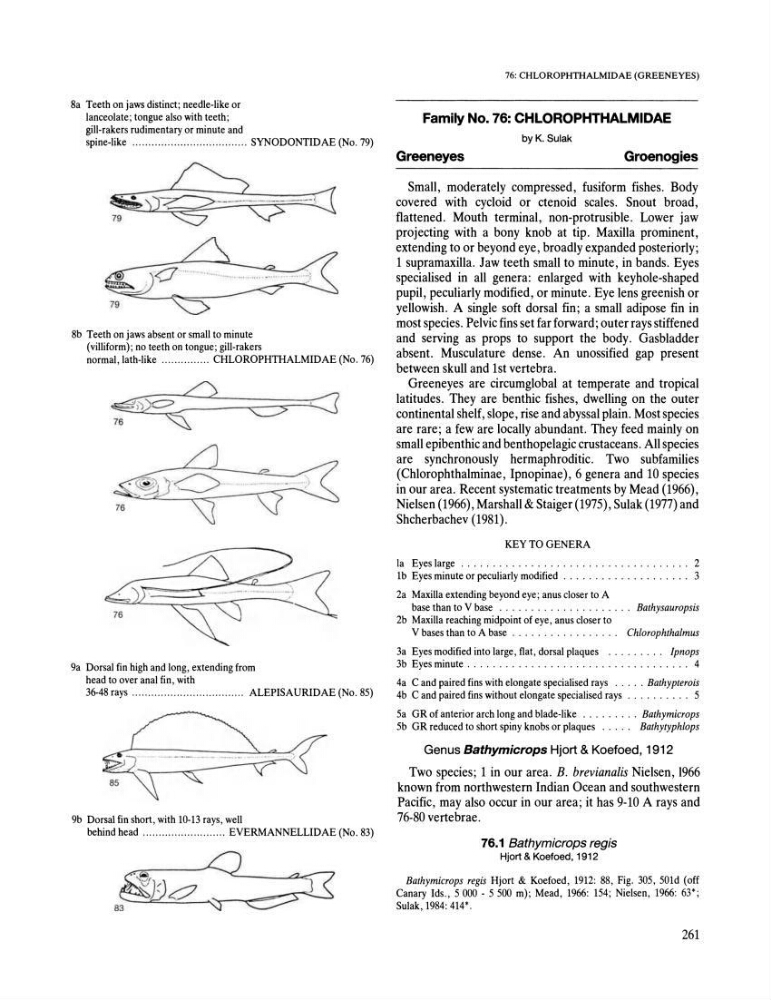
8a Teeth on jaws distinct; needle-like or
Ian ceo late ; tongue also with teeth;
gill-rakers rudimentary or minute and
spine-like .................................... SYNODONTIDAE (No. 79)
8b Teeth on jaws absent or small to minute
(villiform); no teeth on tongue; gill-rakers
normal, lath-like ............... CHLOROPHTHALMIDAE (No. 76)
9a Dorsal fin high and long, extending from
head to over anal fin, with
36-48 rays ................................... ALEPISAURIDAE (No. 85)
9b Dorsal fin short, with 10-13 rays, well
behind head .......................... EVERMANNELLIDAE (No. 83)
76: CHLOROPHTHALMIDAE (GREENE YES)
Family No. 76: CHLOROPHTHALMIDAE
byK. Sulak
Greeneyes
Groenogies
Small, moderately compressed, fusiform fishes. Body
covered with cycloid or ctenoid scales. Snout broad,
flattened. Mouth terminal, non-protrusible. Lower jaw
projecting with a bony knob at tip. Maxilla prominent,
extending to or beyond eye, broadly expanded posteriorly;
1 supramaxilla. Jaw teeth small to minute, in bands. Eyes
specialised in all genera: enlarged with keyhole-shaped
pupil, peculiarly modified, or minute. Eye lens greenish or
yellowish. A single soft dorsal fin; a small adipose fin in
most species. Pelvic fins set far forward; outer rays stiffened
and serving as props to support the body. Gasbladder
absent. Musculature dense. An un ossified gap present
between skull and 1st vertebra.
Greeneyes are circumglobal at temperate and tropical
latitudes. They are benthic fishes, dwelling on the outer
continental shelf, slope, rise and abyssal plain. Most species
are rare; a few are locally abundant. They feed mainly on
small epibenthic and benthopelagic crustaceans. All species
are synchronously hermaphroditic. Two subfamilies
(Chlorophthalminae, Ipnopinae), 6 genera and 10 species
in our area. Recent systematic treatments by Mead (1966),
Nielsen (1966), Marshall & Staiger (1975), Sulak (1977) and
Shcherbachev (1981).
KEY TO GENERA
la Eyes large . . . . . . . . . . . . . . . . . . . . . . . . . . . . . . . . . . . . 2
Ib Eyes minute or peculiarly modified . . . . . . . . . . . . . . . . . . . . 3
2a Maxilla extending beyond eye; anus closer to A
base than to V base . . . . . . . . . . . . . . . . . . . . . Bathysauropsis
2b Maxilla reaching midpoint of eye, anus closer to
V bases than to A base . . . . . . . . . . . . . . . .. Chlorophthalmus
3a Eyes modified into large, flat, dorsal plaques ......... Jpnops
3b Eyes minute . . . . . . . . . . . . . . . . . . . . . . . . . . . . . . . . . . . 4
4a C and paired fins with elongate specialised rays ..... Bathypterois
4b C and paired fins without elongate specialised rays . . . . . . . . . . 5
Sa GR of anterior arch long and blade-like ......... Bathymicrops
5b GR reduced to short spiny knobs or plaques .. . .. Bathytyphlops
Genus Bathymicrops Hjort & Koefoed, 1912
Two species; 1 in our area. B. brevianalis Nielsen, 1966
known from northwestern Indian Ocean and southwestern
Pacific, may also occur in our area; it has 9-10 A rays and
76-80 vertebrae.
76.1 8athymicrops regis
Hjort & Koefoed, 1912
Bathymicrops regis Hjort & Koefoed, 1912: 88, Fig. 305, SOld (off
Canary Ids., 5000 - 5500 m); Mead, 1966: 154; Nielsen, 1966: 63*;
Sulak, 1984: 414 *.
261
Ian ceo late ; tongue also with teeth;
gill-rakers rudimentary or minute and
spine-like .................................... SYNODONTIDAE (No. 79)
8b Teeth on jaws absent or small to minute
(villiform); no teeth on tongue; gill-rakers
normal, lath-like ............... CHLOROPHTHALMIDAE (No. 76)
9a Dorsal fin high and long, extending from
head to over anal fin, with
36-48 rays ................................... ALEPISAURIDAE (No. 85)
9b Dorsal fin short, with 10-13 rays, well
behind head .......................... EVERMANNELLIDAE (No. 83)
76: CHLOROPHTHALMIDAE (GREENE YES)
Family No. 76: CHLOROPHTHALMIDAE
byK. Sulak
Greeneyes
Groenogies
Small, moderately compressed, fusiform fishes. Body
covered with cycloid or ctenoid scales. Snout broad,
flattened. Mouth terminal, non-protrusible. Lower jaw
projecting with a bony knob at tip. Maxilla prominent,
extending to or beyond eye, broadly expanded posteriorly;
1 supramaxilla. Jaw teeth small to minute, in bands. Eyes
specialised in all genera: enlarged with keyhole-shaped
pupil, peculiarly modified, or minute. Eye lens greenish or
yellowish. A single soft dorsal fin; a small adipose fin in
most species. Pelvic fins set far forward; outer rays stiffened
and serving as props to support the body. Gasbladder
absent. Musculature dense. An un ossified gap present
between skull and 1st vertebra.
Greeneyes are circumglobal at temperate and tropical
latitudes. They are benthic fishes, dwelling on the outer
continental shelf, slope, rise and abyssal plain. Most species
are rare; a few are locally abundant. They feed mainly on
small epibenthic and benthopelagic crustaceans. All species
are synchronously hermaphroditic. Two subfamilies
(Chlorophthalminae, Ipnopinae), 6 genera and 10 species
in our area. Recent systematic treatments by Mead (1966),
Nielsen (1966), Marshall & Staiger (1975), Sulak (1977) and
Shcherbachev (1981).
KEY TO GENERA
la Eyes large . . . . . . . . . . . . . . . . . . . . . . . . . . . . . . . . . . . . 2
Ib Eyes minute or peculiarly modified . . . . . . . . . . . . . . . . . . . . 3
2a Maxilla extending beyond eye; anus closer to A
base than to V base . . . . . . . . . . . . . . . . . . . . . Bathysauropsis
2b Maxilla reaching midpoint of eye, anus closer to
V bases than to A base . . . . . . . . . . . . . . . .. Chlorophthalmus
3a Eyes modified into large, flat, dorsal plaques ......... Jpnops
3b Eyes minute . . . . . . . . . . . . . . . . . . . . . . . . . . . . . . . . . . . 4
4a C and paired fins with elongate specialised rays ..... Bathypterois
4b C and paired fins without elongate specialised rays . . . . . . . . . . 5
Sa GR of anterior arch long and blade-like ......... Bathymicrops
5b GR reduced to short spiny knobs or plaques .. . .. Bathytyphlops
Genus Bathymicrops Hjort & Koefoed, 1912
Two species; 1 in our area. B. brevianalis Nielsen, 1966
known from northwestern Indian Ocean and southwestern
Pacific, may also occur in our area; it has 9-10 A rays and
76-80 vertebrae.
76.1 8athymicrops regis
Hjort & Koefoed, 1912
Bathymicrops regis Hjort & Koefoed, 1912: 88, Fig. 305, SOld (off
Canary Ids., 5000 - 5500 m); Mead, 1966: 154; Nielsen, 1966: 63*;
Sulak, 1984: 414 *.
261