

KEY TO SPECIES
1a All photophores of anterior AC group over
A base; last 2 IV displaced ventrally .. .... .. ..... ...... . M. obtusirostra
1b Ultimate photophores of anterior AC series
posterior to base of last A ray; IV series
straight ....... ... ........... .... .... ...... ................. ....... M. valentinae
74.15 Margrethia obtusirostra
Jespersen & Tflning, 1919
Margrethia obtusirostra Jespersen & Timing, 1919: 222, PI. 17, Figs. 11
and 12 (20"26'N, 61°03'W); Grey, 1964: 200*; Grindley & Penrith, 1965:
282; Mukhacheva, 1976: 81 (in part) .
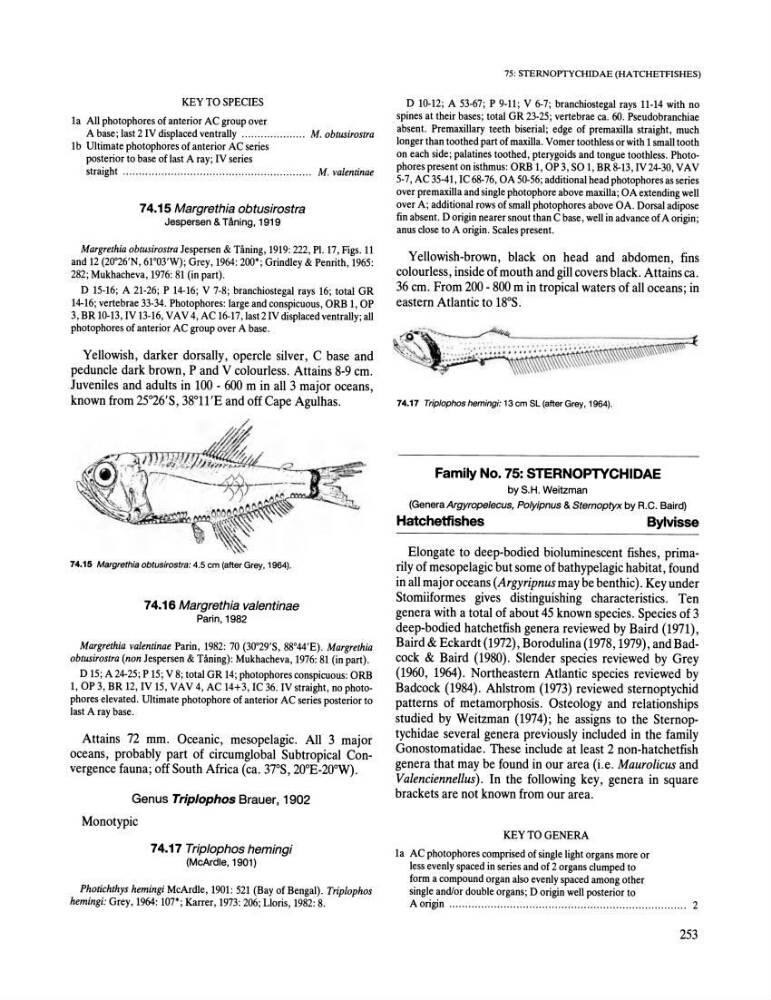
D 15-16; A 21-26; P 14-16; V 7-8; branchiostegal rays 16; total GR
14-16; vertebrae 33-34. Photophores: large and conspicuous, ORB 1, OP
3, BR 10-13, IV 13-16, VA V 4, AC 16-17, last 2 IV displaced ventrally; all
photophores of anterior AC group over A base.
Yellowish, darker dorsally, opercle silver, C base and
peduncle dark brown, P and V colourless. Attains 8-9 cm.
Juveniles and adults in 100 - 600 m in all 3 major oceans,
known from 25"26'S, 38°11'E and off Cape Agulhas.
74.15 Margrethia obtusirostra: 4.5 em (after Grey, 1964).
74.16 Margrethia valentinae
Parin, 1982
Margrethia valentinae Parin, 1982: 70 (30"29'5, 88°44'E). Margrethia
obtusirostra (non Jespersen & Taning): Mukhacheva, 1976: 81 (in part).
D 15; A 24-25; P 15; V 8; total GR 14; photophores conspicuous: ORB
1, OP 3, BR 12, IV 15, VAV 4, AC 14+3, IC 36. IV straight, no photophores elevated. Ultimate photophore of anterior AC series posterior to
last A ray base.
Attains 72 mm. Oceanic, mesopelagic. All 3 major
oceans, probably part of circumglobal Subtropical Convergence fauna; off South Africa (ca. 37°S, 20oE-200W).
Genus Trip/ophos Brauer, 1902
Monotypic
74.17 Triplophos hemingi
(McArdle, 1901)
Photichthys hemingi McArdle, 1901: 521 (Bay of Bengal). Triplophos
hemingi: Grey, 1964: 107*; Karrer, 1973: 206; Lioris, 1982: 8.
75: STERNOPTYCHIDAE (HATCHETFISHES)
D 10-12; A 53-67; P 9-11; V 6-7; branchiostegal rays 11-14 with no
spines at their bases; total GR 23-25; vertebrae ca. 60. Pseudobranchiae
absent. Premaxillary teeth biserial; edge of premaxilla straight, much
longer than toothed part of maxilla. Vomer toothless or with 1 small tooth
on each side; palatines toothed, pterygoids and tongue toothless. Photophores present on isthmus: ORB 1, OP 3, SO 1, BR 8-13, IV 24-30, VAV
5-7, AC 35-41, IC 68-76, OA 50-56; additional head photophores as series
over premaxilla and single photophore above maxilla; OA extending well
over A; additional rows of small photophores above OA. Dorsal adipose
fin absent. D origin nearer snout than C base, well in advance of A origin;
anus close to A origin. Scales present.
Yellowish-brown, black on head and abdomen, fins
colourless, inside of mouth and gill covers black. Attains ca.
36 cm. From 200 - 800 m in tropical waters of all oceans; in
eastern Atlantic to 18°S.
74.17 Triplophos hemingi: 13 em SL (after Grey, 1964).
Family No. 75: STERNOPTYCHIDAE
by S.H. Weitzman
(Genera Argyropelecus, Polyipnus & Stemoptyx by R.e. Baird)
Hatchetfishes
8y1visse
Elongate to deep-bodied bioluminescent fishes, primarily of mesopelagic but some of bathypelagic habitat, found
in all major oceans (Argyripnus may be benthic). Key under
Stomiiformes gives distinguishing characteristics. Ten
genera with a total of about 45 known species. Species of 3
deep-bodied hatchetfish genera reviewed by Baird (1971),
Baird & Eckardt (1972), Borodulina (1978, 1979), and Badcock & Baird (1980). Slender species reviewed by Grey
(1960, 1964). Northeastern Atlantic species reviewed by
Badcock (1984). Ahlstrom (1973) reviewed sternoptychid
patterns of metamorphosis. Osteology and relationships
studied by Weitzman (1974); he assigns to the Sternoptychidae several genera previously included in the family
Gonostomatidae. These include at least 2 non-hatchetfish
genera that may be found in our area (i.e. Maurolicus and
Valenciennellus). In the following key, genera in square
brackets are not known from our area.
KEY TO GENERA
1a AC photophores comprised of single light organs more or
less evenly spaced in series and of 2 organs clumped to
form a compound organ also evenly spaced among other
single and/or double organs; D origin well posterior to
Aorigin .... ......... ......... ....... .. ...... .... .... .... .... .... .... ..... ... ..... 2
253
1a All photophores of anterior AC group over
A base; last 2 IV displaced ventrally .. .... .. ..... ...... . M. obtusirostra
1b Ultimate photophores of anterior AC series
posterior to base of last A ray; IV series
straight ....... ... ........... .... .... ...... ................. ....... M. valentinae
74.15 Margrethia obtusirostra
Jespersen & Tflning, 1919
Margrethia obtusirostra Jespersen & Timing, 1919: 222, PI. 17, Figs. 11
and 12 (20"26'N, 61°03'W); Grey, 1964: 200*; Grindley & Penrith, 1965:
282; Mukhacheva, 1976: 81 (in part) .
D 15-16; A 21-26; P 14-16; V 7-8; branchiostegal rays 16; total GR
14-16; vertebrae 33-34. Photophores: large and conspicuous, ORB 1, OP
3, BR 10-13, IV 13-16, VA V 4, AC 16-17, last 2 IV displaced ventrally; all
photophores of anterior AC group over A base.
Yellowish, darker dorsally, opercle silver, C base and
peduncle dark brown, P and V colourless. Attains 8-9 cm.
Juveniles and adults in 100 - 600 m in all 3 major oceans,
known from 25"26'S, 38°11'E and off Cape Agulhas.
74.15 Margrethia obtusirostra: 4.5 em (after Grey, 1964).
74.16 Margrethia valentinae
Parin, 1982
Margrethia valentinae Parin, 1982: 70 (30"29'5, 88°44'E). Margrethia
obtusirostra (non Jespersen & Taning): Mukhacheva, 1976: 81 (in part).
D 15; A 24-25; P 15; V 8; total GR 14; photophores conspicuous: ORB
1, OP 3, BR 12, IV 15, VAV 4, AC 14+3, IC 36. IV straight, no photophores elevated. Ultimate photophore of anterior AC series posterior to
last A ray base.
Attains 72 mm. Oceanic, mesopelagic. All 3 major
oceans, probably part of circumglobal Subtropical Convergence fauna; off South Africa (ca. 37°S, 20oE-200W).
Genus Trip/ophos Brauer, 1902
Monotypic
74.17 Triplophos hemingi
(McArdle, 1901)
Photichthys hemingi McArdle, 1901: 521 (Bay of Bengal). Triplophos
hemingi: Grey, 1964: 107*; Karrer, 1973: 206; Lioris, 1982: 8.
75: STERNOPTYCHIDAE (HATCHETFISHES)
D 10-12; A 53-67; P 9-11; V 6-7; branchiostegal rays 11-14 with no
spines at their bases; total GR 23-25; vertebrae ca. 60. Pseudobranchiae
absent. Premaxillary teeth biserial; edge of premaxilla straight, much
longer than toothed part of maxilla. Vomer toothless or with 1 small tooth
on each side; palatines toothed, pterygoids and tongue toothless. Photophores present on isthmus: ORB 1, OP 3, SO 1, BR 8-13, IV 24-30, VAV
5-7, AC 35-41, IC 68-76, OA 50-56; additional head photophores as series
over premaxilla and single photophore above maxilla; OA extending well
over A; additional rows of small photophores above OA. Dorsal adipose
fin absent. D origin nearer snout than C base, well in advance of A origin;
anus close to A origin. Scales present.
Yellowish-brown, black on head and abdomen, fins
colourless, inside of mouth and gill covers black. Attains ca.
36 cm. From 200 - 800 m in tropical waters of all oceans; in
eastern Atlantic to 18°S.
74.17 Triplophos hemingi: 13 em SL (after Grey, 1964).
Family No. 75: STERNOPTYCHIDAE
by S.H. Weitzman
(Genera Argyropelecus, Polyipnus & Stemoptyx by R.e. Baird)
Hatchetfishes
8y1visse
Elongate to deep-bodied bioluminescent fishes, primarily of mesopelagic but some of bathypelagic habitat, found
in all major oceans (Argyripnus may be benthic). Key under
Stomiiformes gives distinguishing characteristics. Ten
genera with a total of about 45 known species. Species of 3
deep-bodied hatchetfish genera reviewed by Baird (1971),
Baird & Eckardt (1972), Borodulina (1978, 1979), and Badcock & Baird (1980). Slender species reviewed by Grey
(1960, 1964). Northeastern Atlantic species reviewed by
Badcock (1984). Ahlstrom (1973) reviewed sternoptychid
patterns of metamorphosis. Osteology and relationships
studied by Weitzman (1974); he assigns to the Sternoptychidae several genera previously included in the family
Gonostomatidae. These include at least 2 non-hatchetfish
genera that may be found in our area (i.e. Maurolicus and
Valenciennellus). In the following key, genera in square
brackets are not known from our area.
KEY TO GENERA
1a AC photophores comprised of single light organs more or
less evenly spaced in series and of 2 organs clumped to
form a compound organ also evenly spaced among other
single and/or double organs; D origin well posterior to
Aorigin .... ......... ......... ....... .. ...... .... .... .... .... .... .... ..... ... ..... 2
253