

74: GONOSTOMATIDAE (BRISTLEMOUTHS)
Dorsum dark; silvery finish on translucent flanks; oral
cavity and inner surface of gill covers pale; fin rays colourless; black pigment at base of each D and A ray. Attains
6-7 cm. Juveniles and adults in 300 -500 m (day) and 50 -200
m (night) in tropical/subtropical waters of all oceans;
25°26'S, 38°11'E and 39° OI'S, 20
0
04'E in our region.
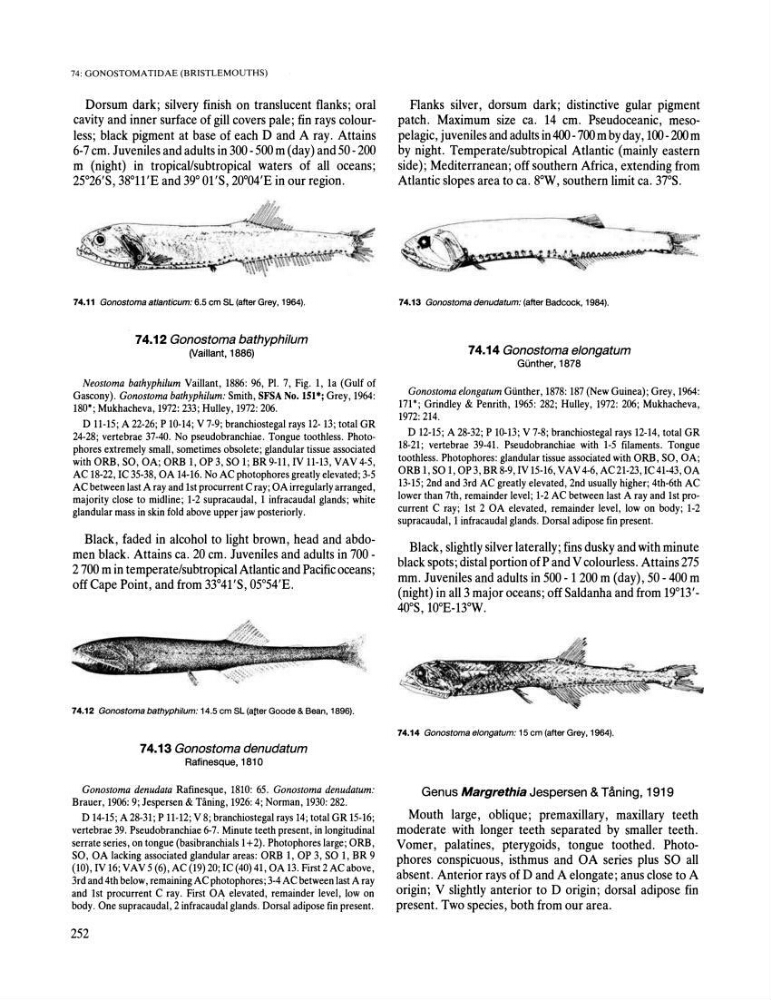
74.11 Gonostoma atlanticum: 6.5 em SL (after Grey, 1964).
74.12 Gonostoma bathyphilum
(Vaillant, 1886)
Neostoma bathyphilum Vaillant, 1886: 96, PI. 7, Fig. 1, 1a (Gulf of
Gascony). Gonostoma bathyphilum: Smith, SFSA No. 151*; Grey, 1964:
180'; Mukhacheva, 1972: 233; Hulley, 1972: 206.
D 11-15; A 22-26; P 10-14; V 7-9; branchiostegal rays 12-13; total GR
24-28; vertebrae 37-40. No pseudobranchiae. Tongue toothless. Photophores extremely small, sometimes obsolete; glandular tissue associated
with ORB, SO, OA; ORB 1, OP 3, SO 1; BR 9-11, IV 11-13, VA V 4-5,
AC 18-22, IC 35-38, OA 14-16. No AC photophores greatly elevated; 3-5
AC between last A ray and 1st procurrent C ray; OA irregularly arranged,
majority close to midline; 1-2 supracaudal, 1 infracaudal glands; white
glandular mass in skin fold above upper jaw posteriorly.
Black, faded in alcohol to light brown, head and abdomen black. Attains ca. 20 cm. Juveniles and adults in 7002700 m in temperate/subtropical Atlantic and Pacific oceans;
off Cape Point, and from 33°41'S, 05°54'E.
74.12 Gonostoma bathyphilum: 14.5 em SL (atter Goode & Bean, 1896).
74.13 Gonostoma denudatum
Rafinesque, 1810
Gonostoma denudata Rafinesque, 1810: 65. Gonostoma denudatum:
Brauer, 1906: 9; Jespersen & Timing, 1926: 4; Norman, 1930: 282.
D 14-15; A 28-31; P 11-12; V 8; branchiostegal rays 14; total GR 15-16;
vertebrae 39. Pseudobranchiae 6-7. Minute teeth present, in longitudinal
serrate series, on tongue (basibranchials 1 + 2). Photophores large; ORB,
SO, OA lacking associated glandular areas: ORB 1, OP 3, SO 1, BR 9
(10), IV 16; VAV 5 (6), AC (19) 20; IC (40) 41, OA 13. First 2 AC above,
3rd and 4th below, remaining AC photophores; 3-4 AC between last A ray
and 1st procurrent C ray. First OA elevated, remainder level, low on
body. One supracaudal, 2 infracaudal glands. Dorsal adipose fin present.
252
Flanks silver, dorsum dark; distinctive gular pigment
patch. Maximum size ca, 14 cm. Pseudoceanic, mesopelagic, juveniles and adults in 400 -700 m by day, 100 -200 m
by night. Temperate/subtropical Atlantic (mainly eastern
side); Mediterranean; off southern Africa, extending from
Atlantic slopes area to ca. 8°W, southern limit ca. 37°S.
74.13 Gonostoma denudatum: (after Badeoek, 1984).
74.14 Gonostoma elongatum
Gunther, 1878
Gonostoma elongatum Giinther, 1878: 187 (New Guinea); Grey, 1964:
171 *; Grindley & Penrith, 1965: 282; Hulley, 1972: 206; Mukhacheva,
1972: 214.
D 12-15; A 28-32; P 10-13; V 7-8; branchiostegal rays 12-14, total GR
18-21; vertebrae 39-41. Pseudobranchiae with 1-5 filaments. Tongue
toothless. Photophores: glandular tissue associated with ORB, SO, OA;
ORB 1, SO 1, OP3, BR8-9, IV 15-16, VAV 4-6, AC21-23, IC41-43, OA
13-15; 2nd and 3rd AC greatly elevated, 2nd usually higher; 4th-6th AC
lower than 7th, remainder level; 1-2 AC between last A ray and 1st procurrent C ray; 1st 2 OA elevated, remainder level, low on body; 1-2
supracaudal, 1 infracaudal glands. Dorsal adipose fin present.
Black, slightly silver laterally; fins dusky and with minute
black spots; distal portion ofP and V colourless. Attains 275
mm. Juveniles and adults in 500 -1200 m (day), 50 - 400 m
(night) in all 3 major oceans; off Saldanha and from 19°13'40 0 S, lOoE-13°W.
74.14 Gonostoma elongatum: 15 em (after Grey, 1964).
Genus Margrethia Jespersen & Taning, 1919
Mouth large, oblique; premaxillary, maxillary teeth
moderate with longer teeth separated by smaller teeth.
Vomer, palatines, pterygoids, tongue toothed. Photoph ores conspicuous, isthmus and OA series plus SO all
absent. Anterior rays of D and A elongate; anus close to A
origin; V slightly anterior to D origin; dorsal adipose fin
present. Two species, both from our area.
Dorsum dark; silvery finish on translucent flanks; oral
cavity and inner surface of gill covers pale; fin rays colourless; black pigment at base of each D and A ray. Attains
6-7 cm. Juveniles and adults in 300 -500 m (day) and 50 -200
m (night) in tropical/subtropical waters of all oceans;
25°26'S, 38°11'E and 39° OI'S, 20
0
04'E in our region.
74.11 Gonostoma atlanticum: 6.5 em SL (after Grey, 1964).
74.12 Gonostoma bathyphilum
(Vaillant, 1886)
Neostoma bathyphilum Vaillant, 1886: 96, PI. 7, Fig. 1, 1a (Gulf of
Gascony). Gonostoma bathyphilum: Smith, SFSA No. 151*; Grey, 1964:
180'; Mukhacheva, 1972: 233; Hulley, 1972: 206.
D 11-15; A 22-26; P 10-14; V 7-9; branchiostegal rays 12-13; total GR
24-28; vertebrae 37-40. No pseudobranchiae. Tongue toothless. Photophores extremely small, sometimes obsolete; glandular tissue associated
with ORB, SO, OA; ORB 1, OP 3, SO 1; BR 9-11, IV 11-13, VA V 4-5,
AC 18-22, IC 35-38, OA 14-16. No AC photophores greatly elevated; 3-5
AC between last A ray and 1st procurrent C ray; OA irregularly arranged,
majority close to midline; 1-2 supracaudal, 1 infracaudal glands; white
glandular mass in skin fold above upper jaw posteriorly.
Black, faded in alcohol to light brown, head and abdomen black. Attains ca. 20 cm. Juveniles and adults in 7002700 m in temperate/subtropical Atlantic and Pacific oceans;
off Cape Point, and from 33°41'S, 05°54'E.
74.12 Gonostoma bathyphilum: 14.5 em SL (atter Goode & Bean, 1896).
74.13 Gonostoma denudatum
Rafinesque, 1810
Gonostoma denudata Rafinesque, 1810: 65. Gonostoma denudatum:
Brauer, 1906: 9; Jespersen & Timing, 1926: 4; Norman, 1930: 282.
D 14-15; A 28-31; P 11-12; V 8; branchiostegal rays 14; total GR 15-16;
vertebrae 39. Pseudobranchiae 6-7. Minute teeth present, in longitudinal
serrate series, on tongue (basibranchials 1 + 2). Photophores large; ORB,
SO, OA lacking associated glandular areas: ORB 1, OP 3, SO 1, BR 9
(10), IV 16; VAV 5 (6), AC (19) 20; IC (40) 41, OA 13. First 2 AC above,
3rd and 4th below, remaining AC photophores; 3-4 AC between last A ray
and 1st procurrent C ray. First OA elevated, remainder level, low on
body. One supracaudal, 2 infracaudal glands. Dorsal adipose fin present.
252
Flanks silver, dorsum dark; distinctive gular pigment
patch. Maximum size ca, 14 cm. Pseudoceanic, mesopelagic, juveniles and adults in 400 -700 m by day, 100 -200 m
by night. Temperate/subtropical Atlantic (mainly eastern
side); Mediterranean; off southern Africa, extending from
Atlantic slopes area to ca. 8°W, southern limit ca. 37°S.
74.13 Gonostoma denudatum: (after Badeoek, 1984).
74.14 Gonostoma elongatum
Gunther, 1878
Gonostoma elongatum Giinther, 1878: 187 (New Guinea); Grey, 1964:
171 *; Grindley & Penrith, 1965: 282; Hulley, 1972: 206; Mukhacheva,
1972: 214.
D 12-15; A 28-32; P 10-13; V 7-8; branchiostegal rays 12-14, total GR
18-21; vertebrae 39-41. Pseudobranchiae with 1-5 filaments. Tongue
toothless. Photophores: glandular tissue associated with ORB, SO, OA;
ORB 1, SO 1, OP3, BR8-9, IV 15-16, VAV 4-6, AC21-23, IC41-43, OA
13-15; 2nd and 3rd AC greatly elevated, 2nd usually higher; 4th-6th AC
lower than 7th, remainder level; 1-2 AC between last A ray and 1st procurrent C ray; 1st 2 OA elevated, remainder level, low on body; 1-2
supracaudal, 1 infracaudal glands. Dorsal adipose fin present.
Black, slightly silver laterally; fins dusky and with minute
black spots; distal portion ofP and V colourless. Attains 275
mm. Juveniles and adults in 500 -1200 m (day), 50 - 400 m
(night) in all 3 major oceans; off Saldanha and from 19°13'40 0 S, lOoE-13°W.
74.14 Gonostoma elongatum: 15 em (after Grey, 1964).
Genus Margrethia Jespersen & Taning, 1919
Mouth large, oblique; premaxillary, maxillary teeth
moderate with longer teeth separated by smaller teeth.
Vomer, palatines, pterygoids, tongue toothed. Photoph ores conspicuous, isthmus and OA series plus SO all
absent. Anterior rays of D and A elongate; anus close to A
origin; V slightly anterior to D origin; dorsal adipose fin
present. Two species, both from our area.