

75: STERNOPTYCHIDAE (HATCHETFISHES)
1b AC photophores sometimes comprised of evenly spaced
single organs and always with clusters of at least 3-4 (or
more in some genera) photophores in series and forming
bands of compound organs surrounded by black or silvery
skin; D origin in advance of or only slightly posterior
to A origin ....................................................................... 3
2a AC photophores immediately dorsal to A base in a series
of 9-12 more or less equally spaced separate organs
or in clusters of 2 organs each; A origin nearer to
snout tip than to C base; distance from V origin
to a vertical at tip of P much less than greatest
body depth; Drays 9-12 ........................................ [Thorophos]
2b AC photophores immediately dorsal to A base in a
series of 3-4 more or less evenly spaced separate organs
or clusters of 2 organs each; A origin equidistant
from snout tip and C base or nearer to C base;
distance from V origin to tip of P equal to or
greater than greatest body depth; Drays 13-17
[Araiophos]
3a OA (lateral series) photophores 9 (rarely 10); SO
(mental, i.e. symphysial lower jaw) photophores
present; 3 cartilaginous V radials ............................. Maurolicus
3b OA photophores 3-8; SO photophores absent;
6 cartilaginous V radials .... .. ...... .. .. .. .. ...... .. .. .. .. ...... .. ........... 4
4a Body relatively slender, greatest depth about 3.7 or more
in SL; preopercular spines absent; external pelvic girdle
spines absent; abdominal region not keeled ............................. 5
4b Body relatively deep, greatest depth 0.8-2.0 in SL;
preopercular spines present; external pelvic girdle
spines present; abdominal region keeled with
specialised stiff scales or with a membranous
keel ...................................................... Tribe Sternoptychini
(Genera Argyropelecus, Polyipnus & Sternoptyx see below)
Sa A fin continuous, rays evenly spaced; AC photophores
single and also arranged in clusters of no more than 4
light organs; bases of anterior 2-3 A rays with no AC
photophores; adipose fin base about equal to or longer
than horizontal eye diameter; D 6-7 ...................................... 6
5b A fin interrupted, with appearance of 2 separate fins; AC
photophores arranged in serial clusters of 5 to many light
organs; bases of anterior 2-3 A rays with AC photophores
dorsal to them; adipose fin either absent or its base
shorter than horizontal eye diameter; D 9-12 ........................... 7
6a D anterior to mid length of body and well anterior
to A origin; most AC photophores single, not
clustered except for anterior and posterior organ
groups of this series; adipose fin base much
longer than horizontal eye diameter and about
equal to or longer than head length .......................... [Danaphos]
6b D about in midlength of body, over A origin;
AC photophores clustered i.n 2-4 groups
(occasionally a single organ present) evenly
spaced with other groups; adipose fin base
less than horizontal eye diameter ........................ Valenciennellus
7a V A V and anterior group of several AC
photophores forming a continuous serial group
of 18-28 organs; Drays 10-14; D origin anterior
to A origin; adipose fin present ............................. [Argyripnus]
7b V A V and anterior group of 1 or 2 AC
photophores forming a continuous serial group of
7 -8 organs; Drays 8-9; D origin posterior to A
origin; adipose fin absent (all known specimens
so damaged that absence of this fin not a certainty) ........ [Sonoda]
254
Genus Maurolicus Cocco, 1838
Mesopelagic, 1 species known.
75.1 Maurolicus muelleri
(Gmelin, 1788)
Salmo MUlleri Gmelin, 1788: 1378 (Sondm6r, Norway). Maurolicus
pennanti (non Walbaum): Barnard, 1925: 151. Maurolicus muelleri:
Smith, SFSA No. 155*; Grey, 1964: 226; Grindley & Penrith, 1965: 282.
D 10-11; A 19-23; P 17-19; V 6-7 (usually 7); GR (17-21)+(4-7). Depth
4.7-3.9; head 3.0-3.6.
Colour in life brilliant silvery with greenish blue back.
Attains about 6 cm. In all oceans, more common in colder
regions. Sometimes found on surface or thrown up on
beaches after storms. A common species of some commercial importance.
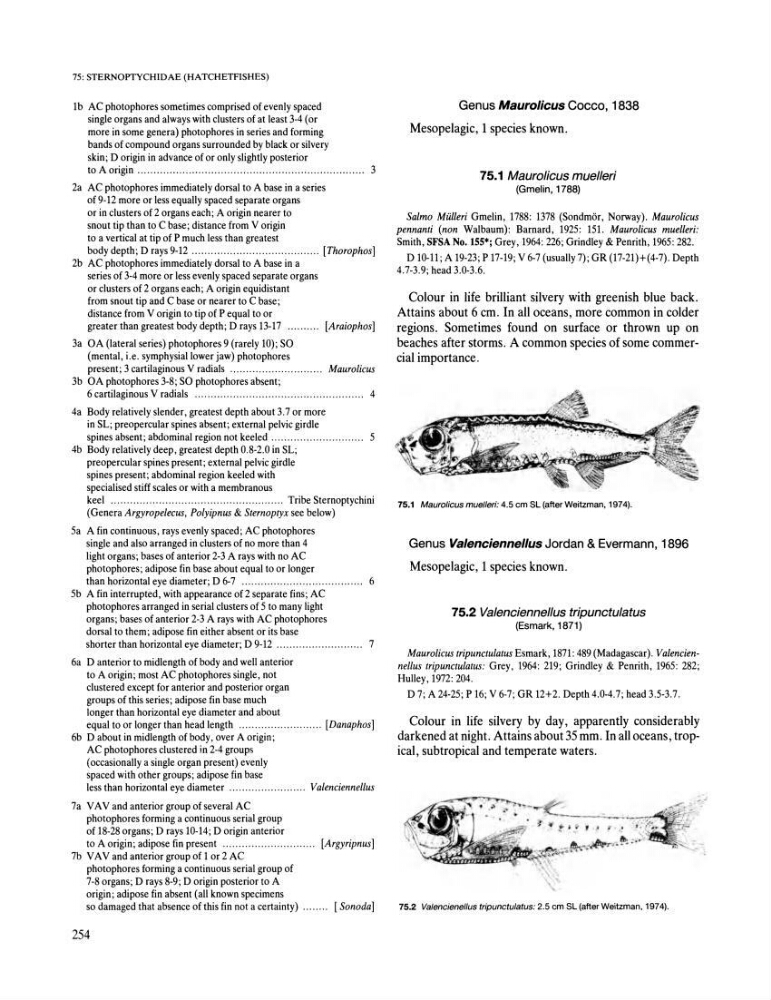
75.1 Maurolicus muelleri: 4.5 em SL (after Weitzman, 1974).
Genus Valenciennellus Jordan & Evermann, 1896
Mesopelagic, 1 species known.
75.2 Valenciennellus tripunctulatus
(Esmark,1871)
Maurolicus tripunctulatus Esmark, 1871: 489 (Madagascar). Valenciennellus tripunctulatus: Grey, 1964: 219; Grindley & Penrith, 1965: 282;
Hulley, 1972: 204.
D 7; A 24-25; P 16; V 6-7; GR 12+2. Depth 4.0-4.7; head 3.5-3.7.
Colour in life silvery by day, apparently considerably
darkened at night. Attains about 35 mm. In all oceans, tropical, subtropical and temperate waters.
75.2 Valencienellus tripunctulatus: 2.5 em SL (after Weitzman, 1974).
1b AC photophores sometimes comprised of evenly spaced
single organs and always with clusters of at least 3-4 (or
more in some genera) photophores in series and forming
bands of compound organs surrounded by black or silvery
skin; D origin in advance of or only slightly posterior
to A origin ....................................................................... 3
2a AC photophores immediately dorsal to A base in a series
of 9-12 more or less equally spaced separate organs
or in clusters of 2 organs each; A origin nearer to
snout tip than to C base; distance from V origin
to a vertical at tip of P much less than greatest
body depth; Drays 9-12 ........................................ [Thorophos]
2b AC photophores immediately dorsal to A base in a
series of 3-4 more or less evenly spaced separate organs
or clusters of 2 organs each; A origin equidistant
from snout tip and C base or nearer to C base;
distance from V origin to tip of P equal to or
greater than greatest body depth; Drays 13-17
[Araiophos]
3a OA (lateral series) photophores 9 (rarely 10); SO
(mental, i.e. symphysial lower jaw) photophores
present; 3 cartilaginous V radials ............................. Maurolicus
3b OA photophores 3-8; SO photophores absent;
6 cartilaginous V radials .... .. ...... .. .. .. .. ...... .. .. .. .. ...... .. ........... 4
4a Body relatively slender, greatest depth about 3.7 or more
in SL; preopercular spines absent; external pelvic girdle
spines absent; abdominal region not keeled ............................. 5
4b Body relatively deep, greatest depth 0.8-2.0 in SL;
preopercular spines present; external pelvic girdle
spines present; abdominal region keeled with
specialised stiff scales or with a membranous
keel ...................................................... Tribe Sternoptychini
(Genera Argyropelecus, Polyipnus & Sternoptyx see below)
Sa A fin continuous, rays evenly spaced; AC photophores
single and also arranged in clusters of no more than 4
light organs; bases of anterior 2-3 A rays with no AC
photophores; adipose fin base about equal to or longer
than horizontal eye diameter; D 6-7 ...................................... 6
5b A fin interrupted, with appearance of 2 separate fins; AC
photophores arranged in serial clusters of 5 to many light
organs; bases of anterior 2-3 A rays with AC photophores
dorsal to them; adipose fin either absent or its base
shorter than horizontal eye diameter; D 9-12 ........................... 7
6a D anterior to mid length of body and well anterior
to A origin; most AC photophores single, not
clustered except for anterior and posterior organ
groups of this series; adipose fin base much
longer than horizontal eye diameter and about
equal to or longer than head length .......................... [Danaphos]
6b D about in midlength of body, over A origin;
AC photophores clustered i.n 2-4 groups
(occasionally a single organ present) evenly
spaced with other groups; adipose fin base
less than horizontal eye diameter ........................ Valenciennellus
7a V A V and anterior group of several AC
photophores forming a continuous serial group
of 18-28 organs; Drays 10-14; D origin anterior
to A origin; adipose fin present ............................. [Argyripnus]
7b V A V and anterior group of 1 or 2 AC
photophores forming a continuous serial group of
7 -8 organs; Drays 8-9; D origin posterior to A
origin; adipose fin absent (all known specimens
so damaged that absence of this fin not a certainty) ........ [Sonoda]
254
Genus Maurolicus Cocco, 1838
Mesopelagic, 1 species known.
75.1 Maurolicus muelleri
(Gmelin, 1788)
Salmo MUlleri Gmelin, 1788: 1378 (Sondm6r, Norway). Maurolicus
pennanti (non Walbaum): Barnard, 1925: 151. Maurolicus muelleri:
Smith, SFSA No. 155*; Grey, 1964: 226; Grindley & Penrith, 1965: 282.
D 10-11; A 19-23; P 17-19; V 6-7 (usually 7); GR (17-21)+(4-7). Depth
4.7-3.9; head 3.0-3.6.
Colour in life brilliant silvery with greenish blue back.
Attains about 6 cm. In all oceans, more common in colder
regions. Sometimes found on surface or thrown up on
beaches after storms. A common species of some commercial importance.
75.1 Maurolicus muelleri: 4.5 em SL (after Weitzman, 1974).
Genus Valenciennellus Jordan & Evermann, 1896
Mesopelagic, 1 species known.
75.2 Valenciennellus tripunctulatus
(Esmark,1871)
Maurolicus tripunctulatus Esmark, 1871: 489 (Madagascar). Valenciennellus tripunctulatus: Grey, 1964: 219; Grindley & Penrith, 1965: 282;
Hulley, 1972: 204.
D 7; A 24-25; P 16; V 6-7; GR 12+2. Depth 4.0-4.7; head 3.5-3.7.
Colour in life silvery by day, apparently considerably
darkened at night. Attains about 35 mm. In all oceans, tropical, subtropical and temperate waters.
75.2 Valencienellus tripunctulatus: 2.5 em SL (after Weitzman, 1974).