

74: GONOSTOMA TIDAE (BRISTLEMOUTHS)
D 12-15; A 16-19; P 9-11; V 6-7; branchiostegal rays 13-15; total GR
22-27, none in epi-ceratobranchial articulation; vertebrae 31-33. Gill filaments free. Pyloric caeca 4. Anus closer to V bases than A origin. Scales
present. Premaxillary teeth uneven, with at least 1 tooth, usually the 4th,
greatly enlarged; posterior maxillary series with longer teeth separated by
smaller teeth; vomer toothed. Photophores: ORB 1, OP 2, BR 9- 11, IV
12-14, VA V 5, AC 14-15, IC32-34, OA 8-10. Two to 3 ACbetween last A
ray and 1st procurrent C ray; precaudal and opercular glands moderately
developed.
Light to dark brown; areas immediately anterior to A and
D origins usually transparent or only slightly pigmented;
median fin rays and internasal area pigmented; meningeal
pigment extending to level of rear margin of eye; branchiostegal membrane pigment diffuse. Attains ca. 75 mm.
Juveniles and adults mainly in 400 - 1 000 m. In all 3 major
oceans; known from 22°-40 0 S, 25°-400W.
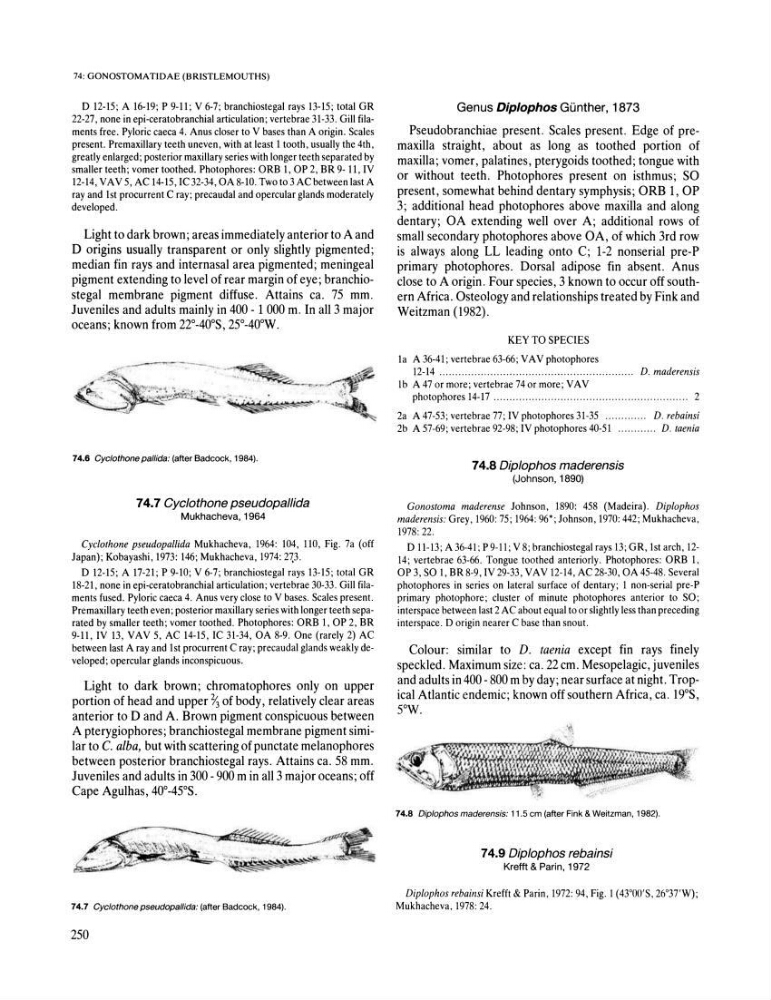
74.6 Cye/othone pallida: (after Badeoek, 1984).
74.7 Cyclothone pseudopallida
Mukhacheva, 1964
eyclothone pseudopallida Mukhacheva, 1964: 104, 110, Fig. 7a (off
Japan); Kobayashi, 1973: 146; Mukhacheva, 1974: 2~3.
D 12-15; A 17c21; P 9-10; V 6-7; branchiostegal rays 13-15; total GR
18-21, none in epi-ceratobranchial articulation; vertebrae 30-33. Gill filaments fused. Pyloric caeca 4. Anus very close to V bases. Scales present.
Premaxillary teeth even; posterior maxillary series with longer teeth separated by smaller teeth; vomer toothed. Photophores: ORB 1, OP 2, BR
9-11, IV 13, VAV 5, AC 14-15, IC 31-34, OA 8-9. One (rarely 2) AC
between last A ray and 1st procurrent C ray; precaudal glands weakly developed; opercular glands inconspicuous.
Light to dark brown; chromatophores only on upper
portion of head and upper 73 of body, relatively clear areas
anterior to D and A. Brown pigment conspicuous between
A pterygiophores; branchiostegal membrane pigment similar to C. alba, but with scattering of punctate melanophores
between posterior branchiostegal rays. Attains ca. 58 mm.
Juveniles and adults in 300 - 900 m in all 3 major oceans; off
Cape Agulhas, 400-45°S.
74.7 Cye/othone pseudopallida: (after Badeoek, 1984).
250
Genus Dip/ophos Gunther, 1873
Pseudobranchiae present. Scales present. Edge of premaxilla straight, about as long as toothed portion of
maxilla; vomer, palatines, pterygoids toothed; tongue with
or without teeth. Photophores present on isthmus; SO
present, somewhat behind dentary symphysis; ORB 1, OP
3; additional head photophores above maxilla and along
dentary; OA extending well over A; additional rows of
small secondary photophores above OA, of which 3rd row
is always along LL leading onto C; 1-2 nonserial pre-P
primary photophores. Dorsal adipose fin absent. Anus
close to A origin. Four species, 3 known to occur off southern Africa. Osteology and relationships treated by Fink and
Weitzman (1982).
KEY TO SPECIES
la A 36-41; vertebrae 63-66; VA V photophores
12-14 ............................................................. D. maderensis
Ib A 47 or more; vertebrae 74 or more; VAV
photophores 14-17 ......................................... . ................... 2
2a A 47-53; vertebrae 77; IV photophores 31-35 ............. D. rebainsi
2b A 57-69; vertebrae 92-98; IV photophores 40-51 ............ D. taenia
74.8 Diplophos maderensis
(Johnson, 1890)
Gonostoma maderense Johnson, 1890: 458 (Madeira). Diplophos
maderensis: Grey, 1960: 75; 1964: 96*; Johnson, 1970: 442; Mukhacheva,
1978: 22.
D 11-13; A 36-41; P 9-11; V 8; branchiostegal rays 13; GR, 1st arch, 1214; vertebrae 63-66. Tongue toothed anteriorly. Photophores: ORB 1,
OP3, SO 1, BR8-9, IV 29-33, VAV 12-14, AC28-30, OA45-48. Several
photophores in series on lateral surface of dentary; 1 non-serial pre-P
primary photophore; cluster of minute photophores anterior to SO;
interspace between last 2 AC about equal to or slightly less than preceding
interspace. D origin nearer C base than snout.
Colour: similar to D. taenia except fin rays finely
speckled. Maximum size: ca. 22 cm. Mesopelagic, juveniles
and adults in 400 - 800 m by day; near surface at night. Tropical Atlantic endemic; known off southern Africa, ca. 19°5,
SOW.
74.8 Dip/ophos maderensis: 11.5 em (after Fink & Weitzman, 1982).
74.9 Diplophos rebainsi
Krefft & Parin, 1972
Diplophos rebainsi Krefft & Parin, 1972: 94, Fig. 1 (43°00'S, 26°37'W);
Mukhacheva, 1978:24.
D 12-15; A 16-19; P 9-11; V 6-7; branchiostegal rays 13-15; total GR
22-27, none in epi-ceratobranchial articulation; vertebrae 31-33. Gill filaments free. Pyloric caeca 4. Anus closer to V bases than A origin. Scales
present. Premaxillary teeth uneven, with at least 1 tooth, usually the 4th,
greatly enlarged; posterior maxillary series with longer teeth separated by
smaller teeth; vomer toothed. Photophores: ORB 1, OP 2, BR 9- 11, IV
12-14, VA V 5, AC 14-15, IC32-34, OA 8-10. Two to 3 ACbetween last A
ray and 1st procurrent C ray; precaudal and opercular glands moderately
developed.
Light to dark brown; areas immediately anterior to A and
D origins usually transparent or only slightly pigmented;
median fin rays and internasal area pigmented; meningeal
pigment extending to level of rear margin of eye; branchiostegal membrane pigment diffuse. Attains ca. 75 mm.
Juveniles and adults mainly in 400 - 1 000 m. In all 3 major
oceans; known from 22°-40 0 S, 25°-400W.
74.6 Cye/othone pallida: (after Badeoek, 1984).
74.7 Cyclothone pseudopallida
Mukhacheva, 1964
eyclothone pseudopallida Mukhacheva, 1964: 104, 110, Fig. 7a (off
Japan); Kobayashi, 1973: 146; Mukhacheva, 1974: 2~3.
D 12-15; A 17c21; P 9-10; V 6-7; branchiostegal rays 13-15; total GR
18-21, none in epi-ceratobranchial articulation; vertebrae 30-33. Gill filaments fused. Pyloric caeca 4. Anus very close to V bases. Scales present.
Premaxillary teeth even; posterior maxillary series with longer teeth separated by smaller teeth; vomer toothed. Photophores: ORB 1, OP 2, BR
9-11, IV 13, VAV 5, AC 14-15, IC 31-34, OA 8-9. One (rarely 2) AC
between last A ray and 1st procurrent C ray; precaudal glands weakly developed; opercular glands inconspicuous.
Light to dark brown; chromatophores only on upper
portion of head and upper 73 of body, relatively clear areas
anterior to D and A. Brown pigment conspicuous between
A pterygiophores; branchiostegal membrane pigment similar to C. alba, but with scattering of punctate melanophores
between posterior branchiostegal rays. Attains ca. 58 mm.
Juveniles and adults in 300 - 900 m in all 3 major oceans; off
Cape Agulhas, 400-45°S.
74.7 Cye/othone pseudopallida: (after Badeoek, 1984).
250
Genus Dip/ophos Gunther, 1873
Pseudobranchiae present. Scales present. Edge of premaxilla straight, about as long as toothed portion of
maxilla; vomer, palatines, pterygoids toothed; tongue with
or without teeth. Photophores present on isthmus; SO
present, somewhat behind dentary symphysis; ORB 1, OP
3; additional head photophores above maxilla and along
dentary; OA extending well over A; additional rows of
small secondary photophores above OA, of which 3rd row
is always along LL leading onto C; 1-2 nonserial pre-P
primary photophores. Dorsal adipose fin absent. Anus
close to A origin. Four species, 3 known to occur off southern Africa. Osteology and relationships treated by Fink and
Weitzman (1982).
KEY TO SPECIES
la A 36-41; vertebrae 63-66; VA V photophores
12-14 ............................................................. D. maderensis
Ib A 47 or more; vertebrae 74 or more; VAV
photophores 14-17 ......................................... . ................... 2
2a A 47-53; vertebrae 77; IV photophores 31-35 ............. D. rebainsi
2b A 57-69; vertebrae 92-98; IV photophores 40-51 ............ D. taenia
74.8 Diplophos maderensis
(Johnson, 1890)
Gonostoma maderense Johnson, 1890: 458 (Madeira). Diplophos
maderensis: Grey, 1960: 75; 1964: 96*; Johnson, 1970: 442; Mukhacheva,
1978: 22.
D 11-13; A 36-41; P 9-11; V 8; branchiostegal rays 13; GR, 1st arch, 1214; vertebrae 63-66. Tongue toothed anteriorly. Photophores: ORB 1,
OP3, SO 1, BR8-9, IV 29-33, VAV 12-14, AC28-30, OA45-48. Several
photophores in series on lateral surface of dentary; 1 non-serial pre-P
primary photophore; cluster of minute photophores anterior to SO;
interspace between last 2 AC about equal to or slightly less than preceding
interspace. D origin nearer C base than snout.
Colour: similar to D. taenia except fin rays finely
speckled. Maximum size: ca. 22 cm. Mesopelagic, juveniles
and adults in 400 - 800 m by day; near surface at night. Tropical Atlantic endemic; known off southern Africa, ca. 19°5,
SOW.
74.8 Dip/ophos maderensis: 11.5 em (after Fink & Weitzman, 1982).
74.9 Diplophos rebainsi
Krefft & Parin, 1972
Diplophos rebainsi Krefft & Parin, 1972: 94, Fig. 1 (43°00'S, 26°37'W);
Mukhacheva, 1978:24.