

74: GONOSTOMATIDAE (BRISTLEMOUTHS)
Genus Bonapartia Goode & Bean, 1896
Monotypic.
74.1 Bonapartia pedaliota
Goode & Bean, 1896
Bonapartia pedaliota Goode & Bean, 1896: 102 (25°20'N, 79°58'W);
Jespersen & Ti'ming, 1919: 221*; Grey, 1964: 193*; Karrer, 1975: 68 ;
~ukhacheva, 1976:74.
D 16-20; A 28-31 ; P 14-16; V 7-9; branchiostegal rays 15-17; GR 16-18;
vertebrae 36-38. Pseudobranchiae ill-defined, 4-5 . ~outh large, oblique,
premaxilla and maxilla with long teeth separated by series of small , subequal teeth ; vomer, palatines, pterygoids toothed; tongue toothless.
Photophores conspicuous ; isthmus and OA series absent, SO present :
ORB 1, OP3, SO 1, BR 11-13, IV 14-15, VAV 5-6, AC 16-18+ 1-3=18-21,
IC 37- 41. Scales present. Last D and A rays not split to base ; A origin in
advance of D origin; anterior rays of median fins elongate. Anus nearer to
A than V origin; V well in advance of D origin. Dorsal adipose fin absent.
Silvery operculum and peritoneum; tail translucent ventrally; D and C rays pigmented. Maximum size ca. 75 mm.
Oceanic, mesopelagic, non-migrant, in 100 - 700 m. Subtropical/tropical Atlantic, Gulf of Mexico, Indian Ocean ;
reported from 19°03'S, 11°27'E by Karrer (1975) .
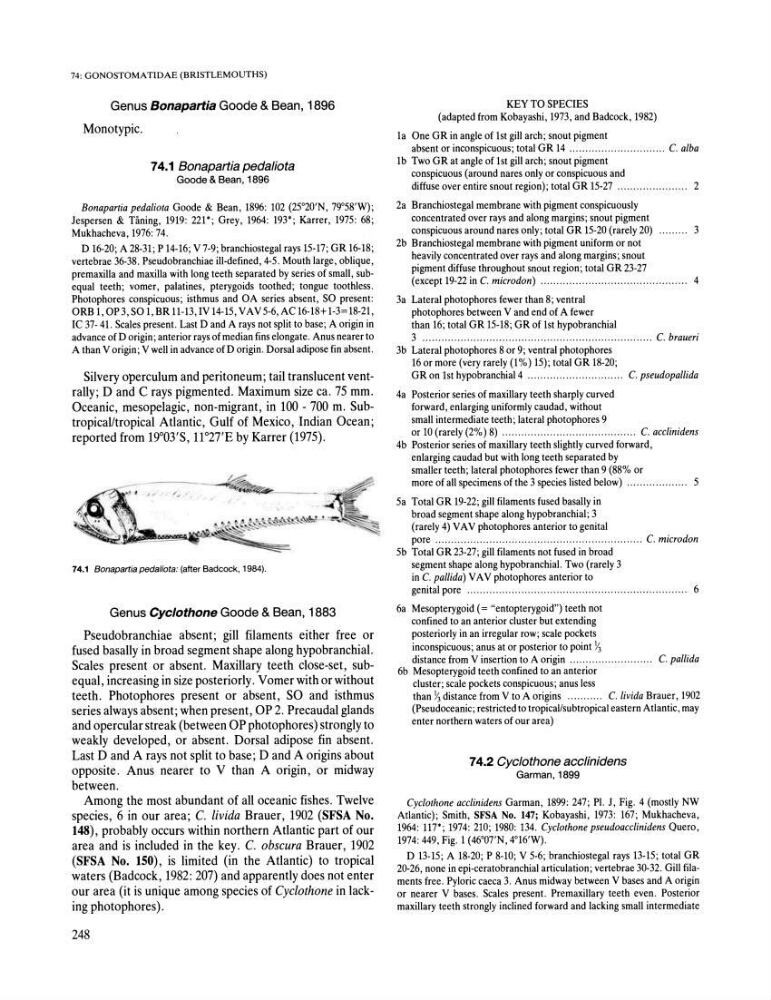
74.1 Bonapartia pedaliota: (after Badcock, 1984).
Genus Cyclothone Goode & Bean, 1883
Pseudobranchiae absent; gill filaments either free or
fused basally in broad segment shape along hypobranchial.
Scales present or absent. Maxillary teeth close-set, subequal, increasing in size posteriorly. Vomer with or without
teeth. Photophores present or absent , SO and isthmus
series always absent; when present, OP 2. Precaudal glands
and opercular streak (between 0 P photophores) strongly to
weakly developed, or absent. Dorsal adipose fin absent.
Last D and A rays not split to base; D and A origins about
opposite. Anus nearer to V than A origin, or midway
between.
Among the most abundant of all oceanic fishes. Twelve
species, 6 in our area; C. livida Brauer, 1902 (SFSA No.
148), probably occurs within northern Atlantic part of our
area and is included in the key. C. obscura Brauer, 1902
(SFSA No. 150), is limited (in the Atlantic) to tropical
waters (Badcock, 1982: 207) and apparently does not enter
our area (it is unique among species of Cyclothone in lacking photophores).
248
KEY TO SPECIES
(adapted from Kobayashi, 1973, and Badcock, 1982)
1a One GR in angle of 1st gill arch; snout pigment
absent or inconspicuous; total GR 14 .... ... ....... ..... ....... .... C. alba
Ib Two GR at angle of 1st gill arch; snout pigment
conspicuous (around nares only or conspicuous and
diffuse over entire snout region) ; total GR 15-27 ...... ....... .... .. .. . 2
2a Branchiostegal membrane with pigment conspicuously
concentrated over rays and along margins; snout pigment
conspicuous around nares only; total GR 15-20 (rarely 20) ... .. ... . 3
2b Branchiostegal membrane with pigment uniform or not
heavily concentrated over rays and along margins; snout
pigment diffuse throughout snout region; total GR 23-27
(except 19-22 in C. microdon) ..... .... ..... ..... ................ ... ....... . 4
3a Lateral photophores fewer than 8; ventral
photophores between V and end of A fewer
than 16; total GR 15-18; GR of 1st hypobranchial
3 ... ............. ......... .. ........ .. ... ...... ... ....... .... ...... ...... C. braueri
3b Lateral photophores 8 or 9; ventral photophores
16 or more (very rarely (1 %) 15); total GR 18-20;
GR on 1st hypobranchial 4 ................. ........... .. C. pseudopal/ida
4a Posterior series of maxillary teeth sharply curved
forward , enlarging uniformly caudad, without
small intermediate teeth; lateral photophores 9
or 10 (rarely (2%) 8) .. ..... ..... .......... ... ..... ....... .. .. . C. acclinidens
4b Posterior series of maxillary teeth slightly curved forward,
enlarging caudad but with long teeth separated by
smaller teeth; lateral photophores fewer than 9 (88% or
more of all specimens of the 3 species listed below) ..... .... .. ... ..... 5
Sa Total GR 19-22; gill filaments fused basally in
broad segment shape along hypobranchial ; 3
(rarely 4) VA V photophores anterior to genital
pore .. .. .... ..... ...... ....... ... ............ .. ....... ............... C. microdon
5b Total GR 23-27; gill filaments not fused in broad
segment shape along hypobranchial. Two (rarely 3
in C. pal/ida) VA V photophores anterior to
genital pore ...... ..... ...... .... ... ... ..... .. ... .... ... .... .... ....... ...... ... . 6
6a ~esopterygoid (= "entopterygoid") teeth not
confined to an anterior cluster but extending
posteriorly in an irregular row; scale pockets
inconspicuous; anus at or posterior to point ))
distance from V insertion to A origin .. ... ................ .... . C. pal/ida
6b ~esopterygoid teeth confined to an anterior
cluster; scale pockets conspicuous; anus less
than)) distance from V to A origins .. .. ..... .. C. livida Brauer, 1902
(Pseudoceanic; restricted to tropical/subtropical eastern Atlantic, may
enter northern waters of our area)
74.2 eye/othone aeelinidens
Garman, 1899
Cyclothone acclinidens Garman, 1899: 247; PI. J, Fig. 4 (mostly NW
Atlantic) ; Smith , SFSA No. 147; Kobayashi, 1973: 167; ~ukhacheva ,
1964: 117*; 1974: 210; 1980: 134. Cyclothone pseudoacclinidens Quero ,
1974: 449, Fig. 1 (46°07'N , 4°16'W).
D 13-15; A 18-20; P 8-10; V 5-6; branchiostegal rays 13-15; total GR
20-26, none in epi-ceratobranchial articulation; vertebrae 30-32. Gill filaments free. Pyloric caeca 3. Anus midway between V bases and A origin
or nearer V bases. Scales present. Premaxillary teeth even. Posterior
maxillary teeth strongly inclined forward and lacking small intermediate
Genus Bonapartia Goode & Bean, 1896
Monotypic.
74.1 Bonapartia pedaliota
Goode & Bean, 1896
Bonapartia pedaliota Goode & Bean, 1896: 102 (25°20'N, 79°58'W);
Jespersen & Ti'ming, 1919: 221*; Grey, 1964: 193*; Karrer, 1975: 68 ;
~ukhacheva, 1976:74.
D 16-20; A 28-31 ; P 14-16; V 7-9; branchiostegal rays 15-17; GR 16-18;
vertebrae 36-38. Pseudobranchiae ill-defined, 4-5 . ~outh large, oblique,
premaxilla and maxilla with long teeth separated by series of small , subequal teeth ; vomer, palatines, pterygoids toothed; tongue toothless.
Photophores conspicuous ; isthmus and OA series absent, SO present :
ORB 1, OP3, SO 1, BR 11-13, IV 14-15, VAV 5-6, AC 16-18+ 1-3=18-21,
IC 37- 41. Scales present. Last D and A rays not split to base ; A origin in
advance of D origin; anterior rays of median fins elongate. Anus nearer to
A than V origin; V well in advance of D origin. Dorsal adipose fin absent.
Silvery operculum and peritoneum; tail translucent ventrally; D and C rays pigmented. Maximum size ca. 75 mm.
Oceanic, mesopelagic, non-migrant, in 100 - 700 m. Subtropical/tropical Atlantic, Gulf of Mexico, Indian Ocean ;
reported from 19°03'S, 11°27'E by Karrer (1975) .
74.1 Bonapartia pedaliota: (after Badcock, 1984).
Genus Cyclothone Goode & Bean, 1883
Pseudobranchiae absent; gill filaments either free or
fused basally in broad segment shape along hypobranchial.
Scales present or absent. Maxillary teeth close-set, subequal, increasing in size posteriorly. Vomer with or without
teeth. Photophores present or absent , SO and isthmus
series always absent; when present, OP 2. Precaudal glands
and opercular streak (between 0 P photophores) strongly to
weakly developed, or absent. Dorsal adipose fin absent.
Last D and A rays not split to base; D and A origins about
opposite. Anus nearer to V than A origin, or midway
between.
Among the most abundant of all oceanic fishes. Twelve
species, 6 in our area; C. livida Brauer, 1902 (SFSA No.
148), probably occurs within northern Atlantic part of our
area and is included in the key. C. obscura Brauer, 1902
(SFSA No. 150), is limited (in the Atlantic) to tropical
waters (Badcock, 1982: 207) and apparently does not enter
our area (it is unique among species of Cyclothone in lacking photophores).
248
KEY TO SPECIES
(adapted from Kobayashi, 1973, and Badcock, 1982)
1a One GR in angle of 1st gill arch; snout pigment
absent or inconspicuous; total GR 14 .... ... ....... ..... ....... .... C. alba
Ib Two GR at angle of 1st gill arch; snout pigment
conspicuous (around nares only or conspicuous and
diffuse over entire snout region) ; total GR 15-27 ...... ....... .... .. .. . 2
2a Branchiostegal membrane with pigment conspicuously
concentrated over rays and along margins; snout pigment
conspicuous around nares only; total GR 15-20 (rarely 20) ... .. ... . 3
2b Branchiostegal membrane with pigment uniform or not
heavily concentrated over rays and along margins; snout
pigment diffuse throughout snout region; total GR 23-27
(except 19-22 in C. microdon) ..... .... ..... ..... ................ ... ....... . 4
3a Lateral photophores fewer than 8; ventral
photophores between V and end of A fewer
than 16; total GR 15-18; GR of 1st hypobranchial
3 ... ............. ......... .. ........ .. ... ...... ... ....... .... ...... ...... C. braueri
3b Lateral photophores 8 or 9; ventral photophores
16 or more (very rarely (1 %) 15); total GR 18-20;
GR on 1st hypobranchial 4 ................. ........... .. C. pseudopal/ida
4a Posterior series of maxillary teeth sharply curved
forward , enlarging uniformly caudad, without
small intermediate teeth; lateral photophores 9
or 10 (rarely (2%) 8) .. ..... ..... .......... ... ..... ....... .. .. . C. acclinidens
4b Posterior series of maxillary teeth slightly curved forward,
enlarging caudad but with long teeth separated by
smaller teeth; lateral photophores fewer than 9 (88% or
more of all specimens of the 3 species listed below) ..... .... .. ... ..... 5
Sa Total GR 19-22; gill filaments fused basally in
broad segment shape along hypobranchial ; 3
(rarely 4) VA V photophores anterior to genital
pore .. .. .... ..... ...... ....... ... ............ .. ....... ............... C. microdon
5b Total GR 23-27; gill filaments not fused in broad
segment shape along hypobranchial. Two (rarely 3
in C. pal/ida) VA V photophores anterior to
genital pore ...... ..... ...... .... ... ... ..... .. ... .... ... .... .... ....... ...... ... . 6
6a ~esopterygoid (= "entopterygoid") teeth not
confined to an anterior cluster but extending
posteriorly in an irregular row; scale pockets
inconspicuous; anus at or posterior to point ))
distance from V insertion to A origin .. ... ................ .... . C. pal/ida
6b ~esopterygoid teeth confined to an anterior
cluster; scale pockets conspicuous; anus less
than)) distance from V to A origins .. .. ..... .. C. livida Brauer, 1902
(Pseudoceanic; restricted to tropical/subtropical eastern Atlantic, may
enter northern waters of our area)
74.2 eye/othone aeelinidens
Garman, 1899
Cyclothone acclinidens Garman, 1899: 247; PI. J, Fig. 4 (mostly NW
Atlantic) ; Smith , SFSA No. 147; Kobayashi, 1973: 167; ~ukhacheva ,
1964: 117*; 1974: 210; 1980: 134. Cyclothone pseudoacclinidens Quero ,
1974: 449, Fig. 1 (46°07'N , 4°16'W).
D 13-15; A 18-20; P 8-10; V 5-6; branchiostegal rays 13-15; total GR
20-26, none in epi-ceratobranchial articulation; vertebrae 30-32. Gill filaments free. Pyloric caeca 3. Anus midway between V bases and A origin
or nearer V bases. Scales present. Premaxillary teeth even. Posterior
maxillary teeth strongly inclined forward and lacking small intermediate