

water pockets in eastern South Atlantic (34°-36°S). Tropical/subtropical waters of North Atlantic, Indian and Pacific
oceans.
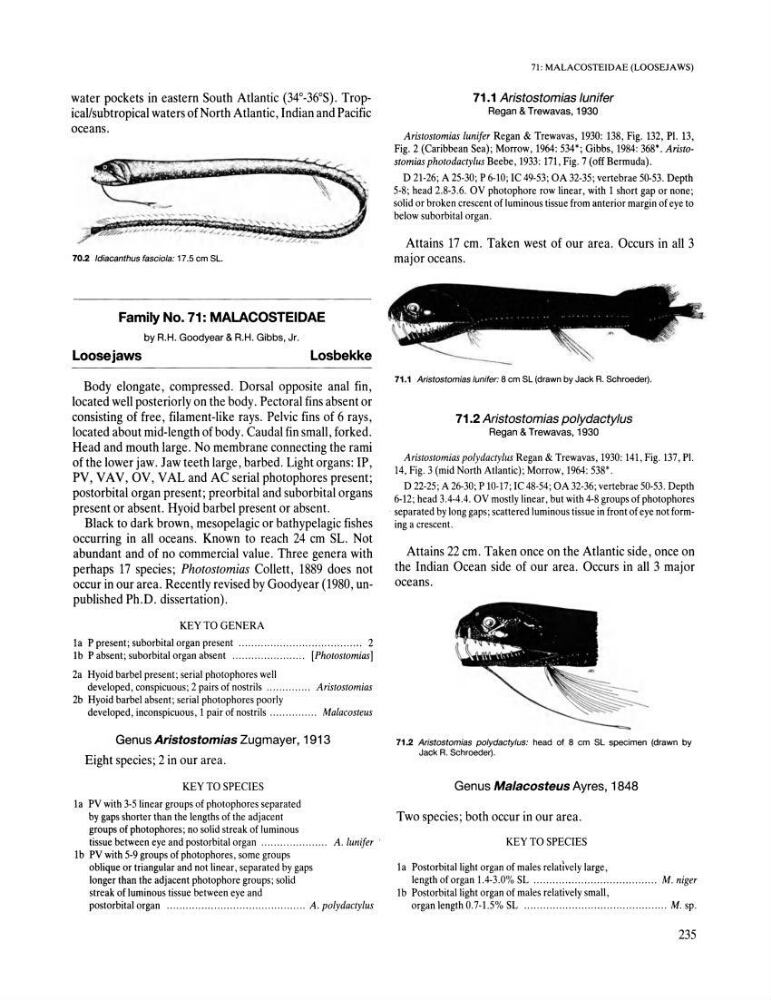
70.2 /diacanthus fascio/a: 17.5 cm SL.
Family No. 71: MALACOSTEIDAE
by R.H. Goodyear & R.H. Gibbs, Jr.
Loose jaws
Losbekke
Body elongate, compressed. Dorsal opposite anal fin,
located well posteriorly on the body. Pectoral fins absent or
consisting of free, filament-like rays. Pelvic fins of 6 rays,
located about mid-length of body. Caudal fin small, forked.
Head and mouth large. No membrane connecting the rami
of the lower jaw. Jaw teeth large, barbed. Light organs: IP,
PV, VAV, OV, VAL and AC serial photophores present;
postorbital organ present; pre orbital and suborbital organs
present or absent. Hyoid barbel present or absent.
Black to dark brown, mesopelagic or bathypelagic fishes
occurring in all oceans. Known to reach 24 cm SL. Not
abundant and of no commercial value. Three genera with
perhaps 17 species; Photostomias Collett, 1889 does not
occur in our area. Recently revised by Goodyear (1980, unpublished Ph.D. dissertation).
KEY TO GENERA
1a P present; suborbital organ present ....................................... 2
Ib P absent; suborbital organ absent ....................... [Pholos/omiasj
2a Hyoid barbel present; serial photophores well
developed, conspicuous; 2 pairs of nostrils .............. Aristostomias
2b Hyoid barbel absent; serial photophores poorly
developed, inconspicuous, 1 pair of nostrils............... Malacosteus
Genus Aristostomias Zugmayer, 1913
Eight species; 2 in our area.
KEY TO SPECIES
la PV with 3-5 linear groups of photophores separated
by gaps shorter than the lengths of the adjacent
groups of photophores; no solid streak of luminous
tissue between eye and postorbital organ ..................... A. lunifer .
Ib PV with 5-9 groups of photophores, some groups
oblique or triangular and not linear, separated by gaps
longer than the adjacent photophore groups; solid
streak of luminous tissue between eye and
postorbital organ .................................... ........ A. polydactylus
71: MALACOSTEIDAE (LOOSEJA WS)
71.1 Aristostomias luniter
Regan & Trewavas, 1930
Aristostomias [unifer Regan & Trewavas, 1930: 138, Fig. 132, PI. 13,
Fig. 2 (Caribbean Sea); Morrow, 1964: 534*; Gibbs, 1984: 368*. Aristostomias photodactylus Beebe, 1933: 171, Fig. 7 (off Bermuda).
D 21-26; A 25-30; P 6-10; IC 49-53; OA 32-35; vertebrae 50-53. Depth
5-8; head 2.8-3.6. OV photophore row linear, with 1 short gap or none;
solid or broken crescent of luminous tissue from anterior margin of eye to
below suborbital organ.
Attains 17 cm. Taken west of our area. Occurs in all 3
major oceans.
71.1 Aristostomias /uniter: 8 cm SL (drawn by Jack R. Schroeder).
71.2 Aristostomias polydactylus
Regan & Trewavas, 1930
Aristostomias polydactylus Regan & Trewavas, 1930: 141, Fig. 137, PI.
14, Fig. 3 (mid North Atlantic); Morrow, 1964: 538*.
D 22-25; A 26-30; P 10-17; IC48-54; OA 32-36; vertebrae 50-53. Depth
6-12; head 3.4-4.4. OV mostly linear, but with 4-8 groups of photophores
separated by long gaps; scattered luminous tissue in front of eye not forming a crescent.
Attains 22 cm. Taken once on the Atlantic side, once on
the Indian Ocean side of our area. Occurs in all 3 major
oceans.
71.2 Aristostomias po/ydactylus: head of 8 cm SL specimen (drawn by
Jack R. Schroeder).
Genus Malacosteus Ayres, 1848
Two species; both occur in our area.
KEY TO SPECIES
1 a Postorbital light organ of males relatively large,
length of organ 1.4-3.0% SL ....................................... M. niger
Ib Postorbital light organ of males relatively small,
organ length 0.7-1.5% SL ...................................... ....... M. sp.
235
oceans.
70.2 /diacanthus fascio/a: 17.5 cm SL.
Family No. 71: MALACOSTEIDAE
by R.H. Goodyear & R.H. Gibbs, Jr.
Loose jaws
Losbekke
Body elongate, compressed. Dorsal opposite anal fin,
located well posteriorly on the body. Pectoral fins absent or
consisting of free, filament-like rays. Pelvic fins of 6 rays,
located about mid-length of body. Caudal fin small, forked.
Head and mouth large. No membrane connecting the rami
of the lower jaw. Jaw teeth large, barbed. Light organs: IP,
PV, VAV, OV, VAL and AC serial photophores present;
postorbital organ present; pre orbital and suborbital organs
present or absent. Hyoid barbel present or absent.
Black to dark brown, mesopelagic or bathypelagic fishes
occurring in all oceans. Known to reach 24 cm SL. Not
abundant and of no commercial value. Three genera with
perhaps 17 species; Photostomias Collett, 1889 does not
occur in our area. Recently revised by Goodyear (1980, unpublished Ph.D. dissertation).
KEY TO GENERA
1a P present; suborbital organ present ....................................... 2
Ib P absent; suborbital organ absent ....................... [Pholos/omiasj
2a Hyoid barbel present; serial photophores well
developed, conspicuous; 2 pairs of nostrils .............. Aristostomias
2b Hyoid barbel absent; serial photophores poorly
developed, inconspicuous, 1 pair of nostrils............... Malacosteus
Genus Aristostomias Zugmayer, 1913
Eight species; 2 in our area.
KEY TO SPECIES
la PV with 3-5 linear groups of photophores separated
by gaps shorter than the lengths of the adjacent
groups of photophores; no solid streak of luminous
tissue between eye and postorbital organ ..................... A. lunifer .
Ib PV with 5-9 groups of photophores, some groups
oblique or triangular and not linear, separated by gaps
longer than the adjacent photophore groups; solid
streak of luminous tissue between eye and
postorbital organ .................................... ........ A. polydactylus
71: MALACOSTEIDAE (LOOSEJA WS)
71.1 Aristostomias luniter
Regan & Trewavas, 1930
Aristostomias [unifer Regan & Trewavas, 1930: 138, Fig. 132, PI. 13,
Fig. 2 (Caribbean Sea); Morrow, 1964: 534*; Gibbs, 1984: 368*. Aristostomias photodactylus Beebe, 1933: 171, Fig. 7 (off Bermuda).
D 21-26; A 25-30; P 6-10; IC 49-53; OA 32-35; vertebrae 50-53. Depth
5-8; head 2.8-3.6. OV photophore row linear, with 1 short gap or none;
solid or broken crescent of luminous tissue from anterior margin of eye to
below suborbital organ.
Attains 17 cm. Taken west of our area. Occurs in all 3
major oceans.
71.1 Aristostomias /uniter: 8 cm SL (drawn by Jack R. Schroeder).
71.2 Aristostomias polydactylus
Regan & Trewavas, 1930
Aristostomias polydactylus Regan & Trewavas, 1930: 141, Fig. 137, PI.
14, Fig. 3 (mid North Atlantic); Morrow, 1964: 538*.
D 22-25; A 26-30; P 10-17; IC48-54; OA 32-36; vertebrae 50-53. Depth
6-12; head 3.4-4.4. OV mostly linear, but with 4-8 groups of photophores
separated by long gaps; scattered luminous tissue in front of eye not forming a crescent.
Attains 22 cm. Taken once on the Atlantic side, once on
the Indian Ocean side of our area. Occurs in all 3 major
oceans.
71.2 Aristostomias po/ydactylus: head of 8 cm SL specimen (drawn by
Jack R. Schroeder).
Genus Malacosteus Ayres, 1848
Two species; both occur in our area.
KEY TO SPECIES
1 a Postorbital light organ of males relatively large,
length of organ 1.4-3.0% SL ....................................... M. niger
Ib Postorbital light organ of males relatively small,
organ length 0.7-1.5% SL ...................................... ....... M. sp.
235