

69: ASTRONESTHIDAE (SNAGGLETOOTHS)
D 8-9; A 21-24; P 8-9. Ventral row of serial photophores: IP 9-10, PV
15-17, VA V 20-21, AC 11-13, total 57-59; lateral row of serial photophores: OV 15-17, VAL 18-20, total 33-37. Palatine teeth 0-2. Gill teeth
37-39. Vertebrae 50-52. Barbel 2.5 times to less than Y;, head length, its tip
with a short, slender swelling, from which 1 or more filaments may arise.
Body black, often iridescent. Attains 17 cm. Not yet
recorded from our area, but known to occur in adjacent
subtropical/temperate waters of South Atlantic and Indian
oceans, as well as Pacific.
Family No. 70: IDIACANTHIDAE
by PA Hulley
Sawtail-fishes
Saagstertvisse
Body markedly elongate, without scales or hexagonal
areas, colour black in females, dark brown in males. Sexual
dimorphism marked, adult males retaining semilarval
appearance, with anterior anal rays modified and fused with
sperm duct and serving as an intromittent organ. Head
relatively large; mouth in adult females with numerous,
depressible, barbed, fang-like teeth of variable size; vomer
with 1-2 and palatines with 2-3 sharp teeth; jaws without
teeth in males. Gill arches without rakers or teeth. Chin
barbel about twice head length only in females. Dorsal fin
long, its origin much nearer tip of snout than base of caudal
rays; anal fin about half length of dorsal, its origin under
middle dorsal rays; base of each dorsal (except first) and
anal ray flanked anterolaterally by a small sharp spur.
Pectoral fins absent in adults, present in larvae; pelvic fins
with 6 rays in females, absent in males. Postorbital luminous
organ present, larger in males than in females, and another
organ embedded in skin immediately below eye; small
luminous organs scattered over head and body, arranged in
patterns on each serial segment. Two rows of larger photophores, situated low down on body, one from gill opening to
about middle of anal fin, the other from anterior end of
isthmus to near caudal base. Stylophthalmid larvae with
eyes on long transverse stalks, shortening with age.
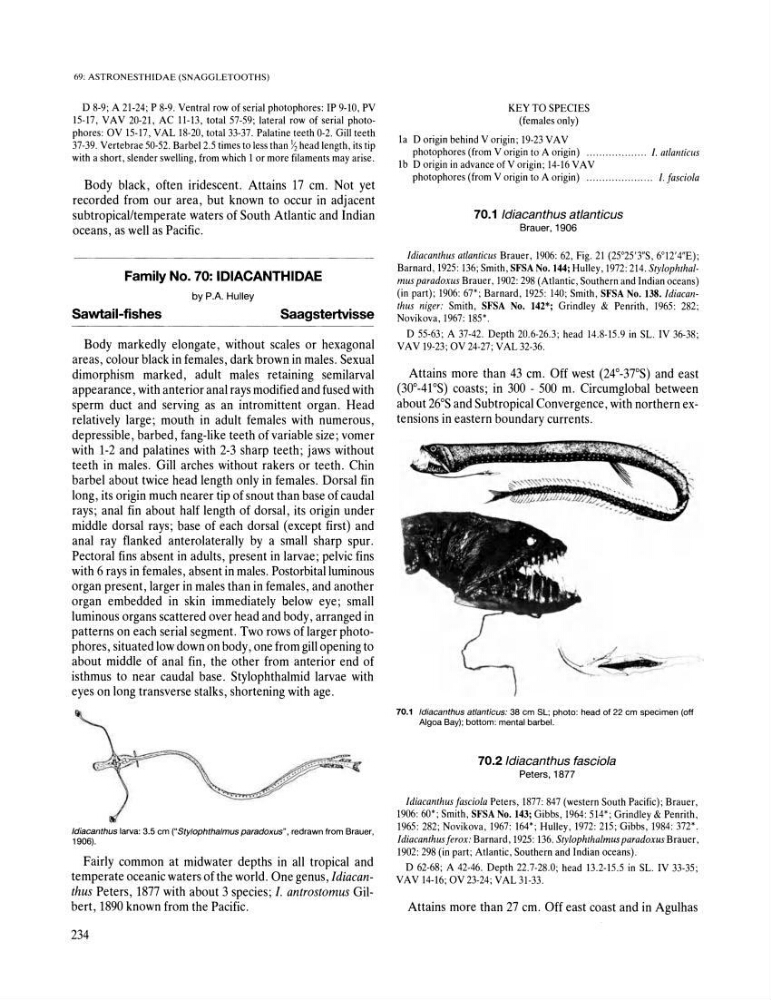
Idiacanthus larva: 3.5 em ("Stylophthalmus paradoxus", redrawn from Brauer,
1906).
Fairly common at midwater depths in all tropical and
temperate oceanic waters of the world. One genus, Idiacanthus Peters, 1877 with about 3 species; I. antrostomus Gilbert, 1890 known from the Pacific.
234
KEY TO SPECIES
(females only)
la D origin behind V origin; 19-23 VA V
photophores (from V origin to A origin) ................... I. at/anticus
1 b D origin in advance of V origin; 14-16 V A V
photophores (from V origin to A origin) ..................... I. faseiola
70.1 Idiacanthus at/anticus
Brauer, 1906
Idiaeanthus at/anticus Brauer, 1906: 62, Fig. 21 (25°25'3"S, 6°12'4"E);
Barnard, 1925: 136; Smith, SFSA No. 144; Hulley, 1972: 214. Stylophthalmus paradoxus Brauer, 1902: 298 (Atlantic, Southern and Indian oceans)
(in part); 1906: 67*; Barnard, 1925: 140; Smith, SFSA No. 138. ldiacanthus niger: Smith, SFSA No. 142*; Grindley & Penrith, 1965: 282;
Novikova, 1967: 185*.
D 55-63; A 37-42. Depth 20.6-26.3; head 14.8-15.9 in SL. IV 36-38;
VAV 19-23; OV 24-27; VAL 32-36.
Attains more than 43 cm. Off west (24°-37°S) and east
(30
0
-41°S) coasts; in 300 - 500 m. Circumglobal between
about 26°S and Subtropical Convergence, with northern extensions in eastern boundary currents.
70.1 Idiacanthus at/anticus: 38 em SL; photo: head of 22 em specimen (off
Algoa Bay); bottom: mental barbel.
70.2 Idiacanthus fasciola
Peters, 1877
Idiacanthus fasciola Peters, 1877: 847 (western South Pacific); Brauer,
1906: 60*; Smith, SFSA No. 143; Gibbs, 1964: 514*; Grindley & Penrith,
1965: 282; Novikova, 1967: 164*; Hulley, 1972: 215; Gibbs, 1984: 372*.
Idiacanthus ferox: Barnard, 1925: 136. Stylophthalmus paradoxus Brauer,
1902: 298 (in part; Atlantic, Southern and Indian oceans).
D 62-68; A 42-46. Depth 22.7-28.0; head 13.2-15.5 in SL. IV 33-35;
VAV 14-16; OV 23-24; VAL 31-33.
Attains more than 27 cm. Off east coast and in Agulhas
D 8-9; A 21-24; P 8-9. Ventral row of serial photophores: IP 9-10, PV
15-17, VA V 20-21, AC 11-13, total 57-59; lateral row of serial photophores: OV 15-17, VAL 18-20, total 33-37. Palatine teeth 0-2. Gill teeth
37-39. Vertebrae 50-52. Barbel 2.5 times to less than Y;, head length, its tip
with a short, slender swelling, from which 1 or more filaments may arise.
Body black, often iridescent. Attains 17 cm. Not yet
recorded from our area, but known to occur in adjacent
subtropical/temperate waters of South Atlantic and Indian
oceans, as well as Pacific.
Family No. 70: IDIACANTHIDAE
by PA Hulley
Sawtail-fishes
Saagstertvisse
Body markedly elongate, without scales or hexagonal
areas, colour black in females, dark brown in males. Sexual
dimorphism marked, adult males retaining semilarval
appearance, with anterior anal rays modified and fused with
sperm duct and serving as an intromittent organ. Head
relatively large; mouth in adult females with numerous,
depressible, barbed, fang-like teeth of variable size; vomer
with 1-2 and palatines with 2-3 sharp teeth; jaws without
teeth in males. Gill arches without rakers or teeth. Chin
barbel about twice head length only in females. Dorsal fin
long, its origin much nearer tip of snout than base of caudal
rays; anal fin about half length of dorsal, its origin under
middle dorsal rays; base of each dorsal (except first) and
anal ray flanked anterolaterally by a small sharp spur.
Pectoral fins absent in adults, present in larvae; pelvic fins
with 6 rays in females, absent in males. Postorbital luminous
organ present, larger in males than in females, and another
organ embedded in skin immediately below eye; small
luminous organs scattered over head and body, arranged in
patterns on each serial segment. Two rows of larger photophores, situated low down on body, one from gill opening to
about middle of anal fin, the other from anterior end of
isthmus to near caudal base. Stylophthalmid larvae with
eyes on long transverse stalks, shortening with age.
Idiacanthus larva: 3.5 em ("Stylophthalmus paradoxus", redrawn from Brauer,
1906).
Fairly common at midwater depths in all tropical and
temperate oceanic waters of the world. One genus, Idiacanthus Peters, 1877 with about 3 species; I. antrostomus Gilbert, 1890 known from the Pacific.
234
KEY TO SPECIES
(females only)
la D origin behind V origin; 19-23 VA V
photophores (from V origin to A origin) ................... I. at/anticus
1 b D origin in advance of V origin; 14-16 V A V
photophores (from V origin to A origin) ..................... I. faseiola
70.1 Idiacanthus at/anticus
Brauer, 1906
Idiaeanthus at/anticus Brauer, 1906: 62, Fig. 21 (25°25'3"S, 6°12'4"E);
Barnard, 1925: 136; Smith, SFSA No. 144; Hulley, 1972: 214. Stylophthalmus paradoxus Brauer, 1902: 298 (Atlantic, Southern and Indian oceans)
(in part); 1906: 67*; Barnard, 1925: 140; Smith, SFSA No. 138. ldiacanthus niger: Smith, SFSA No. 142*; Grindley & Penrith, 1965: 282;
Novikova, 1967: 185*.
D 55-63; A 37-42. Depth 20.6-26.3; head 14.8-15.9 in SL. IV 36-38;
VAV 19-23; OV 24-27; VAL 32-36.
Attains more than 43 cm. Off west (24°-37°S) and east
(30
0
-41°S) coasts; in 300 - 500 m. Circumglobal between
about 26°S and Subtropical Convergence, with northern extensions in eastern boundary currents.
70.1 Idiacanthus at/anticus: 38 em SL; photo: head of 22 em specimen (off
Algoa Bay); bottom: mental barbel.
70.2 Idiacanthus fasciola
Peters, 1877
Idiacanthus fasciola Peters, 1877: 847 (western South Pacific); Brauer,
1906: 60*; Smith, SFSA No. 143; Gibbs, 1964: 514*; Grindley & Penrith,
1965: 282; Novikova, 1967: 164*; Hulley, 1972: 215; Gibbs, 1984: 372*.
Idiacanthus ferox: Barnard, 1925: 136. Stylophthalmus paradoxus Brauer,
1902: 298 (in part; Atlantic, Southern and Indian oceans).
D 62-68; A 42-46. Depth 22.7-28.0; head 13.2-15.5 in SL. IV 33-35;
VAV 14-16; OV 23-24; VAL 31-33.
Attains more than 27 cm. Off east coast and in Agulhas