

Genus Borostomias Regan, 1908
Five species; 2 in our area, possibly variants of a single
species, as no characters have been found that distinguish
them completely.
KEY TO SPECIES
la Anterior part of jaws with fangs much longer than
other teeth; longer teeth straight; photophores in
lateral series (OA) usually 44 or fewer, in ventral
series to tail (IC) usually 68 or fewer .......... .. .......... B. antarcticus
1b Anterior part of jaws with fangs not much larger
than other teeth; longer teeth curved; OA usually
46 or more, IC usually 70 or more ... ...... ... ..... .... .... B. mononema
69.7 Borostomias antarcticus
(Lonnberg, 1905)
Astronesthes antarcticus Lonnberg, 1905: 762 (48"27'S, 42°36'W).
Borostomias antarcticus: Regan & Trewavas, 1929: 25; Gibbs, 1964: 334*;
Gibbs, 1984: 331 *. ? BO'rostomias richardsoni (non Poey): Barnard, 1925:
135. Astronesthes richardsoni: Smith, SFSA No. 139 (not figure).
D 9-13; A 12-17; P 7-9. Ventral row of serial photophores: IP 10-11, PV
22-26, V A V 19-25, AC 9-13, total 66-69 (73); lateral row of serial photophores: OV 22-25, VAL 19-24, total 43-47 . Vertebrae 56-60. Barbel from
1.3 times to Yz head length, its tip with a bulbous black swelling and a
smaller, pale distal portion with 1 filament, sometimes 2.
Body black, without well-developed pale patches. Attains about 30 cm. Boreal and temperate North Atlantic
and circumglobally south of about 40 o S. In our area, known
only from Atlantic, where it is reported up to 18°S.
---_ .. "69.7 Borostomias antarcticus: 18 em; enlarged mental barbel below (after
Norman, 1930).
69.8 Borostomias mononema
(Regan & Trewavas, 1929)
Diplolychnus mononema Regan & Trewavas, 1929: 27, Fig. 19, PI. 5,
Fig. 2 (off Virgin Ids.); Gibbs , 1964: 341 *. Borostomias mononema:
Weitzman, 1967: 5; ? Karrer, 1973: 208 (could be B. antarcticus); Gibbs,
1984: 333*.
D 12-14; A 15-19; P 6-8. Ventral row of serial photophores: IP 10-11,
PV 23-26, VA V 19-25, AC 11-13, total 65-72; lateral row of serial photophores: OV 19-25, VAL 21-25, total (43) 46-49. Vertebrae 60-63. Barbel
from 1.25 times to Yz head length, its tip with a bulbous, black swelling and
a smaller, pale distal portion with 1 filament, sometimes 2.
Body black, without well-developed pale patches. Attains
31 cm. Reported from Atlantic side at 28°S and from Indian
Ocean to about 25°S. Mainly in tropical waters of Atlantic
and Indian oceans.
69: ASTRONESTHIDAE (SNAGGLETOOTHS)
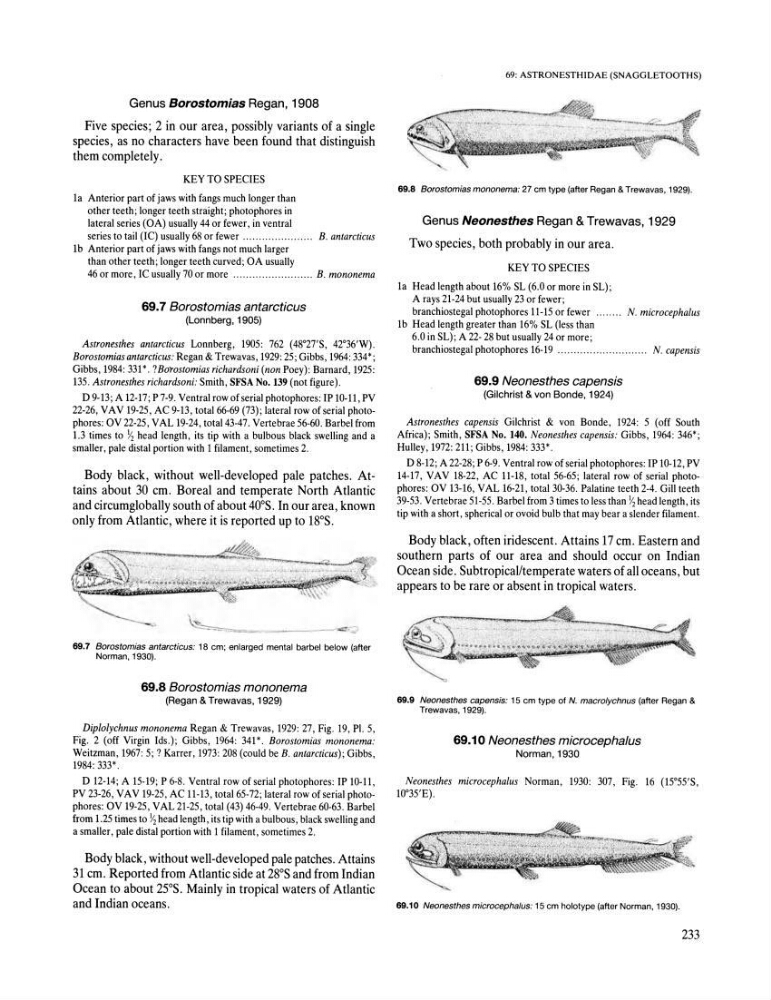
69.8 Borostomias mononema: 27 em type (after Regan & Trewavas, 1929).
Genus Neonesthes Regan & Trewavas, 1929
Two species, both probably in our area.
KEY TO SPECIES
la Head length about 16% SL (6.0 or more in SL);
A rays 21-24 but usually 23 or fewer;
branchiostegal photophores 11-15 or fewer ........ N. microcephalus
Ib Head length greater than 16% SL (less than
6.0 in SL); A 22- 28 but usually 24 or more;
branchiostegal photophores 16-19 ............ .. .............. N. capensis
69.9 Neonesthes capensis
(Gilchrist & von Bonde, 1924)
Astronesthes capensis Gilchrist & von Bonde, 1924: 5 (off South
Africa); Smith, SFSA No. 140. Neonesthes capensis: Gibbs, 1964: 346*;
Hulley, 1972: 211; Gibbs , 1984: 333*.
D 8-12; A 22-28; P 6-9. Ventral row of serial photophores: IP 10-12, PV
14-17, VA V 18-22, AC 11-18, total 56-65; lateral row of serial photophores: OV 13-16, VAL 16-21 , total 30-36. Palatine teeth 2-4. Gill teeth
39-53. Vertebrae 51-55. Barbel from 3 times to less than Yz head length, its
tip with a short, spherical or ovoid bulb that may bear a slender filament.
Body black, often iridescent. Attains 17 cm. Eastern and
southern parts of our area and should occur on Indian
Ocean side. Subtropical/temperate waters of all oceans, but
appears to be rare or absent in tropical waters.
69.9 Neonesthes capensis: 15 em type of N. macrolychnus (after Regan &
Trewavas, 1929).
69.10 Neonesthes microcephalus
Norman, 1930
Neonesthes microcephalus Norman, 1930: 307, Fig. 16 (15°55'S,
10 0 35'E).
69.10 Neonesthes microcephalus: 15 em holotype (after Norman, 1930).
233
Five species; 2 in our area, possibly variants of a single
species, as no characters have been found that distinguish
them completely.
KEY TO SPECIES
la Anterior part of jaws with fangs much longer than
other teeth; longer teeth straight; photophores in
lateral series (OA) usually 44 or fewer, in ventral
series to tail (IC) usually 68 or fewer .......... .. .......... B. antarcticus
1b Anterior part of jaws with fangs not much larger
than other teeth; longer teeth curved; OA usually
46 or more, IC usually 70 or more ... ...... ... ..... .... .... B. mononema
69.7 Borostomias antarcticus
(Lonnberg, 1905)
Astronesthes antarcticus Lonnberg, 1905: 762 (48"27'S, 42°36'W).
Borostomias antarcticus: Regan & Trewavas, 1929: 25; Gibbs, 1964: 334*;
Gibbs, 1984: 331 *. ? BO'rostomias richardsoni (non Poey): Barnard, 1925:
135. Astronesthes richardsoni: Smith, SFSA No. 139 (not figure).
D 9-13; A 12-17; P 7-9. Ventral row of serial photophores: IP 10-11, PV
22-26, V A V 19-25, AC 9-13, total 66-69 (73); lateral row of serial photophores: OV 22-25, VAL 19-24, total 43-47 . Vertebrae 56-60. Barbel from
1.3 times to Yz head length, its tip with a bulbous black swelling and a
smaller, pale distal portion with 1 filament, sometimes 2.
Body black, without well-developed pale patches. Attains about 30 cm. Boreal and temperate North Atlantic
and circumglobally south of about 40 o S. In our area, known
only from Atlantic, where it is reported up to 18°S.
---_ .. "69.7 Borostomias antarcticus: 18 em; enlarged mental barbel below (after
Norman, 1930).
69.8 Borostomias mononema
(Regan & Trewavas, 1929)
Diplolychnus mononema Regan & Trewavas, 1929: 27, Fig. 19, PI. 5,
Fig. 2 (off Virgin Ids.); Gibbs , 1964: 341 *. Borostomias mononema:
Weitzman, 1967: 5; ? Karrer, 1973: 208 (could be B. antarcticus); Gibbs,
1984: 333*.
D 12-14; A 15-19; P 6-8. Ventral row of serial photophores: IP 10-11,
PV 23-26, VA V 19-25, AC 11-13, total 65-72; lateral row of serial photophores: OV 19-25, VAL 21-25, total (43) 46-49. Vertebrae 60-63. Barbel
from 1.25 times to Yz head length, its tip with a bulbous, black swelling and
a smaller, pale distal portion with 1 filament, sometimes 2.
Body black, without well-developed pale patches. Attains
31 cm. Reported from Atlantic side at 28°S and from Indian
Ocean to about 25°S. Mainly in tropical waters of Atlantic
and Indian oceans.
69: ASTRONESTHIDAE (SNAGGLETOOTHS)
69.8 Borostomias mononema: 27 em type (after Regan & Trewavas, 1929).
Genus Neonesthes Regan & Trewavas, 1929
Two species, both probably in our area.
KEY TO SPECIES
la Head length about 16% SL (6.0 or more in SL);
A rays 21-24 but usually 23 or fewer;
branchiostegal photophores 11-15 or fewer ........ N. microcephalus
Ib Head length greater than 16% SL (less than
6.0 in SL); A 22- 28 but usually 24 or more;
branchiostegal photophores 16-19 ............ .. .............. N. capensis
69.9 Neonesthes capensis
(Gilchrist & von Bonde, 1924)
Astronesthes capensis Gilchrist & von Bonde, 1924: 5 (off South
Africa); Smith, SFSA No. 140. Neonesthes capensis: Gibbs, 1964: 346*;
Hulley, 1972: 211; Gibbs , 1984: 333*.
D 8-12; A 22-28; P 6-9. Ventral row of serial photophores: IP 10-12, PV
14-17, VA V 18-22, AC 11-18, total 56-65; lateral row of serial photophores: OV 13-16, VAL 16-21 , total 30-36. Palatine teeth 2-4. Gill teeth
39-53. Vertebrae 51-55. Barbel from 3 times to less than Yz head length, its
tip with a short, spherical or ovoid bulb that may bear a slender filament.
Body black, often iridescent. Attains 17 cm. Eastern and
southern parts of our area and should occur on Indian
Ocean side. Subtropical/temperate waters of all oceans, but
appears to be rare or absent in tropical waters.
69.9 Neonesthes capensis: 15 em type of N. macrolychnus (after Regan &
Trewavas, 1929).
69.10 Neonesthes microcephalus
Norman, 1930
Neonesthes microcephalus Norman, 1930: 307, Fig. 16 (15°55'S,
10 0 35'E).
69.10 Neonesthes microcephalus: 15 em holotype (after Norman, 1930).
233