

71: MALACOSTEIDAE (LOOSEJAWS)
71.3 Malacosteus sp.
Malacosteus niger (non Ayres): Hulley, 1972: 214.
D 16-20; A 17-22; P 3-5; IC 16-22; OA 9-15; vertebrae 48-51. Depth
6.1-8.1; head 3.1-3.8.
Attains 19 cm. Bathypelagic. Southern Subtropical Convergence waters of all 3 major oceans.
71.4 Malacosteus niger
Ayres, 1848
Malacosteus niger Ayres, 1848: 69 (mid North Atlantic); Morrow, 1964:
545*; Gibbs, 1984: 369*. Malacosteus indicus: Smith, SFSA No. 137;
Hulley, 1972: 214.
D 17-21; A 18-23; P 2-4; IC 12-22; OA 7-14; vertebrae 45-51. Depth
5.6-11.4; head 3.1-4.1.
Attains 24 cm. Bathypelagic. Tropical and subtropical
waters of all 3 major oceans and Atlantic north to subarctic
waters.
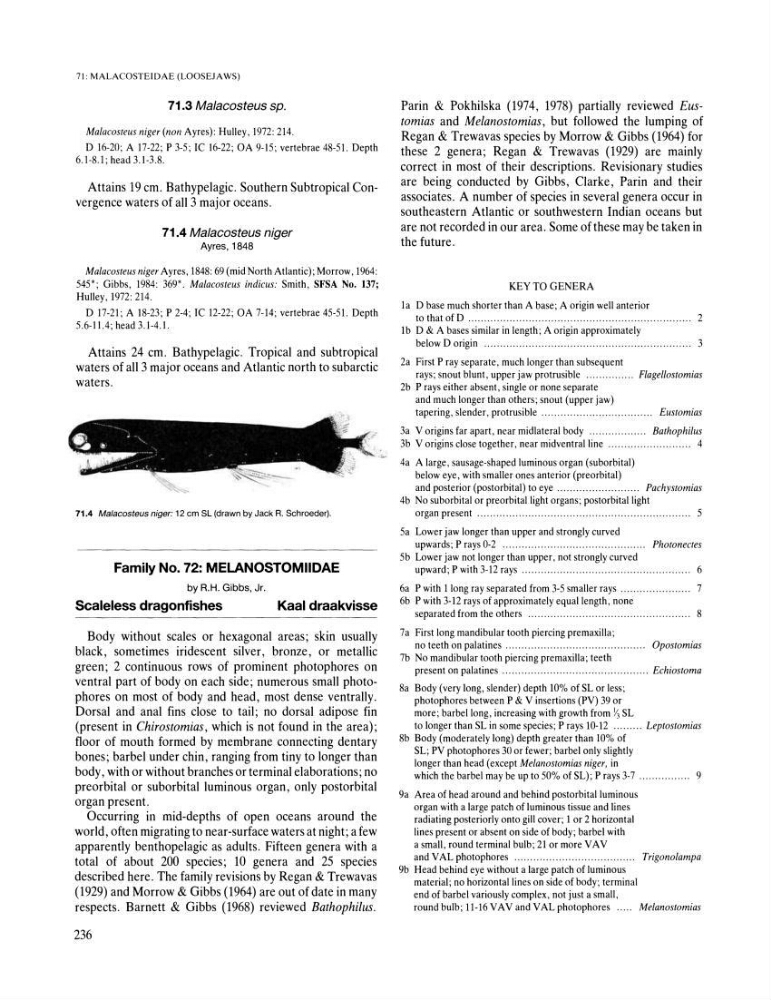
71.4 Malacosteus niger: 12 cm SL (drawn by Jack R. Schroeder).
Family No. 72: MELANOSTOMIIDAE
by R.H. Gibbs, Jr.
Scaleless dragonfishes
Kaal draakvisse
Body without scales or hexagonal areas; skin usually
black, sometimes iridescent silver, bronze, or metallic
green; 2 continuous rows of prominent photophores on
ventral part of body on each side; numerous small photophores on most of body and head, most dense ventrally.
Dorsal and anal fins close to tail; no dorsal adipose fin
(present in Chirostomias, which is not found in the area);
floor of mouth formed by membrane connecting dentary
bones; barbel under chin, ranging from tiny to longer than
body, with or without branches or terminal elaborations; no
preorbital or suborbital luminous organ, only postorbital
organ present.
Occurring in mid-depths of open oceans around the
world, often migrating to near-surface waters at night; a few
apparently benthopelagic as adults. Fifteen genera with a
total of about 200 species; 10 genera and 25 species
described here. The family revisions by Regan & Trewavas
(1929) and Morrow & Gibbs (1964) are out of date in many
respects. Barnett & Gibbs (1968) reviewed Bathophilus.
236
Parin & Pokhilska (1974, 1978) partially reviewed Eustomias and Melanostomias, but followed the lumping of
Regan & Trewavas species by Morrow & Gibbs (1964) for
these 2 genera; Regan & Trewavas (1929) are mainly
correct in most of their descriptions. Revisionary studies
are being conducted by Gibbs, Clarke, Parin and their
associates. A number of species in several genera occur in
southeastern Atlantic or southwestern Indian oceans but
are not recorded in our area. Some of these may be taken in
the future.
KEY TO GENERA
la D base much shorter than A base; A origin well anterior
~ili~~D ...................................................................... 2
Ib D & A bases similar in length; A origin approximately
below D origin ........................................................ ......... 3
2a First P ray separate, much longer than subsequent
rays; snout blunt, upper jaw protrusible ............... Flagellostomias
2b P rays either absent, single or none separate
and much longer than others; snout (upper jaw)
tapering, slender, protrusible ................................... Eustomias
3a Y origins far apart, near midlateral body .................. Bathophilus
3b Y origins close together, near midventralline .......................... 4
4a A large, sausage-shaped luminous organ (suborbital)
below eye, with smaller ones anterior (preorbital)
and posterior (postorbital) to eye .......................... Pachystomias
4b No suborbital or preorbitallight organs; postorbital light
organ present ................................................................... 5
5a Lower jaw longer than upper and strongly curved
upwards; Prays 0-2 ............................................. Photonectes
5b Lower jaw not longer than upper, not strongly curved
upward; P with 3-12 rays..................................................... 6
6a P with I long ray separated from 3-5 smaller rays.......... .. ..... .. ... 7
6b P with 3-12 rays of approximately equal length , none
separated from the others ................................................... 8
7a First long mandibular tooth piercing premaxilla;
no teeth on palatines ............................................ Opostomias
7b No mandibular tooth piercing premaxilla; teeth
present on palatines .............................................. Echiostoma
8a Body (very long, slender) depth 10% of SL or less;
photophores between P & Y insertions (PY) 39 or
more; barbel long, increasing with growth from )j SL
to longer than SL in some species; Prays 10-12 ......... Leptostomias
8b Body (moderately long) depth greater than 10% of
SL; PY photophores 30 or fewer; barbel only slightly
longer than head (except Melanostomias niger, in
which the barbel may be up to 50% of SL); Prays 3-7 ................ 9
9a Area of head around and behind postorbital luminous
organ with a large patch of luminous tissue and lines
radiating posteriorly onto gill cover; I or 2 horizontal
lines present or absent on side of body; barbel with
a small, round terminal bulb; 21 or more YAY
and Y AL photophores ...................................... Trigonolampa
9b Head behind eye without a large patch of luminous
material; no horizontal lines on side of body; terminal
end of barbel variously complex, not just a small,
round bulb; 11-16 YAY and Y AL photophores ..... Melanostomias
71.3 Malacosteus sp.
Malacosteus niger (non Ayres): Hulley, 1972: 214.
D 16-20; A 17-22; P 3-5; IC 16-22; OA 9-15; vertebrae 48-51. Depth
6.1-8.1; head 3.1-3.8.
Attains 19 cm. Bathypelagic. Southern Subtropical Convergence waters of all 3 major oceans.
71.4 Malacosteus niger
Ayres, 1848
Malacosteus niger Ayres, 1848: 69 (mid North Atlantic); Morrow, 1964:
545*; Gibbs, 1984: 369*. Malacosteus indicus: Smith, SFSA No. 137;
Hulley, 1972: 214.
D 17-21; A 18-23; P 2-4; IC 12-22; OA 7-14; vertebrae 45-51. Depth
5.6-11.4; head 3.1-4.1.
Attains 24 cm. Bathypelagic. Tropical and subtropical
waters of all 3 major oceans and Atlantic north to subarctic
waters.
71.4 Malacosteus niger: 12 cm SL (drawn by Jack R. Schroeder).
Family No. 72: MELANOSTOMIIDAE
by R.H. Gibbs, Jr.
Scaleless dragonfishes
Kaal draakvisse
Body without scales or hexagonal areas; skin usually
black, sometimes iridescent silver, bronze, or metallic
green; 2 continuous rows of prominent photophores on
ventral part of body on each side; numerous small photophores on most of body and head, most dense ventrally.
Dorsal and anal fins close to tail; no dorsal adipose fin
(present in Chirostomias, which is not found in the area);
floor of mouth formed by membrane connecting dentary
bones; barbel under chin, ranging from tiny to longer than
body, with or without branches or terminal elaborations; no
preorbital or suborbital luminous organ, only postorbital
organ present.
Occurring in mid-depths of open oceans around the
world, often migrating to near-surface waters at night; a few
apparently benthopelagic as adults. Fifteen genera with a
total of about 200 species; 10 genera and 25 species
described here. The family revisions by Regan & Trewavas
(1929) and Morrow & Gibbs (1964) are out of date in many
respects. Barnett & Gibbs (1968) reviewed Bathophilus.
236
Parin & Pokhilska (1974, 1978) partially reviewed Eustomias and Melanostomias, but followed the lumping of
Regan & Trewavas species by Morrow & Gibbs (1964) for
these 2 genera; Regan & Trewavas (1929) are mainly
correct in most of their descriptions. Revisionary studies
are being conducted by Gibbs, Clarke, Parin and their
associates. A number of species in several genera occur in
southeastern Atlantic or southwestern Indian oceans but
are not recorded in our area. Some of these may be taken in
the future.
KEY TO GENERA
la D base much shorter than A base; A origin well anterior
~ili~~D ...................................................................... 2
Ib D & A bases similar in length; A origin approximately
below D origin ........................................................ ......... 3
2a First P ray separate, much longer than subsequent
rays; snout blunt, upper jaw protrusible ............... Flagellostomias
2b P rays either absent, single or none separate
and much longer than others; snout (upper jaw)
tapering, slender, protrusible ................................... Eustomias
3a Y origins far apart, near midlateral body .................. Bathophilus
3b Y origins close together, near midventralline .......................... 4
4a A large, sausage-shaped luminous organ (suborbital)
below eye, with smaller ones anterior (preorbital)
and posterior (postorbital) to eye .......................... Pachystomias
4b No suborbital or preorbitallight organs; postorbital light
organ present ................................................................... 5
5a Lower jaw longer than upper and strongly curved
upwards; Prays 0-2 ............................................. Photonectes
5b Lower jaw not longer than upper, not strongly curved
upward; P with 3-12 rays..................................................... 6
6a P with I long ray separated from 3-5 smaller rays.......... .. ..... .. ... 7
6b P with 3-12 rays of approximately equal length , none
separated from the others ................................................... 8
7a First long mandibular tooth piercing premaxilla;
no teeth on palatines ............................................ Opostomias
7b No mandibular tooth piercing premaxilla; teeth
present on palatines .............................................. Echiostoma
8a Body (very long, slender) depth 10% of SL or less;
photophores between P & Y insertions (PY) 39 or
more; barbel long, increasing with growth from )j SL
to longer than SL in some species; Prays 10-12 ......... Leptostomias
8b Body (moderately long) depth greater than 10% of
SL; PY photophores 30 or fewer; barbel only slightly
longer than head (except Melanostomias niger, in
which the barbel may be up to 50% of SL); Prays 3-7 ................ 9
9a Area of head around and behind postorbital luminous
organ with a large patch of luminous tissue and lines
radiating posteriorly onto gill cover; I or 2 horizontal
lines present or absent on side of body; barbel with
a small, round terminal bulb; 21 or more YAY
and Y AL photophores ...................................... Trigonolampa
9b Head behind eye without a large patch of luminous
material; no horizontal lines on side of body; terminal
end of barbel variously complex, not just a small,
round bulb; 11-16 YAY and Y AL photophores ..... Melanostomias